One manifestation of how
reckless this country can
be is that it went for two
years without a properly
constituted election agency, denying
representation to a number of constituencies, wards and a Senate seat.
Vacancies there arose following the
2022 general elections. Worse still,
it left the country running on a national security and stability gap had,
God forbid, such vacancies arisen
in much more important national
offices. But God apparently loves
Kenya a lot more than its leaders do.
This is why the reconstitution of
IEBC in July caused an instant rush
towards the November 27 ‘little general election,’ when the electoral
agency will conduct 24 by-elections for one Senate seat (Baringo),
six constituency vacancies and 17
ward representatives, spread out
across the country.
It will be the
biggest election festival outside the
regular electoral cycle. The polls will
not only present IEBC with a massive headache about demonstrating
some credibility to win back public’s
confidence ahead of 2027, but also
throw the country into a midterm
campaign mode.
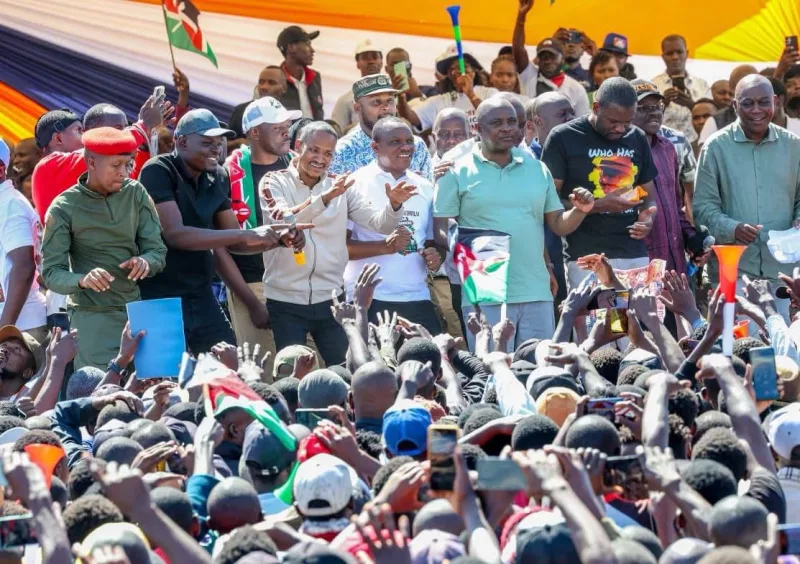
Wherever you go in this country
these days, everyone seems to be
chanting some sort of term limits
for or against elected leadership, especially for President William Ruto.
Chants of ‘Wantam’ and ‘Tutam’,
corruptions of “one term” and “two
terms”, have become routine slogans
wherever two or more Kenyans are
gathered.
Essentially, a large portion
of the population can’t wait for the
next general election, so that it can
use the ballot to punish and reward
politicians in almost equal measure.
Luckily, for the 24 electoral zones
in the upcoming by-elections, and
indeed for the rest of the Kenyan
watchers, November 27 will present
a rehearsal on the changing political alliances and dynamics, with 2027
campaigns all but on.
As of today, it
is easy to cluster the political field
into two broad formations, namely
the ‘Wantam’ and ‘Tutam’ brigades,
revolving around those who want to
end the Kenya Kwanza experiment
after just one term and those want
Ruto to be re-elected.
The truth, however, goes beyond
the superficial.
Within the two broad
formations, sub-alliances and divisions have emerged, giving rise
to even smaller political groupings
and interests. For instance, the loose
coalition of opposition parties led
by former Deputy President Rigathi
Gachagua would have looked like
a solid team heading into these
by-elections.
But instead, Gachagua’s own DCP
has already identified candidates in
both Mbeere North and Malava constituencies, considered the spheres
of their allies in DP and DAP-K, respectively.
Especially interesting is the
Malava seat left vacant following
the death of Malulu Injendi.
Gachagua’s own deputy party leader,
former Kakamega Senator Cleophas
Malala, has asked DAP-K, the party of former CS Eugene Wamalwa
and Trans Nzoia Governor George
Natembeya, to drop their ambitions
and support DCP. It is not difficult
to understand the position of Gachagua and his party.
A creature of raw tribal politics,
the former DP obviously sees his
Mount Kenya political base as being too big to play second fiddle
within his formation.
Besides, as
an impeached politician barred
from running in 2027 (though he is
challenging this ban in court), he
may want to popularise his party so
effectively countrywide that by the
next general election, he can win
enough parliamentary seats to negotiate with and arm-twist whoever emerges president.
Gachagua is also a frontline believer in his own hype, always seeing
himself as the most important and
most influential individual in the
room, an ego-fuelled political animal not used to being subservient.
I actually pity those who intend to
work with him.
It is not as if all the incoming
problems belong only to the opposition coalition.
The broad-based
government led by Ruto and ODM
boss Raila Odinga may have even
bigger issues.
Take note of Ugunja constituency
in Siaya county, left vacant when MP
Opiyo Wandayi was appointed to the
Cabinet, and Kasipul constituency
in Homa Bay county, whose MP
Ong’ondo Were was assassinated in
Nairobi.
ODM may have an easy ride,
purely because the two are situated
bang in Raila’s Luo heartland. Outside Luo Nyanza this time, a reality
check awaits the Orange party.
To begin with, no serious candidate in Malava has shown interest
in the ODM ticket, with political
parties scheduled to present their
candidates’ names to IEBC on September 17.
This is noteworthy because
Kakamega is an authentic ODM
stronghold where the party holds
10 of the 12 parliamentary seats,
alongside two of the three elective
county seats.
The general consensus is that
outside Luoland, ODM is suffering
a decline arising from its continued
association with the Ruto regime,
and in the eyes of the people, it bears
part of the government’s baggage.
The foregoing makes by-election
outcomes in Magarini in Kilifi and
Banissa in Mandera a toss-up, which
could go any which way.
The Magarini seat fell vacant after 2022 winner Harrison Kombe
of ODM lost it following a petition by runner-up Karisa Kenga of the
ruling UDA. Kilifi county has fashioned itself over the past four electoral cycles as a trusted ODM zone,
but it remains to be seen if the party’s challenges will manifest there as
well.
The two protagonists were separated by just 21 votes in the nullified
2022 contest, making it a virtual tie.
But if both ODM and UDA are
facing crises of confidence within
the larger population, Magarini may
be where this will become clearer. If
the people decide to reject both parties, it will open the door for a third
party to steal the show.
Word from
the ground is that Senate Speaker
Amason Kingi’s PAA party will be
fielding a candidate. That leaves the
Banissa outcome possibly the most
unpredictable of all the by-elections.
The seat fell vacant following the
death of MP Kulow Hassan in March
2023, making it the constituency
with the longest lack of parliamentary representation. Hassan was
from the UDM party, but changes
within the political sphere could
throw the contest wide open.
What remains largely unsaid is
that beyond the little general election seen as a test of emerging political formations, it will also focus on
the ability of the newly reconstituted
IEBC to conduct a credible election.
Polls will test whether it can assure
a restless nation that progress has
been made in a sector that often
divides the country more than any
other.
I don’t find the new chairman,
Erastus Ethekon, more inspiring
than the disgraced former chairman,
Wafula Chebukati (deceased), but I
hope he proves me wrong.
I believe the chairman and his
commissioners, as well as the entire
IEBC secretariat, have been around
long enough to understand that
rising frustration with the electoral
systems and management portend
long-term instability for the nation.
Many more citizens today do not
trust the conduct of elections. The
whole team is lucky to have so many
by-elections in which to test the efficacy and efficiency of their tools,
before the general elections in less
than two years.
I am certain the outcomes and
conduct of the November 2027 little
general election will define the sentiments leading to the big one, and
no one wants to put a foot wrong,

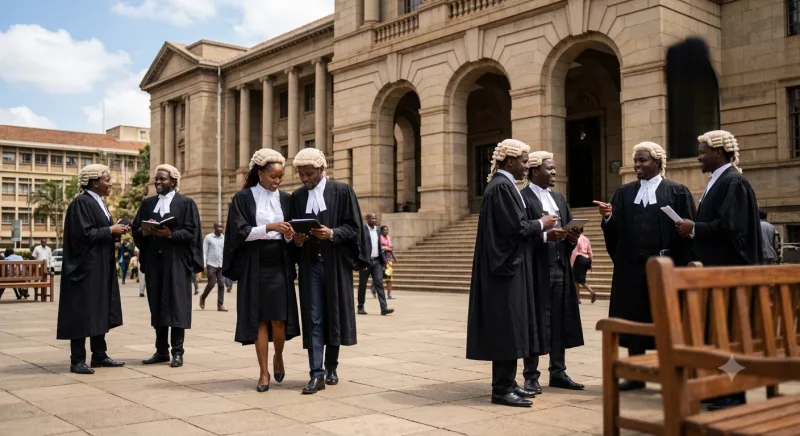
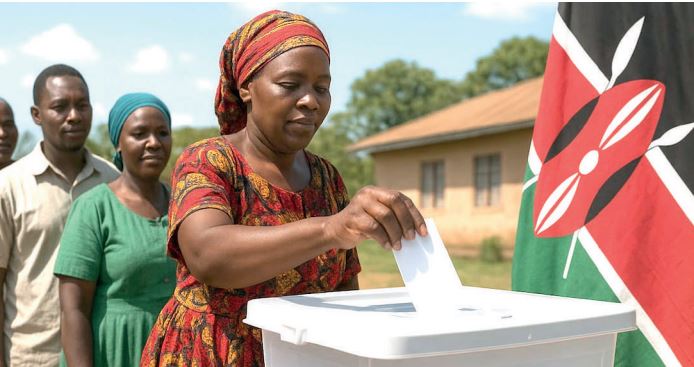 Kenyans cast ballot in the 2027 general election /AI ILLUSTRATION