Advocates' court boycott: What to do if your lawyer doesn't show up
Boycott has raised concerns for litigants but the Judiciary says justice will continue uninterrupted.
by EMMANUEL WANJALA
Audio By Vocalize
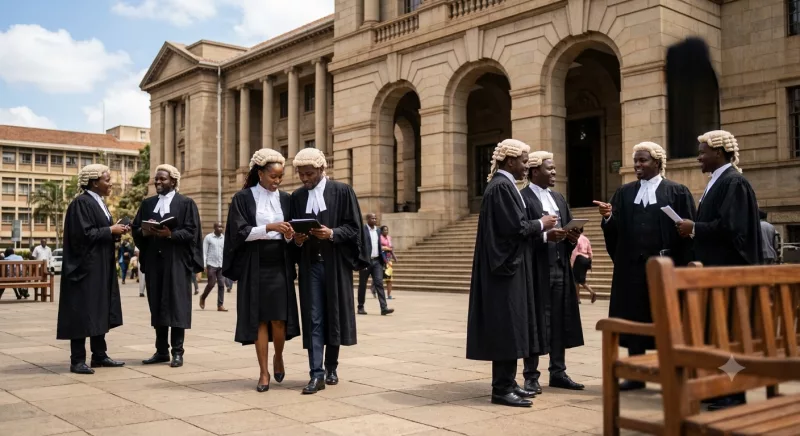
AI ILLUSTRATION
Litigants whose cases are scheduled for hearing on Wednesday need not panic if their advocates fail to appear following the nationwide court boycott called by the Law Society of Kenya (LSK).
The Judiciary has assured the public that all courts across the country will remain open and continue hearing and determining matters as scheduled, meaning parties can still proceed with their cases, including representing themselves where necessary.
The LSK called on advocates to boycott court proceedings nationwide on Wednesday, July 22, 2026, and suspend appearances before certain courts, judges and judicial officers over delayed judgments, registry inefficiencies, case management concerns and judicial accountability.
"The Judiciary assures the public that all courts throughout the Republic will remain open and will continue hearing and determining matters as scheduled on Wednesday, 22 July 2026," the Judiciary said in a statement.
In a separate statement, the Kenya Magistrates and Judges Association (KMJA) said it "does not take lightly" the concerns raised by the LSK but urged the society to reconsider the boycott and instead allow room for dialogue.
"Such engagement provides the most appropriate avenue for candid discussion, principled resolution of concerns and the strengthening of institutional cooperation in the public interest," the association said.
The Judiciary acknowledged the legal profession's role in the administration of justice and pointed to five consultative engagements held over the past two years, during which concerns affecting the administration of justice were discussed and practical action points agreed upon.
"A further consultative meeting involving the Judicial Service Commission, the Council of the Law Society of Kenya and representatives of the Senior Counsel Bar is scheduled for 31 July 2026," the Judiciary said.
The LSK said it would issue a press statement at the Supreme Court on Wednesday at 9.30 am on the nationwide court boycott, noting the media's role in raising public awareness of its concerns.
Amid the standoff, the KMJA observed that the immediate and heaviest cost of advocates withdrawing from court proceedings would be borne by litigants.
Should the boycott proceed, litigants appearing before court without legal representation are permitted to represent themselves during hearings.
According to an e-guide by the Supreme Court of Kenya on practice rules and virtual practice directions, self-representation is a significant undertaking and litigants should seek legal advice where possible, as it may save them time and money.
Although some matters scheduled for hearing on Wednesday may be adjourned, litigants wishing to file fresh cases can still do so without engaging an advocate.
The Judiciary notes, however, that self-representing litigants are expected to comply fully with the applicable statutory procedures governing court filings and appearances.
Before deciding to represent yourself, the courts advise considering several factors, including:
Whether the case is straightforward or legally complex.
Whether you have the time and resources to prepare adequately.
Whether you can communicate your case clearly and confidently before the court.
Whether you understand the law relevant to your case.
Whether you are prepared to bear any costs that may be awarded against you if your case is unsuccessful.
Procedural basics in filing a case
If you decide to represent yourself, the first step is to electronically file your case through the Judiciary's online filing portal before submitting hard copies of the pleadings at the relevant court registry.
Filing is only deemed complete once the hard copies have been received and stamped by the registry.
The submitted documents are then scrutinised to ensure they comply with the applicable practice directions and court rules before the deputy registrar formally lodges them.
The court will thereafter determine whether to commence pre-trial or pre-hearing processes, including issuing mention dates for directions.
The type of document filed depends on the nature of the dispute.
A petition is the initial legal application asking the court to grant specific prayers or orders sought by the person bringing the case.
An appeal is a request asking the Court of Appeal to review a decision made by a lower court.
An application is a request made to a court or judge seeking a particular order, either on a temporary or permanent basis.
Where proceedings are conducted virtually, self-representing litigants must log into the designated online platform and should familiarise themselves with the Judiciary's virtual practice directions before the hearing.
Commonly used court language
Self-representing litigants should also familiarise themselves with common legal terminology used during court proceedings.
Pleadings are the documents filed by each party setting out their respective cases. These include petitions, references, applications and responses.
Submissions are written or oral summaries highlighting the key issues a litigant wants the court to consider.
The bench or presiding judge refers to the judge or panel of judges hearing the matter.
A cause list is the official schedule of all matters listed before a court on a particular day, while a hearing is the in-person or virtual session during which parties present or highlight their cases and submissions.
Proceedings are the official record of everything said before the court and form part of the permanent court record.
An adjournment is the postponement of a case to another date.
Time allocated refers to the period the court gives each party to present its case and is usually displayed on the court screen.
This is premium content
Subscribe to Continue Reading
Help us continue bringing you unbiased news, in-depth investigations, and diverse perspectives. Your subscription keeps our mission alive and empowers us to provide high-quality, trustworthy journalism. Join us today to make a difference!


 AI ILLUSTRATION