AJUOK: Ending big tribes’ perennial power contest key to political sustenance
The country must wake up to the reality that the big tribes’ power rivalry is slowly sending the country to the abyss
by COLLINS AJUOK
Audio By Vocalize
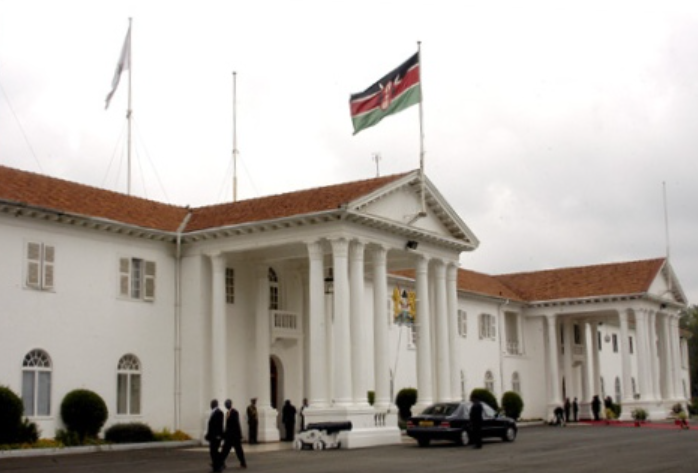
A file photo of State House
Back
in the day, when the long Kanu rule was ending and the quest for constitutional
reforms picked up, many proponents of a parliamentary system of governance loved
to remark that this model was the only way to guarantee that “even someone like
Dr Bonaya Godana can rise to the leadership of Kenya”.
The late Dr Godana was then one of Kanu’s
deputy party leaders, Foreign Affairs Minister and a widely respected national
figure, despite coming from a small ethnic community in North Horr, Marsabit county.
Among
the foremost proponents of parliamentary democracy in Kenya, via an executive
Prime Minister elected by Parliament, has been ODM leader Raila Odinga. His
more right-wing opponents have always fought against the dream.
The
basic principle behind the push for the parliamentary system was that even
though an admittedly brilliant man like Godana could rise through political
party ranks to the apex of its leadership, despite coming from a marginalised
community, if the same person ran for President via universal suffrage, tribal
numbers would be the first consideration, and end up being a limiting factor.
And
even though everyone who has held power after former President Daniel Moi has
previously condemned the all-powerful imperial presidency, each one, on taking
power, has worked hard to entrench the domineering nature of the presidential
system, complete with its attendant influence on skewed distribution of state resources.
The unspoken net effect is that a big tribe in Kenya can practically line up
its most vile member, partner with a few more communities and claim state power
in elections, even where the individual could end up negating all gains made by
the country thus far.
But
something about the Kenyan presidency hides in plain sight. Between
independence in 1963 and the death of founding President Jomo Kenyatta in 1978,
the Luo and Kikuyu communities engaged in an unending rivalry over state power,
the former feeling that they had been unfairly shut out of a shared destiny.
The latter, meanwhile, did everything possible, including an alleged mass oath
in 1969, to keep their Luo counterparts away from any access to power and
wealth bestowed by the state.
As
fate would have it, however, then President Jomo Kenyatta passed on in August
1978, and somewhat unexpectedly despite his Vice President position, Moi
arrived in State House, tagging along his Kalenjin community. Twenty-four years
of his reign opened the doors for his tribe to become the third power player in
this previously two-way rivalry between the Luo and the Kikuyu, thereby
entrenching Kalenjin might within the country’s national security, economic and
political spheres.
This
milestone meant that future elections in Kenya’s multiparty era would
predictably become vicious ethnic contests between these three powerful
communities, with two always ganging up against the third, while the rest of
Kenyan communities were content to play supporting roles in the political
parties led by the three. In fact, one can easily analyse the country’s
political patterns by predicting which two of the three will partner to defeat
the third in the next election.
Quite
tragically, this three-tribe power contest degenerated into civil war after the
2007 election, testimony to how toxic it had indeed become. But rather than
walk away from it, political players in subsequent elections in fact used the
2008 post-election violence as a basis for formation of subsequent political
alliances, in the guise of uniting former warring tribes. The effect was that
it led to the alienation of other ethnicities, but created another problem; the
two partners in government fighting for control of the status, on perceived
equal status.
Both
the Uhuru-Ruto union between 2013 and 2022, and the Ruto-Gachagua political
marriage from 2022, were premised on helping bring the Kalenjin and the Kikuyu
together, but suffered turbulent times from the start, because they were both
based on the equality of two regions controlling government, creating the
spectacle where the deputy president in each case saw himself not as the
president’s principal assistant, but a co-president of sorts. And each time,
the fight for control caused long paralysis in government, forcing the
president to turn to ODM boss Raila Odinga and to a large extent, his Luo
community.
Of
course, the jilted partner always responded with resentment, vowing to bring
down the newfound partnership in the subsequent election. Essentially
therefore, President Uhuru Kenyatta created the Ruto phenomenon just like
President Ruto created the “Wamunyoro” political movement. Today, impeached
former DP Rigathi Gachagua has turned out to be Ruto’s biggest headache, rudely
grabbing his Mt Kenya base from Ruto’s grasp and turning into a national
security nightmare for the government.
Be
as it may, the truth is clear; the country cannot sustain the economic disruptions
caused by the stalemate. The Mountain, the Lake and the Rift have engaged in
this push and pull for far too long, and given that the parliamentary system
isn’t coming soon, perhaps it is time for the country to find a mechanism of
keeping an individual from any of the three from the presidential ballot until a
generation is born that doesn’t consider tribe the first tool for political
mobilisation.
The
alternative is that whatever poisonous siege mentality that Gachagua manages to
build among his people will possibly meet the combined force of a Raila-Ruto
charged electoral machine in 2027, which would have the effect of driving
national cohesion backwards for a time. The difficult question is whether the
three feuding big tribes can sit out a presidential election by voting for
others while not fielding one of their own. To a certain extent, this desire
may be aided by the fact that Raila may not run again, and there is no one of
Luo ancestry after him with the stature, at this time, to command a large enough
following for a presidential run.
You
can scan the landscape and see former Interior CS Fred Matiangi or Wiper boss
Kalonzo Musyoka, as emerging hopes in this pursuit. Unfortunately, once they
hit the ground, they soon discover how the other three communities have made
themselves fixtures in coalition building, in which they demand the fattest
portion of the hunt. Meanwhile, there is DP Kithure Kindiki, but the worst kept
secret in these shores is that he is merely a stop-gap measure until the elections,
when Ruto will most likely pick another big-tribe partnership and running mate,
to sustain a second stab.
No
matter how difficult the choices to be made, the country must wake up to the
reality that the big tribes’ power rivalry is slowly sending the country to the
abyss, and it is in the interest of the nation to find an alternative political
model that brings on board smaller ethnic groups to the power centre, while
moving the big-tribe rivalry to the back burner, for the sustenance of this
democracy.
This is premium content
Subscribe to Continue Reading
Help us continue bringing you unbiased news, in-depth investigations, and diverse perspectives. Your subscription keeps our mission alive and empowers us to provide high-quality, trustworthy journalism. Join us today to make a difference!