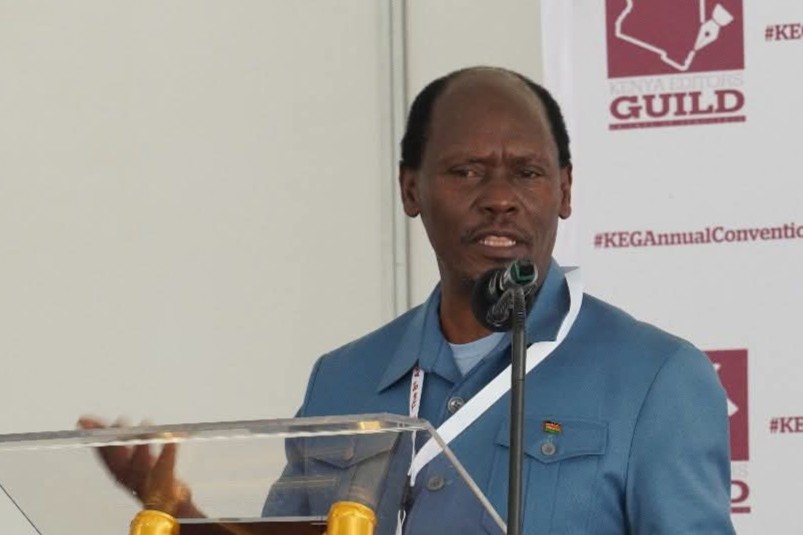
Last week, the Kenya Editors Guild hosted one of the most successful annual conventions of its recent past.
The eighth annual gathering of editors, media practitioners and scholars in media studies was an absolute success, not just in terms of the numbers – close to 100 media professionals attended – but also in the quality of the discussions that took place in Kikambala, Kilifi county.
I saw some misguided souls dismissing the Guild as a mere constellation of grayheads caught in a time-warp. They had no clue!
Quite apart from yours truly and a few comrades such as the inimitable Clay Muganda – and our greying has nothing to do with age – we had a fair mix of young generation of editors.
The discussions on data privacy, cybersecurity, media regulation in the region, biotech reporting, balancing independence and accountability, surviving the squeeze, AI in the newsroom, Gen Z and the newsroom, and life beyond the bylines have nothing to do with age.
Again, the theme of the convention, 'Truth, Trust and Technology, the Place of the Media in the Digital Era', could not have been apt, coming at an inflexion point for both Kenyan media and media world over.
Throughout the world, the media is assailed at several fronts by a combination of factors.
From technology itself, to the scourge of disinformation and misinformation, the surge of populism and autocratic regimes, to shrinking revenues, there is no respite for the media in the modern world.
But, is the solution to sit and whine, and surrender to fate? Is the solution to discredit and spread fake news against credible media institutions, which are pulling all stops to maintain and enhance the relevance of media in the new world?
Will the inhabitants of the new world being forged by recent world events survive without independent and free media? The convention touched on a number of these issues, including envisioning life beyond newsrooms.
I could excuse the naysayers of the Guild, but not the Cabinet Secretary, Information, Communication and Digital Economy, William Kabogo, the man in whose hands the policy direction of the industry lies.
A former politician, Kabogo twice attempted to re-capture his Kiambu gubernatorial seat before he was appointed to the Cabinet, courtesy of new political realities forced on President William Ruto by the Gen Z revolution of 2024.
Having covered him in the ninth parliament, 2002-2007, I had no doubt that he is an experienced politician with the requisite balance in public affairs management. Calumny aside, Kabogo is easily one of the best political brains the country has.
A graduate of Punjab University, India, he went on to serve a second term in parliament and became the pioneer governor of Kiambu, perhaps the most important county in the country after Nairobi.
Yet, with all his brilliance, experience and benefit of advisors, I witnessed Kabogo falter, live, before an audience of journalists. In his address to editors, he confused them with bloggers and content creators.
Apparently, and according to him, all the mockery he has endured on social media by way of memes is a function of editors. They alone have made a mockery of his bald head, and the perceived incongruency of his dress and duty.
Tweeps have ridiculed him for confusing curtains for windows, cyber-attacks for military assaults, booting of laptops to shoe cladding, and web cookies for fruits. At the convention, he swore he had no problem with the derision and that they, in fact, made him popular.
On more than two or three occasions, he required the editors in the room to clap in appreciation, forgetting that this endeavour is as difficult as extracting water from stone. Besides advocates, editors have no match in swinging pride.
But Kabogo’s main crime at the convention was to attempt to tie government advertising to the level of tail-wagging. In his words; “If you are a commercial entity and your job is to continuously hit the government, it is painful for the government to continue putting money where you are.”
I was glad when comrades Pamela Sittoni and Paul Wafula took on the CS, and reminded him that government was not a favour, and cannot depend on the CS’s mood.