

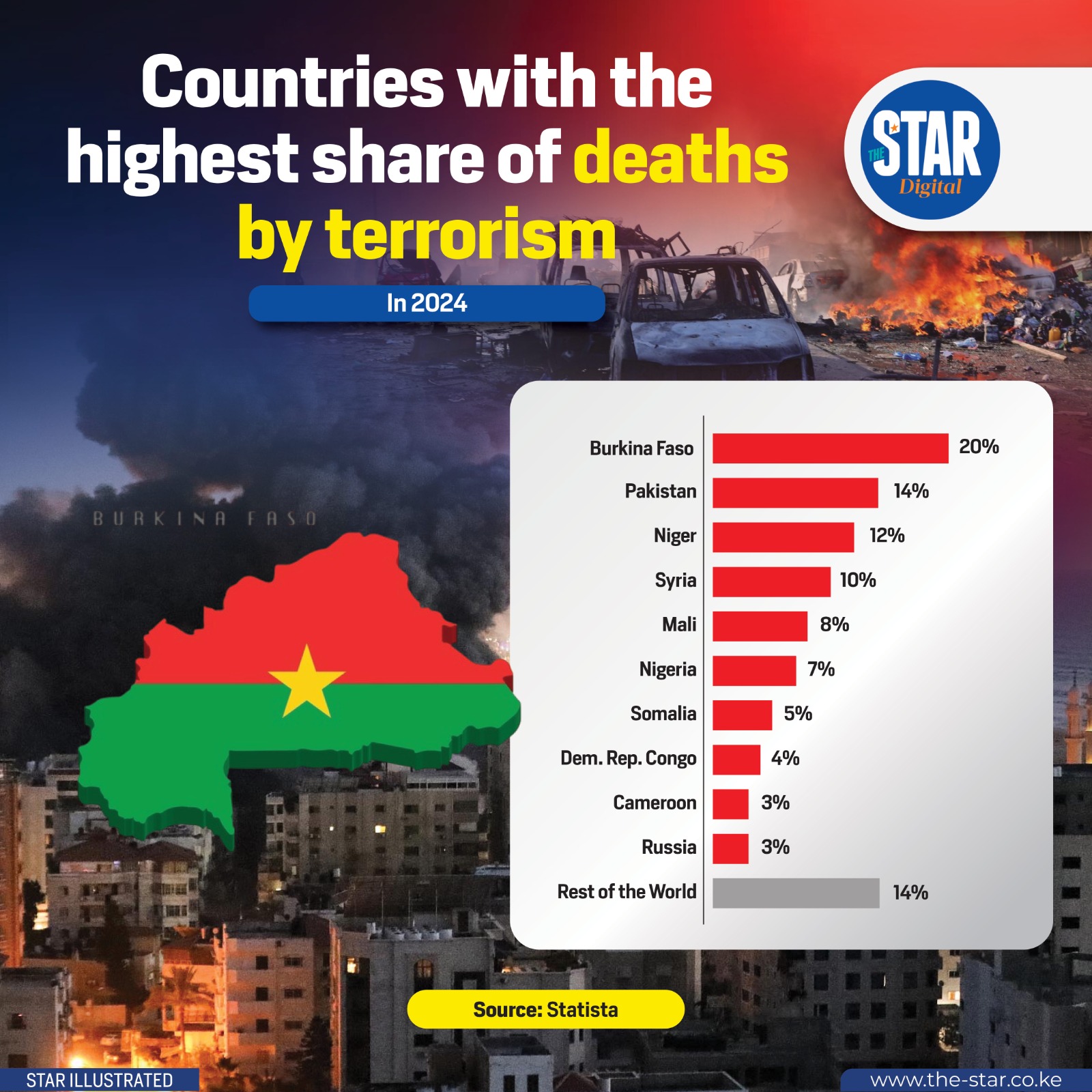
The global landscape of terrorism has undergone a dramatic geographic shift in 2024, with the epicentre firmly taking root in the Sahel region of Africa.
While terrorism is often perceived as a ubiquitous global threat, the data reveal a hyper-concentration of lethality in specific zones of instability.
Burkina Faso currently bears the heaviest burden, accounting for a staggering one-fifth of all global deaths attributed to terrorism. When combined with its neighbours, Niger and Mali, these three nations alone represent 40% of the world's terrorism-related fatalities.
This centralisation of violence indicates that the security crisis in the Sahel is not merely a collection of isolated insurgencies but a cohesive regional emergency.
The spillover effects are evident in surrounding nations like Nigeria and Cameroon, further cementing Sub-Saharan Africa as the primary battleground for extremist groups.
Outside of Africa, Pakistan remains a significant hotspot, accounting for 14% of fatalities, reflecting ongoing internal security challenges and border tensions.
Syria also continues to struggle with the remnants of long-standing conflict, contributing 10% to the global share. Interestingly, major global powers are not immune, with Russia appearing on the list with a 3% share, likely driven by specific, high-casualty attacks within its borders.
Perhaps the most telling statistic is that the "rest of the world" combined accounts for only 14% of deaths. This highlights that for the vast majority of the planet, terrorism is statistically rare, while for citizens in the most affected nations, it remains a daily, existential threat.