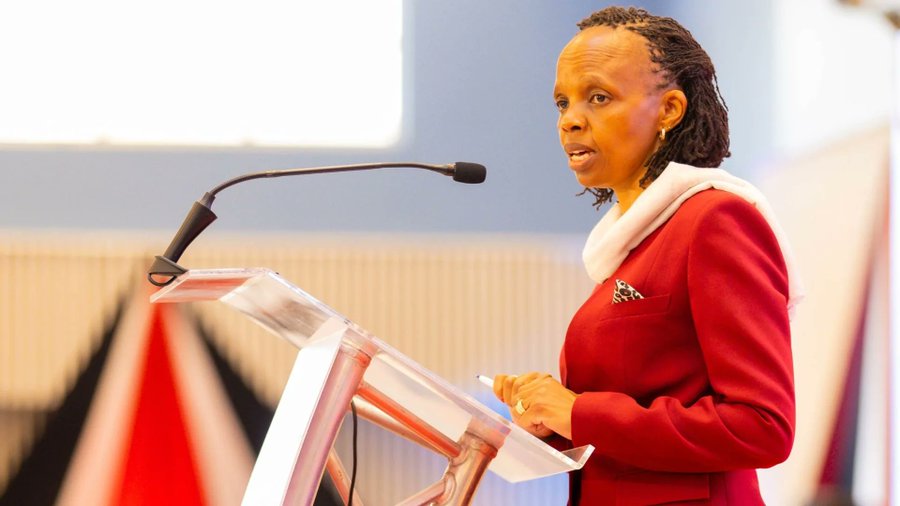
 KUCCPS CEO Mercy Wahome. /FILE
Form Four leavers who may not have revised their university course choices before the closure of the application window on Friday need not panic, as they will still have an opportunity to switch programmes after admission, the Kenya Universities and Colleges Central Placement Service (KUCCPS) has said.
KUCCPS chief executive officer Mercy Wahome said students can transfer to different courses for up to two years after joining university, allowing them to pursue programmes that better align with their interests, talents and career aspirations.
The placement agency had on May 16 issued a second call for revisions of degree courses and fresh applications for students seeking placement in universities and Technical and Vocational Education and Training (TVET) institutions.
The revision window closes at midnight on May 22.
Speaking during the Sema na Spox, Bonga na Gava podcast hosted by Government Spokesperson Isaac Mwaura, Wahome said KUCCPS is committed to ensuring learners find pathways that enable them to realise their full potential rather than feeling trapped in careers they do not enjoy.
Drawing from her own career journey, she encouraged students to choose courses based on passion and personal strengths rather than peer pressure or external influence.
“There's that thing that you do every day, are you getting any happiness in what you do? I was not but I knew I wanted to work with people on a daily basis,” Wahome said, reflecting on her early years in the health sector.
She revealed that she initially trained in community oral health and worked as an oral health officer before realising her interests lay elsewhere.
"The reasons that kept me in KMTC is not because I loved what I was doing, but because of my friends and relationships that I had established in KMTC,” she said.
“That's one of the reasons I'm very passionate with what I do — choosing careers based on what you are good at, your passion, your gifts and not peer influence," she told the forum attended by university students from across the country.
Wahome said it took years for her to recognise that her strengths were more aligned with the social sciences than the medical profession.
The realisation prompted her to return to school and pursue an undergraduate degree in sociology and communication.
“By the time I realised I'm more of a social scientist than a medical person, it took some time,” she said.
The decision, she noted, transformed her career trajectory and eventually led her to pursue a Master’s degree in Medical Sociology, enabling her to combine her healthcare background with her newfound academic interests.
“After that I immediately registered for my Masters and did a Masters in Medical Sociology. I felt there was an opportunity to connect the medical background I had and the sociology that I had gained and I loved what I did,” Wahome said.
She used her experience to reassure students that changing academic direction is possible and should not be viewed as a failure, especially when it helps them pursue careers they find meaningful and fulfilling.
She said while pursuing sociology, some of her colleagues who chose pathways like dentistry thought she was lost but she kept at it because it's what she was passionate about.
"There's no course that is useless," she emphasised.
On the placement process itself, Wahome said KUCCPS operates a fully automated system designed to ensure transparency and fairness, adding that no applicant can be placed in a programme they did not indicate during the application process.
According to her, students are given four programme choices, increasing their chances of securing placement in courses they prefer while maintaining merit-based selection.
“But if we get to your fourth choice but the cut-off points lock you out, we give you another option, we ask you, ‘in case you don't get any of these, can we place you in any other programme?’” she explained.
Where a student agrees to alternative placement, the system analyses the applicant’s strongest subjects and matches them with available programmes for which they qualify.
“It's a yes or no question. If the student says yes, the system looks at the best subjects and places them in the most suitable available programme,” she said.
However, Wahome stressed that such placement does not permanently lock students into a particular course.
“That doesn't mean after we conclude all that process, you can't pick something else. We give you an opportunity to revise, to transfer and we allow students up to two years,” she said.
The KUCCPS boss also dismissed concerns about a shortage of university spaces for the 2025 Kenya Certificate of Secondary Education (KCSE) cohort.
She said the country currently has adequate capacity to absorb all students who attained the minimum university entry grade.
According to KUCCPS data, about 270,000 candidates qualified for university admission in the 2025 KCSE examinations, while universities collectively have approximately 320,000 available slots across more than 40 public and private institutions.
“So capacity is not an issue,” Wahome said, urging eligible candidates who are yet to apply or revise their choices to take advantage of the placement window before it closes.

![[PHOTOS] The new Ngong –Naivasha Road viaduct](https://cdn.radioafrica.digital/image/2026/06/64d4f771-4432-4aee-ba3c-2f304c4436ec.jpg)









![[PHOTOS] 'Mr Speaker Sir' Gen Z protester in court](https://cdn.radioafrica.digital/image/2026/06/b3e62d8e-25c3-4780-90f9-4eb48b1ce8a7.jpg)