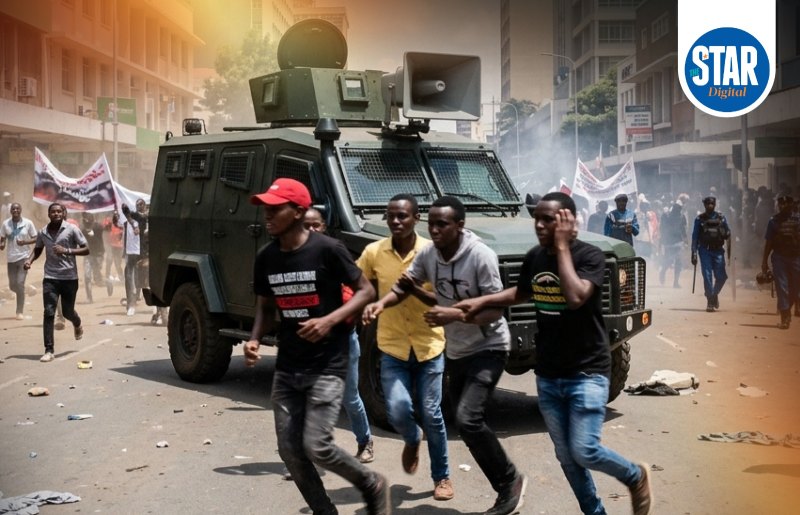
As the political drumbeats get louder towards the 2027 General Elections, a familiar script is unfolding across the Nyanza region.
With the demise of Raila Odinga, leaders are closing
ranks behind the push for President William Ruto reelection for his second and final term.
However, in the midst of the growing chorus, one voice stands
conspicuously apart; that of Siaya Governor James Orengo.
The veteran politician’s reluctance to toe the emerging line has
reignited debate over whether he is once again walking a lonely political path.
Questions are abound on whether Orengo's defiance
strengthens or isolates him in a region long defined by political solidarity
behind Raila.
In recent months, a section of Nyanza leaders has
signalled openness to working with President Ruto’s administration.
Some have gone further to endorse the two-term chorus, saying it will guarantee political stability.
The messaging, subtle but growing, marks a shift in a
region traditionally aligned with opposition politics.
Yet Orengo has struck a markedly different tone and has
come out as guarded, critical, and at times sharply dissenting.
The governor has not outrightly rejected engagement with
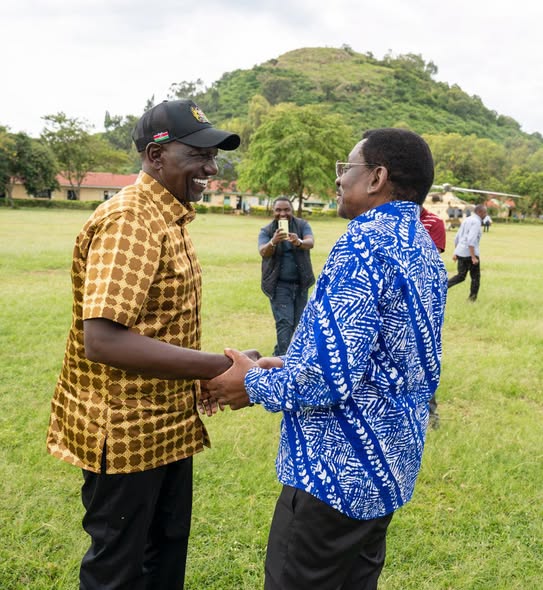
the national government, and even joined President Ruto for the launch of development projects in Bondo on Tuesday.
However, Orengo has consistently warned against premature
political realignments with Ruto’s United Democratic Alliance (UDA) that could
dilute the region’s bargaining power.
Political analysts say this places him at odds not just
with pro-government voices, but also with emerging pragmatists within the
Orange Democratic Movement (ODM).
Alego Usonga MP Sam Atandi, who is among the stalwarts in
Ruto’s corner, says the governor’s political stance is not in the best interests of the
region.
The lawmaker argues that in the absence of Raila Odinga,
the region is safer under the broad-based government rather than gambling with other political formations.
“We are not fearing anybody. We will elect a new
governor for Siaya. There are many people who can do the job," Atandi said in reference to Orengo.
Ugenya MP David Ochieng’ said Orengo has
prioritised politics over development.
“They (Orengo’s team) cannot beat Ruto’s game, that’s
why we insist on ‘two-term’ as a community,” the third-term lawmaker said.
Bondo MP Gideon Ochanda said the
region’s 2027 direction is as good as decided.
“All our options have been closed, and we only have one
alternative, which is William Ruto,” he said.
For those who have followed Orengo’s political journey, his current stance is not surprising.
From the early days of multiparty politics, he has built
a reputation for choosing ideological consistency over political convenience.
In the 1990s, when Nyanza rallied behind Raila’s shift to
the National Development Party, Orengo remained rooted in Ford Kenya.
Later, when Raila entered into a controversial political
pact with then-President Daniel Arap Moi, Orengo aligned himself with the
reformist “Mageuzi” movement.
And when the National Rainbow Coalition wave swept
across the country in 2002, Orengo charted yet another independent path,
associating with the Social Democratic Party instead.
History has recorded Orengo as having never been a
blind follower of Raila’s path, for which the arguments by pro-broad-based
stalwarts are based.
Their paths first diverged sharply following the death
of Jaramogi Oginga Odinga in 1994.
The tension peaked during the infamous Ugunja showdown,
where Orengo and Raila supporters clashed violently.
While Raila would
eventually break away to form the Liberal Democratic Party (LDP), Orengo
supported Charity Ngilu’s presidential bid.
Almost a decade later when Raila formed the ODM party, Orengo returned to his fold with his party membership number being in the 900s.
In 2013 when Raila challenged Uhuru Kenyatta's presidential victory at the Supreme Court, Orengo was conspicuously left out of the ODM supremo's legal team. While he led the legal team in the 2017 presidential petition and won, sources intimate he was a last resort.
Each of these decisions came at a political cost. But
they also cemented his image as a leader unwilling to bend to prevailing winds.
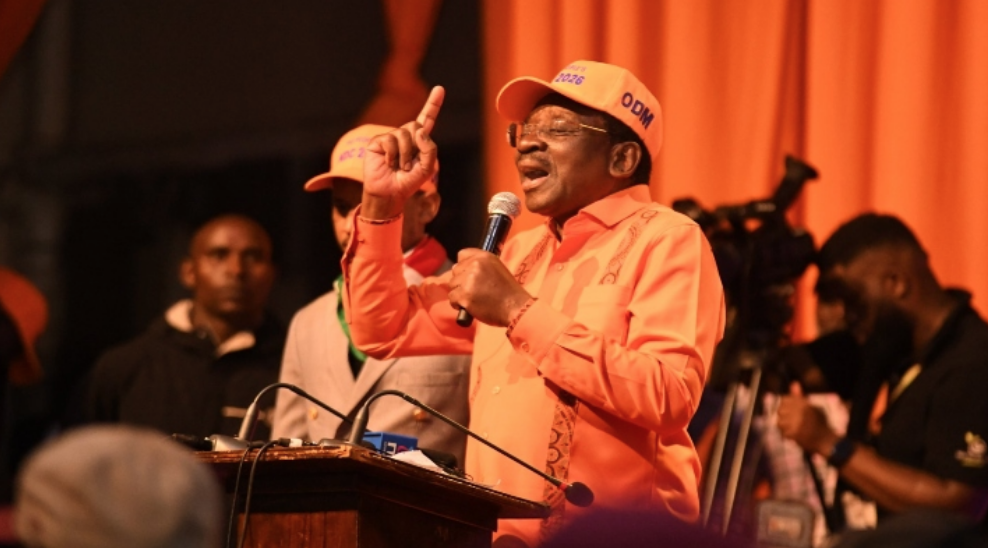
Governor Orengo has become the leading voice for the
"Linda Mwananchi" faction, which insists that ODM must remain an
independent party.
The faction argues that ODM should field its own
presidential candidate in 2027, and is prepared to return to street protests to
hold the government accountable, a stance they believe aligns with the party's
founding ideals.
The governor has maintained a hard stance, saying he
will only collaborate with President Ruto on the development of Siaya, and not politics.
“I am not scared of them. I have the support of the people
of Siaya,” the governor said, arguing that Linda Mwananchi is the way to go.
“Let the Luo community not be scared. We can get the
presidency if we organise ourselves well.”
Despite the political tensions, President Ruto publicly
signalled a truce with Orengo during his tour of Siaya this week.
PRINCIPLE OR POLITICAL RISK
By resisting the two-term chorus, Orengo is positioning
himself as a guardian of opposition ideals in a region where realpolitik has
blurred ideological clarity.
“He is staying true to his brand,” says Wafula Buke.
“Orengo has never been a bandwagon politician. He calculates differently.”
Siaya political activist Oloo Okanda said, “No one knows what will happen in 2027. The landscape will change as we
go on. For now, the governor has no competition in a free and fair election.”
But critics argue that this approach risks leaving him
politically exposed, especially if the Nyanza leadership sticks by Ruto to the
end.
Lawyer Joshua Nyamori holds that, “Orengo will collapse.
The ODM base is emotionally aligned to Raila's legacy. Anyone seen fighting it
will be a minority.”
He added, “William Ruto is seen as the protector of that
legacy, through the way he ensured Raila’s befitting sendoff, and respect for
decisions on development.”
For Nyamori, the community has accepted ODM party leader
Oburu Oginga as the steward, and with the visible government projects, the
region is unlikely to look elsewhere.
“The residents are aligning with President Ruto. Orengo
will have to come to the fold or be written off,” he said.
In Nyanza, political unity has historically translated
into bargaining power at the national level; thus, isolation can carry steep
consequences.
BIGGER
GAME
There is also speculation that Orengo’s defiance could
be part of a longer-term political strategy.
With the 2027 elections on the horizon, some observers
see his stance as an attempt to carve out a distinct political identity.
Such positioning could prove valuable in the current
post-Raila era, where the battle for Nyanza’s political soul is expected to
intensify.
For now, however, Orengo walks a tightrope.
He must balance his criticism of the national government
with his role as governor, a position that requires cooperation with the same
administration he often challenges.
At the same time, he must navigate internal party
dynamics within ODM, where differing views on engagement with the government
are increasingly coming to the fore.
Whether Orengo is ultimately seen as a lone ranger or a
voice of principled caution will depend largely on how Nyanza’s political
landscape evolves in the coming months.
If the region fully embraces the two-term narrative, his
stance may appear increasingly isolated, potentially narrowing his influence.
But if scepticism about early political alignment grows,
Orengo could emerge as a figure who read the moment correctly.



![[PHOTOS] The new Ngong –Naivasha Road viaduct](https://cdn.radioafrica.digital/image/2026/06/64d4f771-4432-4aee-ba3c-2f304c4436ec.jpg)
![[PHOTOS] 'Mr Speaker Sir' Gen Z protester in court](https://cdn.radioafrica.digital/image/2026/06/b3e62d8e-25c3-4780-90f9-4eb48b1ce8a7.jpg)