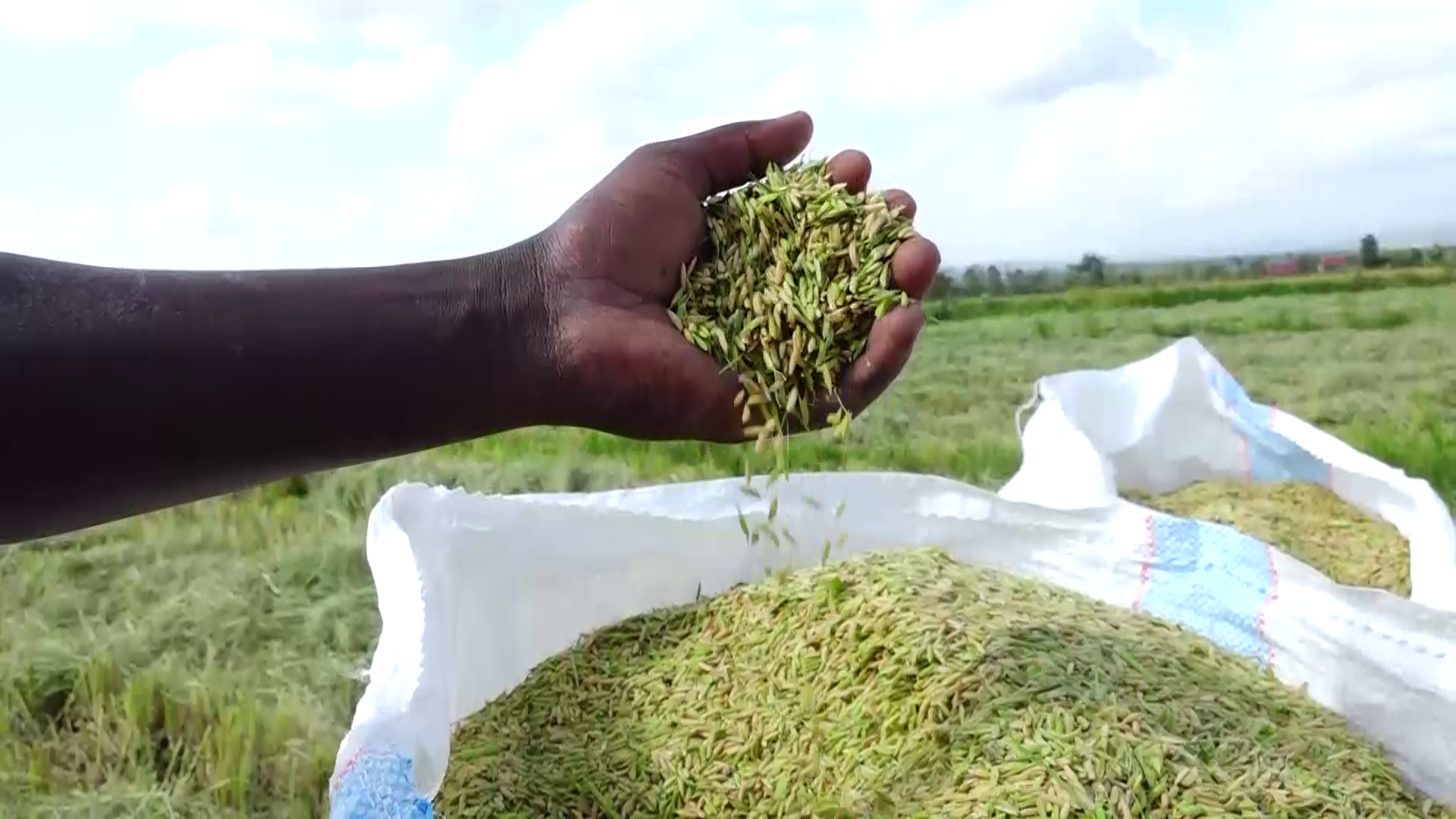
Rice farmers in Mwea and other major growing regions have received a major boost after cooperatives confirmed that all locally produced rice delivered to government agencies has been fully taken and paid for.
The update eases fears over stock
build-up and delayed payments, concerns that have previously triggered unrest
among growers.
The confirmation came during a high-level
visit to the Mwea Rice Growers Multipurpose Co-operative Society (MRGM) by
senior government officials.
The delegation was led by
Agriculture and Food Authority (AFA) Director General Bruno Linyiru and
included Acting Agriculture Secretary Peter Owoko, National Cereals and Produce
Board (NCPB) Managing Director Samuel Ndung’u Karogoh, AFA Director of Crops
Calistus Kundu, and Kenya National Trading Corporation (KNTC) Managing Director
Lucy Anangwe.
The team toured MRGM stores to
assess rice uptake, payments, and general farmer concerns amid ongoing public
debate over imports and the future of local production.
MRGM Chairperson Ndege Muriuki and
Managing Director Anthony Waweru said farmers have been offloading stock
without any complaints.
They confirmed that payments have
been made promptly and in full.
“Offloading of stocks has been
ongoing, and we have no complaint. Payment was done as agreed by KNTC,” Waweru
said.
He added that the cooperative
carried over less than one per cent of stock from 2025 into 2026, a major
improvement from the previous year’s 30 per cent carry-over.
“As of 31st December, I can confirm
that KNTC has paid for all rice that was delivered. Based on our projections,
KNTC is ready to take up all the rice that farmers bring.”
MRGM, founded in 1964, is Kenya’s
oldest and largest rice cooperative. It represents growers in the Mwea
Irrigation Scheme, which produces about 65 per cent of all rice grown in the
country.
The cooperative also dismissed
claims that imports are hurting local farmers. Waweru said Mwea rice occupies a
premium market niche that does not directly compete with cheaper imported
varieties.
“Our rice is niche and premium.
There is no competition between imported rice and locally produced Pishori,” he
said.
While most imported non-basmati rice
sells for Sh80 to 100 per kilo, Mwea Pishori retails at between Sh140 and 160
due to its aroma and quality.
Production has been rising steadily.
Kenya recorded 123,916 metric tonnes of milled rice in 2022, 137,438 MT in 2023 and 169,291 MT in 2024.
In 2026,
paddy production is projected to hit 302,000 MT, equivalent to about 181,200 MT
of milled rice.
Despite the gains, domestic
production still covers less than 20 per cent of national demand, making imports
necessary to stabilise supply.
Government data shows that the
importation of 250,000 MT in late 2025 helped ease prices, although the
majority of imports, more than 95 per cent, are non-basmati varieties that do not
affect the premium Pishori market.
Officials said the government
remains committed to structured marketing to prevent exploitation of farmers.
Through NCPB and KNTC, the state has
assured farmers that all paddy and milled rice offered for sale will be
purchased and paid for within 30 days.
“This ensures every available bag of
locally produced rice is taken up promptly and protects farmers from price
shocks,” said AFA Director General Bruno Linyiru.
Farmers holding rice stocks have
been encouraged to contact NCPB or KNTC for immediate sale.