


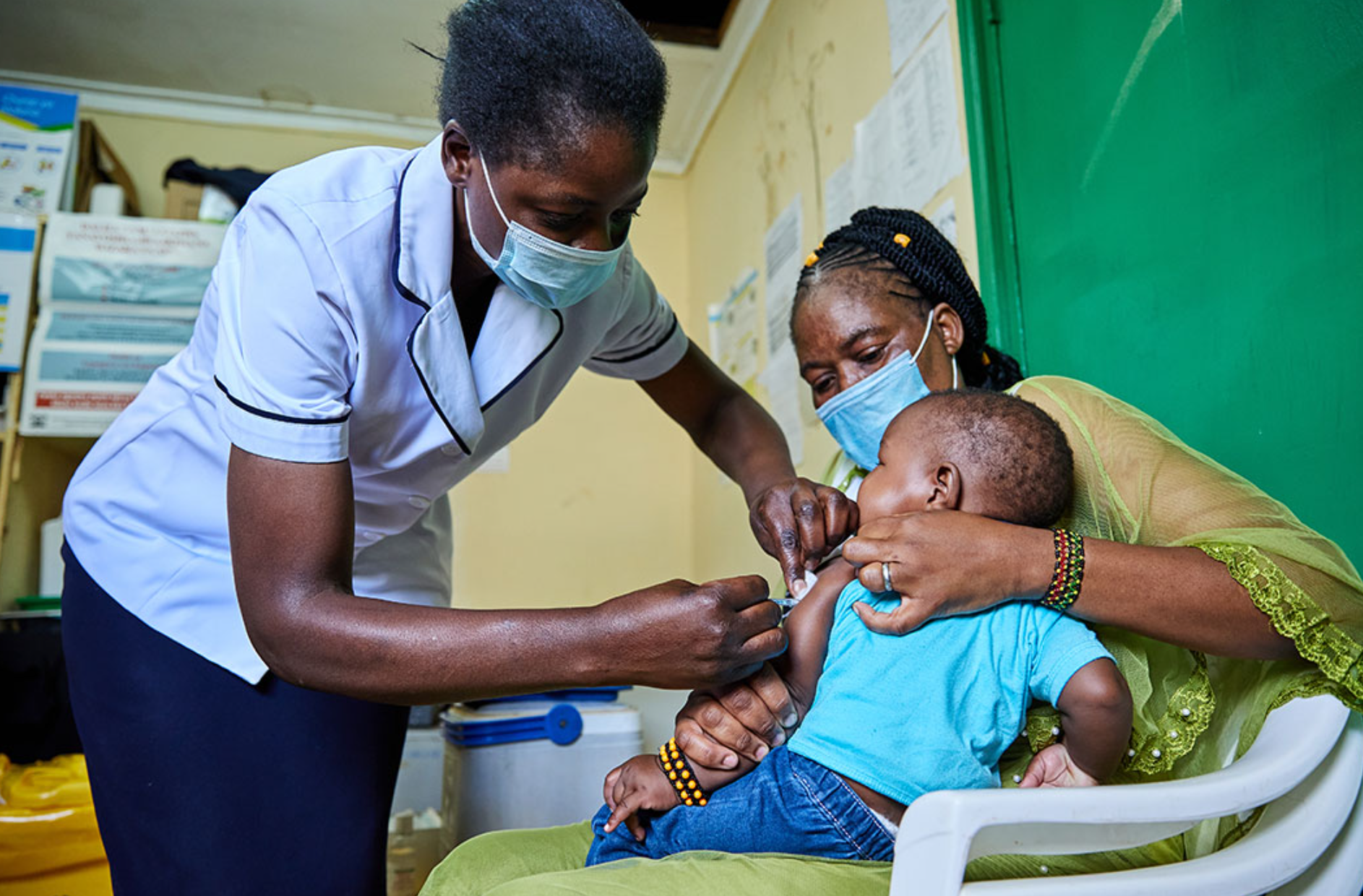
 A child receiving a vaccine in Kenya /HANDOUT
 The World Health Organisation has rejected claims that vaccines cause autism, clarifying that there is no conclusive evidence linking autism to the use of paracetamol during pregnancy.
The statements come after a fresh wave of misleading posts and claims circulating globally, including in Kenya, suggesting vaccines or common painkillers might cause autism.
Autism, or autism spectrum disorder (ASD), is a developmental condition that affects how a person communicates, interacts with others and experiences the world. It is not a disease.
Children with autism may learn or communicate differently, may repeat certain behaviours, or may prefer routines.
Scientists say autism develops from a mix of factors inside the brain, not from vaccines or medicine.
The WHO said: “Based on available evidence, no causal link exists between vaccines and autism spectrum disorders. The conclusion reaffirms WHO’s position that childhood vaccines do not cause autism.”
The analysis was carried out by the Global Advisory Committee on Vaccine Safety, a group of independent experts formed in 1999 to examine vaccine safety concerns. WHO said the committee reviewed 31 major research studies published between 2010 and August 2025. According to the statement:
“Evidence based on 31 primary research studies, published between January 2010 and August 2025, including data from multiple countries, strongly supports the positive safety profile of vaccines used during childhood and pregnancy, and confirms the absence of a causal link with ASD.”
Kenya has one of the highest vaccine uptakes in the world.
According to Kenya’s national health data, about 80 per cent of children aged 12–23 months were fully vaccinated with key routine vaccines before the Covid-19 pandemic period.
The committee also examined concerns related to thiomersal, a preservative used in some vaccines and aluminium, which is used in small amounts in some vaccines to make them work better.
WHO said it reviewed studies stretching from 1999 to March 2023, plus a new large Danish study involving children born between 1997 and 2018.
“In summary, the available high-quality evidence shows no association between the trace amounts of aluminium used in some vaccines and ASD, supporting the ongoing use of vaccines with aluminium adjuvants,” it said.
Because of this, WHO reaffirmed earlier findings from 2002, 2004 and 2012, saying: “Vaccines, including those with thiomersal and/or aluminum, do not cause autism.”
WHO urged countries to base vaccine policies on strong scientific evidence and said childhood immunisation has helped transform global health. It added that immunisation has saved at least 154 million lives in the past 50 years.
In an earlier statement in September, the WHO had also addressed claims that taking acetaminophen (paracetamol) during pregnancy might cause autism.
“The World Health Organization emphasises that there is currently no conclusive scientific evidence confirming a possible link between autism and use of acetaminophen (also known as paracetamol) during pregnancy,” it said.
The organisation added that autism affects about 62 million people worldwide and said: “The exact causes of autism have not been established, and it is understood there are multiple factors that can be involved.”
WHO said researchers have spent the last decade studying any possible link between paracetamol use in pregnancy and autism, but: “At this time, no consistent association has been established.”
Kenya does not yet have official government statistics on the exact number or rate of autism in the population because there has been limited large-scale research or national surveillance specific to autism spectrum disorders.
Parent-led organisations such as the Autism Society of Kenya in 2023 estimated that autism could affect around four per cent of the Kenyan population, which would be approximately 2.2 million individuals living with autism at various levels of severity.
This estimate is based on organisation experience and community reports rather than formal national surveys.