The two Otienos—criminal lawyer SM
Otieno and Richard Otieno —left a lasting impression on him during his
formative years.
When SM passed on in 1986, his
death triggered a protracted legal battle between his Luo clansmen and his
Kikuyu widow, Wambui Otieno, over his burial site.
Richard, Oluga’s neighbour, handled
the case, earning admiration for his professionalism and tenacity.
“That case fascinated everyone in
Simenya village,” Oluga recalls. “I didn’t fully understand what being a lawyer
meant, but I knew it made people famous. I wanted that too.”
Richard’s charisma and success saw
him drive a sleek Mercedes Benz and he would be celebrated in local schools
whenever he visited.
Oluga who watched from a young age
how law commanded respect and influence, was inspired.
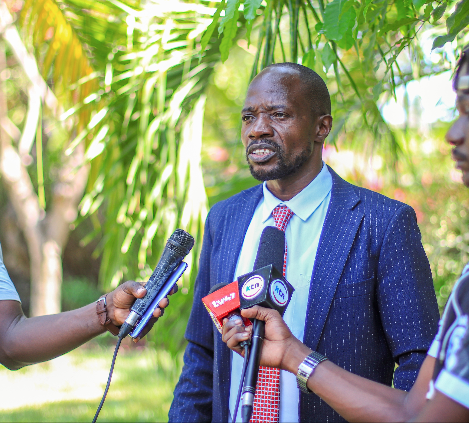
Oluga was born 42 years ago in
Simenya, Ugunja constituency, Siaya county. Tragedy would strike and his
father, a plumber, died when he was just eight and in Class 3 at Simenya
Primary School.
His mother, a housewife with no
formal education, was left to raise him and seven siblings on her own.
“It was a real struggle. There was
no steady income; we only did small-scale subsistence farming. We would wake at
3 am, till the land using a tin lamp, and then go to school,” Oluga recalls.
Despite these hardships, his mother
prioritised education.
“If you missed school without a
valid reason, she would take your hand, drag you to school, and even ensure the
teacher caned you before she did,” he says.
She instilled in us the value of
literacy, emphasising that her children should at least be able to write
letters for themselves and others, a skill she herself had been denied.
Financial constraints made
schooling a constant challenge. It took Oluga 10 years to complete primary
school education.
He repeated Class 3 after missing
exams due to his father’s death and again repeated Class 7 after failing to pay
the Sh300 mock exam fees.
To raise money, he sold sugarcane,
buying at Sh10 and selling at double the price until he could afford the
remainder of his school fees.
A compassionate teacher later
covered his KCPE exam fee, allowing him to sit the exams successfully.
Oluga emerged as the best student
in his primary school, earning an admission to Simenya Secondary School where
he scored an A-.
It was a historic achievement; the
school had never sent a student to the university.
“When I joined, the school’s first
university student had scored a B plain and became a teacher. We broke that
record with an A-, and the school’s name went into newspapers. Enrollment
skyrocketed,” Oluga proudly recalls.
At Simenya Secondary, Oluga
gravitated towards law early. He joined the Law Club, often playing the role of
prosecutor in mock court sessions. Yet his teachers, particularly his Biology
teacher who christened him Dr Oluga, pushed him towards medicine.
In Form Four, under teacher
supervision, he listed medicine as his first-choice course for university. But
deep down, he remained committed to law. Upon receiving his results, he revised
his choices, putting law first and gained admission to Moi University.
He graduated in 2007 and was
admitted to the bar in 2009.
Oluga’s legal career spans over 16
years, including time as a legal researcher at the Judiciary. There, he gained
invaluable experience, observing the work ethics and strategies of some of
Kenya’s most esteemed judges.
“The corridors of justice taught me
that diligence and integrity are as important as legal knowledge,” he reflects.
Early in his private practice,
Oluga learnt firsthand how image shapes perception.
A German client initially doubted
his credibility due to the location of his office atop a pub in Mtwapa.
They had to navigate past
intoxicated patrons to reach him, causing the client to question his
professionalism.
Oluga later relocated to a more
suitable office in Mombasa CBD, securing the client’s trust and the deal.
“Sometimes the image you project can give you or deny you work,” he says.
Oluga has handled high-profile
cases with societal impact. In Mombasa county, he challenged the government’s
plan to evict tenants from ageing estates slated for regeneration.
Many had lived there for years with
no alternative homes. Oluga went to court and halted the evictions until the
authorities implemented a structured and lawful process.
The case forced the county to
consult tenants, creating a blueprint for fair relocation.
Oluga also navigated complex
commercial disputes, including a conflict over rent with Nakumatt, a major
supermarket chain. Representing his client, the mall owner, he had to balance
professional duty with personal sentiment, as he had fond memories of shopping
at Nakumatt.
Negotiations and court interventions
eventually led to partial recovery of owed rent, showcasing his skill in
mediating high-stakes, sensitive matters.
Throughout his journey, Oluga
emphasises the blend of resilience, mentorship and integrity that shaped him.
He credits the inspiration from the
two Otienos, his mother’s unwavering support and his own persistence.
From a curious village boy
captivated by legal luminaries to a respected lawyer influencing justice in
Kenya, Oluga’s story underscores how determination, ethical grounding, and a
clear vision can turn childhood fascination into a lifetime of impact.










![[PHOTOS] Red carpet in Pretoria as Ruto begins South Africa visit](https://cdn.radioafrica.digital/image/2026/06/abe3e750-6e5a-4394-a45c-899768be6240.jpeg)