

 Quenter Atieno at Jaramogi Oginga Odinga Teaching and Referral Hospital in Kisumu/Faith Matete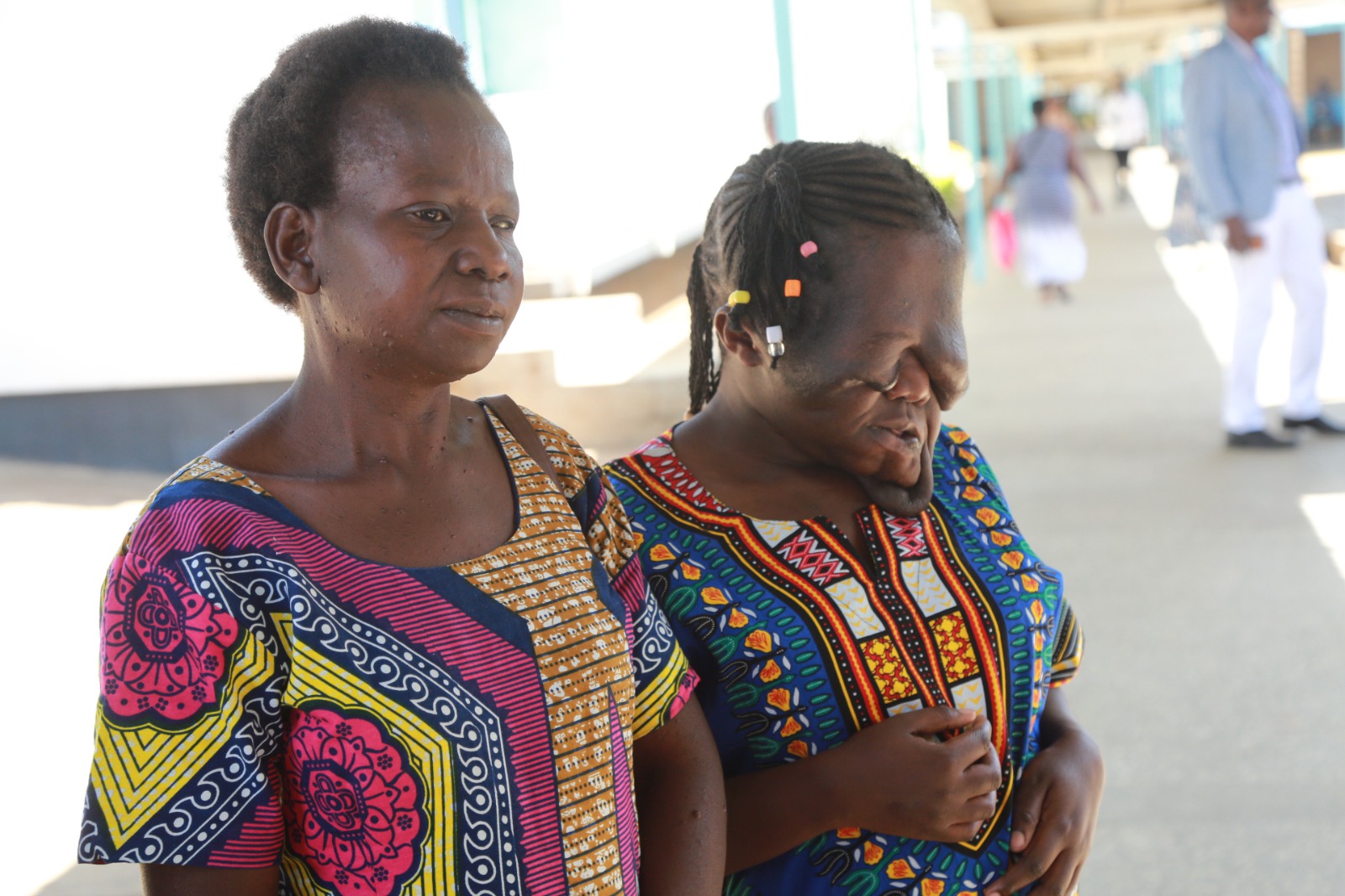
Inside the long, echoing corridors of Jaramogi Oginga Odinga
Teaching and Referral Hospital (JOOTRH) in Kisumu, a mother and her daughter
walk hand in hand.
Twenty-six-year-old Quenter Atieno is guided not by sight but by
the warmth of her mother’s palm.
Her world has gone dark. Her steps now depend entirely on sound,
memory and her mother’s voice.
They have travelled from Nyakach in search of something they
have pursued for two decades – answers.
A doctor willing to examine her, a chance for surgery or
simply the faintest spark of hope after a long and painful journey marked by
fear, stigma and exhaustion.
Atieno’s face carries the story of her illness. A swelling that
started when she was just a year old has grown steadily over the years, spreading
across her forehead and eyes.
The weight of the tumour forces her head downward. Once able
to see the world clearly, she now sees only shadows, if at all.
But even as her condition worsens, Atieno chooses dignity.
On this day, she is dressed in a bright blue dashiki, her hair
braided neatly and adorned with colourful beads.
She stands quietly beside her mother, Millicent Abwao, as they
queue to book a consultation with a maxillofacial surgeon.
“We came to see if she could get help, maybe a surgery. My
daughter cannot see anymore. I am praying that this hospital gives us some
hope,” Abwao says.
The widow has two other children in Form 3 and Form 4.
For 25 years, she has fought to prevent her daughter’s health
from slipping away completely.
She first sought help at Sabatia Eye Hospital when she was seven
years old and the swelling was just a small mass above the eyes, a surgery was
done.
But the growth became bigger and more aggressive each
year.
Treatment required resources she did not have. Today, they
are at JOOTRH trying again.
Atieno remembers the years before the darkness when she could
walk to school, see her friends’ faces and laugh without fear.
She was schooled at Aluor School for the Blind (St Nicholas Hauser )
from Class 1 to Form 4. Here, she learnt how to weave and knit.
“I learnt how to knit sweaters, scarves and baby clothes,”
Atieno says.
“If I had a knitting machine, I could work from home because I
want to be useful. I want to help my mother because life has been difficult. Sometimes
we go without meals.”
This dream of earning a living and supporting her family has
been put on hold.
The society has also stigmatised her.
“People stare,” she says in a voice barely above a whisper. Some
whisper when I pass and ask my mother what is wrong with me. This lowers my
self-esteem,” Atieno says.
Abwao hears everything people say about her daughter and feels
every stare.
But she swallows her tears and squeezes Atieno’s hand a
little tighter.
“As a mother, you feel pain. But I tell myself I must be strong
for her. She still has dreams,” Abwao says.
Despite the long wait, they fail to see the specialist because
he was not available that day and are forced to book another appointment.
Abwao is appealing to doctors, philanthropists, county leaders,
NGOs and well-wishers to help Quenter secure medical intervention and, if
possible, a knitting machine to rebuild her independence.
“She is 26 now. She should be living her life, working and
planning her future. But instead, she depends on me for everything,” she says.
“I just want to see again. Even a little,” Quenter says. For any support or assistance, the child’s mother, Millicent Abwao, can be reached on 0798839598