
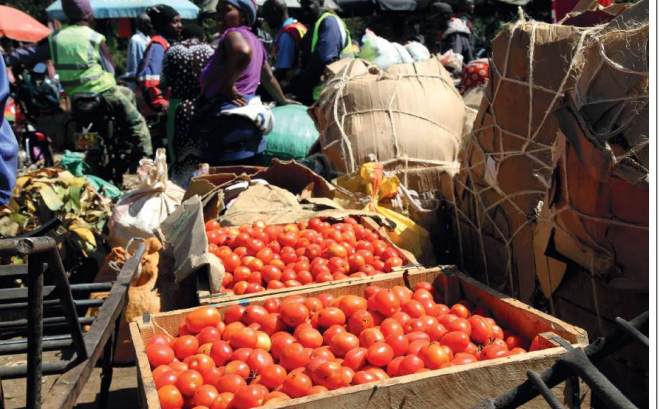
 Tomatoes on
sale at Kangemi
Market
/FILE
Tomatoes on
sale at Kangemi
Market
/FILE
Households should brace for higher food costs, especially for vegetables, this Christmas season, as dryness intensifies across the country.
Although the November 2025 Agriculture Sector Survey by the Central Bank of Kenya (CBK) anticipates improved food supply following recent harvests, particularly of maize, stable pump prices and exchange rate stability to support a stable inflation rate in the near term, it warns of a possible uptick in inflation this festive month.
“A majority of respondents expect seasonal factors associated with the festivities in December, and higher prices of some food items, particularly vegetables, to exert moderate upward pressure on overall inflation,’’ CBK says.
Even so, the apex bank expects inflation to remain below the midpoint of the target range in the near term, supported by lower prices of processed food items, stable energy prices, and continued exchange rate stability.
Last month, Kenya’s overall inflation declined to 4.5 per cent in November 2025 from 4.6 per cent in October, and remained below the mid-point of the target range of 5±2.5 per cent.
Core inflation declined to 2.3 per cent in November from 2.7 per cent in October, mainly on account of lower prices of processed food items, particularly maize flour and sugar.
Non-core inflation increased to 10.1 per cent in November from 9.9 per cent in October, mainly driven by higher prices of vegetables, particularly tomatoes, onions and cabbage.
According to the Kenya National Bureau of Statistics (KNBS), Prices of onions (leeks and bulbs) rose by 4.9 per cent, marking the highest increase among the fresh produce items in November. Although tomato prices decreased by 2.1 per cent, the cost per kilo was still at a nine-month high. Prices of kale (sukuma wiki) rose by 2.7 per cent.
A spot check by the Star shows onion consumers countrywide are grappling with huge scarcity as a kilogramme of the commonly used kitchen vegetable –the bulb onion hit an average of Sh170 and a high of Sh200 in regions like Mombasa, North Eastern Kenya, Kitui, Tharaka Nithi, Meru, Turkana, among other regions experiencing dryness.
A vegetable vendor at the popular Kongowea Market in Mombasa told the Star that she is facing challenges meeting regular supply, especially for onions, Sukuma Wiki, tomatoes, carrots and cucumbers.
“I have been forced to reject many orders. My tomato suppliers in Njabini are really struggling. I have had to increase purchase price by at least Sh3 per kilo as the demand soars,’’ the trader identified as Salome Makau told the Star.
In Zambezi, Kiambu county, a single piece of tomato is currently going for Sh15 from Sh10, while the commodity is more expensive in Nyayo Estate, where it is sold at a high of Sh25.
Vegetable traders at Kangemi Market in Nairobi are worried that vegetable prices will return to the highs seen in 2023 if the current dry season persists into the first three months of 2026.
“We hope that farmers who have harvested their main crops like maize in Trans Nzoia are going to grow vegetables as they wait for the next planting season. This will help ease the high demand as onions, tomatoes and kale become scarce.
The current shortage, which is expected to soar, has been exacerbated by low local production due to the high cost of production against a low return on investment and reduced imports from the neighboring country, Tanzania, where changes in climate and several failed rainfall seasons have also not been favorable to the water-thirsty vegetable.
In Central Kenya, especially Nyeri, consumers have turned to the unpopular spring onion, which too has been affected by the shortage as its demand is now high, thus escalating its price.
The spring onion has for a long time been retailing at Sh50 to Sh60 per kilogramme, but currently the same is going for Sh100 to Sh120.
While some have decided to eliminate the precious must-have vegetable from their meals, terming it a ‘preserve for the elite’ due to its high price, others have become innovative in the kitchen to have the meals ready.
“Just two months ago, we were buying a kilogramme of the red bulb onion at Sh40 only; now the price has more than tripled and I can no longer afford to buy a piece to be used once at Sh20,” says Jane Njeri, a resident of Ndugo Village in Mukurweini sub-county.
The warning by the banking regulator is coming at a time when the National Drought Management Authority (NDMA) is forecasting a prolonged dry spell, coupled with depressed rainfall across several regions, to intensify.
So far, dryness has already pushed seven counties into the alert stage as conditions continue to deteriorate.
The authority projects that the population facing high levels of food insecurity will surpass 2.1 million people by early next year, noting that most parts of the country are likely to receive near-average to below-average rainfall in December.
According to the authority, nine counties, including Wajir, Garissa, Kilifi, Kitui, Marsabit, Kwale, Kajiado, Isiolo and Tana River, are currently in the alert phase and “require close monitoring due to emerging drought conditions and potential impacts on food security, water access and pasture availability.
“The counties experiencing a worsening trend included Isiolo, Turkana, Makueni, Meru, Embu, Tharaka Nithi, Kitui and Marsabit,” the report read.
It has attributed the crisis to the late onset and poor performance of the October–November–December (OND) rains.
![[PHOTOS] The new Ngong –Naivasha Road viaduct](https://cdn.radioafrica.digital/image/2026/06/64d4f771-4432-4aee-ba3c-2f304c4436ec.jpg)











![[PHOTOS] 'Mr Speaker Sir' Gen Z protester in court](https://cdn.radioafrica.digital/image/2026/06/b3e62d8e-25c3-4780-90f9-4eb48b1ce8a7.jpg)