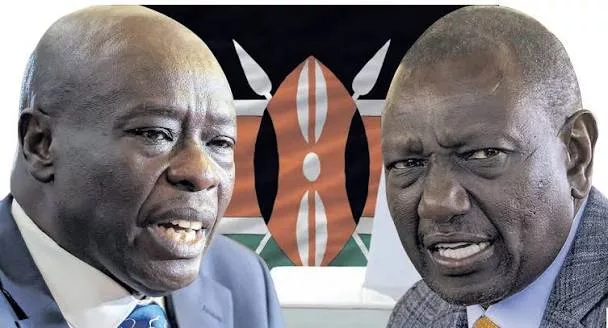
In the intricate game of Kenyan
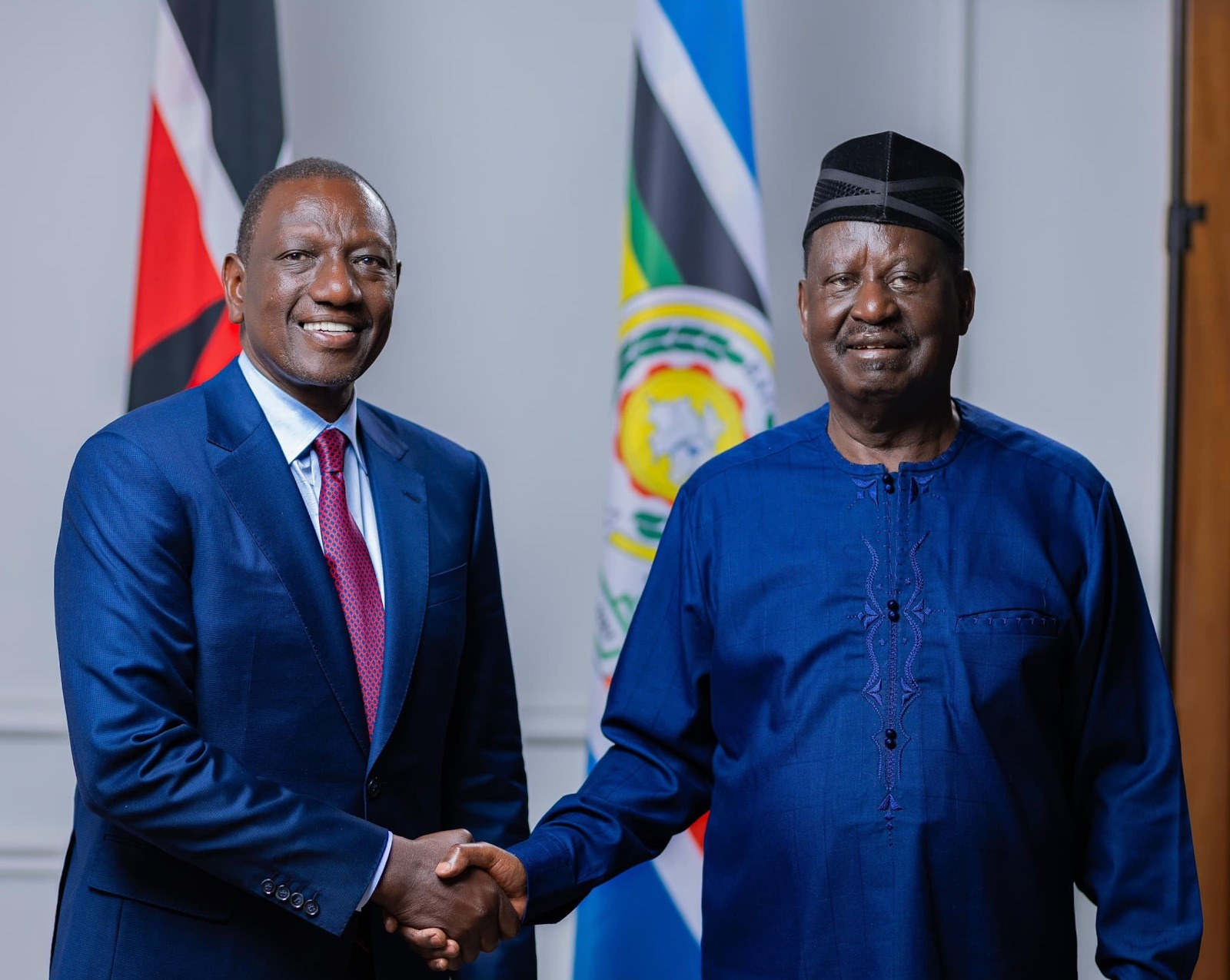
politics, the unfolding rapprochement between President
William Ruto and opposition
chief Raila Odinga is not a simple
handshake but a grandmaster’s move
in a high-stakes chess match.
Every
piece repositioned on the board alters the balance of power, sending
ripples across both sides of the political divide. While many analysts rush
to frame this development through
the predictable, simplistic and even
pedestrian tropes of “betrayal” and
“self-preservation,” a deeper, more
strategic lens is required—one that
goes beyond the obvious and lazy
armchair analysis.
Game theory, a mathematical
framework for understanding strategic decision-making, offers useful
insights into these political manoeuvres.
It suggests that rational actors—
whether individuals or political
entities—make decisions based on
calculated payoffs, anticipating the
moves and counter-moves of their
opponents.
Rather than viewing
Raila’s decision through the narrow
prism of personal gain or ideological
capitulation, Kenyans must interrogate the strategic calculus at play.
In game-theoretic terms, both
Ruto and Raila are rational players
in a game with multiple equilibriums.
What are their primary objectives? It is power consolidation and
political survival. For Ruto, co-opting Raila neutralises a formidable
opponent and potentially divides
the opposition ahead of 2027.
For
Raila, engagement with Ruto secures
political relevance, potential institutional leverage and a say in national
governance beyond the confines of
opposition.
Each move is calculated,
and the outcome is shaped not by
emotions but by strategic necessity.
Kenyan politics operates not as a
one-off encounter but as an iterated game—one played over multiple
electoral cycles.
The handshake between Raila and former President
Uhuru Kenyatta in 2018 was one such
move. It altered the game, realigned
coalitions and ultimately paved the way for Ruto’s rise to power.
Similarly, the current rapprochement
must be seen in a long-term context,
not just as a short-term tactical shift.
Consider the Prisoner’s Dilemma,
a classic model in game theory. It
illustrates how two rational actors,
despite having incentives to betray
each other, often find cooperation to
be the best strategy when the game
is played repeatedly.
Raila and Ruto
may be political adversaries, but in
this moment, their mutual interests
align. Their cooperation, however
uneasy, creates a new power dynamic that reshapes Kenya’s political
trajectory. This unexpected alliance disrupts
the entrenched political expectations
on both sides.
Raila’s supporters,
long accustomed to an adversarial
stance against the government, find
themselves in uncharted territory. The Kenya Kwanza coalition, meanwhile, grapples with the inclusion of
a rival figure whose presence could
dilute its internal coherence.
Yet, as game theory reminds us,
political stability is never a fixed
state—it is always in flux, shaped by
the strategic interests of key players.
The shockwaves emanating from this
political move should not lead Kenyans into reactionary lamentation
but rather into a deeper analysis of
shifting political incentives. What
are the broader implications for governance? For opposition politics?
For electoral strategy in 2027? These
are the questions worth engaging
with.
One of the greatest misconceptions in Kenyan politics is the notion that political destiny rests in the hands of a single individual.
Whether it is Raila, Ruto, or any
other political figure, the will of the
people remains supreme.
Kenyans
must resist the impulse to personalise political developments. The real
challenge is not in deciphering or
even lamenting Raila’s latest move
but in strengthening institutions,
policies and civic engagement to
ensure that leadership decisions
reflect the broader aspirations of
the populace.
This is where game theory off ers
another valuable lesson—the concept of Nash Equilibrium, where no
player has an incentive to unilaterally change their strategy given the
choices of others.
If Kenyans continue to depend on the decisions of
a few political elites, they remain
in a suboptimal equilibrium where
power remains concentrated. But if
the electorate collectively demands
accountability, champions institutional reforms and strengthens democratic structures, a new, more balanced equilibrium can emerge—one
where the people, not politicians,
dictate the rules of the game.
Rather than merely bemoaning
Raila’s chess move, Kenyans must
seek to understand it. Political strategy is complex, and every decision
carries far-reaching implications.
To push the boundaries of political
analysis, citizens must employ new
theoretical lenses to decode the unfolding dynamics.
At its core, politics is not about
personalities; it is about structures,
interests and power dynamics. If
Kenyans wish to shape their political future, they must recognise
their own agency.
A strategic awakening is necessary—one that moves
beyond blind loyalty to individuals
and instead embraces a deeper, more
nuanced engagement with the forces
shaping the nation’s governance.
The chessboard is set, the pieces
are moving and the game continues. The question is: will Kenyans be
mere spectators, or will they become
active players in defining their own
political future?
The writer teaches
Globalisation
and International
Development
at Pwani
University and is
a Programmes
Associate at DTM, a
Media CSO/ [email protected]