BWIRE: Youth and work: Rethink crime prevention this International Labour Day
Crime often festers where opportunity is limited and where young people, in particular, feel excluded.
by VERA BWIRE
Audio By Vocalize
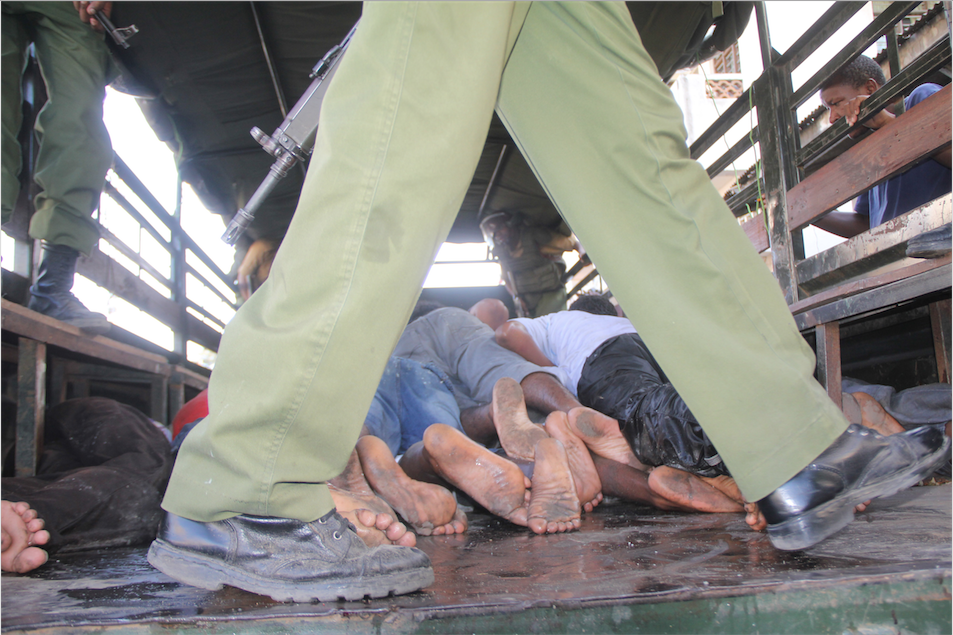
Young men arrested by police on suspicion of links with al Shabaab in Mombasa /FILE
As Kenya joins the rest of the world in
marking International Labour Day today, the national conversation that often
centres on wages, working conditions and job creation can extend a little more
to youth unemployment, idleness and rising crime, which continue to be pressing realities.
For us to build safer communities, we must rethink labour not
just as an economic activity, but as a powerful tool for social stability.
Crime rarely exists in isolation, and
this is a fact. Crime often festers where opportunity is limited and where
young people, in particular, feel excluded from meaningful participation in the
economy.
In many urban and peri-urban areas across Kenya, the lack of
sustainable livelihoods has created fertile ground for petty crime, drug abuse and organised criminal activity, which is a visible reality every day if you look
at the daily gathering of young idle people in many town centres.
Addressing
this challenge is not easy, in a country
where education and home income levels vary, thus it may require more immediate investment in people, rather than drafting policies that may take a long time to be actualised.
Promoting self-sustenance through labour definitely
offers a practical pathway forward for many youth. Kenya’s informal sector,
often referred to as the hustle economy, already provides evidence of what is
possible.
Many youth are creating digital content without formal education on
digital matters, making edible and non-food items to sell in small hustle
markets as well as online, many are embracing farming and carpentry, among
others.
With Kenya, and other development
partners providing access to vocational training, small business support and
affordable credit, many young people have successfully carved out dignified
livelihoods in areas such as carpentry, mechanics, urban farming and digital
services. Those who have embraced such businesses are naturally avoiding
crime.
While there are a good number of youth in
formal employment, and those who have started businesses, there is another good
number of youth who are still seeking jobs, with university degrees, and
others who are jobless due to lack of fees to pursue tertiary education, or
simply truant youth who are into drugs and alcohol and who have refused to engage in
meaningful employment. Those are the youth who are vulnerable to influence and
sliding into petty or major criminal activities.
These are the same youth who are misused
by politicians and crooked business people to engage in mob political
activities, robberies and fraud. This group is the one that needs immediate
help to get into the formal or informal labour market, by different
stakeholders, especially this and next year, as we approach the election period,
to avoid them being misused.
National and county governments,
alongside the private sector and development partners, must therefore scale up
labour-intensive initiatives. Public works programmes, green economy jobs and
digital innovation hubs, that can absorb thousands into productive work.
Equally important is shifting youth and
general society attitudes to value all forms of honest labour, moving beyond
the narrow prestige attached to white-collar jobs. Immediate ‘small’ jobs such
as cleaning, delivery services, restaurant waiting, cashier, nanny jobs, among
others, can be jobs for the youth to start on to make a living.
Government and parents should be at the forefront to support them in getting
immediate opportunity, even as they pursue their future ambitions, just so they
can avoid being idle and being lured and trapped into crime.
Reducing crime, therefore, is not solely
a matter of enforcement. It is all about expanding immediate opportunity, changing
societal attitudes on meaningful employment, restoring dignity and enabling
every Kenyan youth to work, use their capabilities, earn and thrive. Happy Labour Day!
Vera Bwire writes on African
Youth, Democracy, Higher Education and Development | [email protected]
This is premium content
Subscribe to Continue Reading
Help us continue bringing you unbiased news, in-depth investigations, and diverse perspectives. Your subscription keeps our mission alive and empowers us to provide high-quality, trustworthy journalism. Join us today to make a difference!



![[PHOTOS] The new Ngong –Naivasha Road viaduct](https://cdn.radioafrica.digital/image/2026/06/64d4f771-4432-4aee-ba3c-2f304c4436ec.jpg)








![[PHOTOS] 'Mr Speaker Sir' Gen Z protester in court](https://cdn.radioafrica.digital/image/2026/06/b3e62d8e-25c3-4780-90f9-4eb48b1ce8a7.jpg)