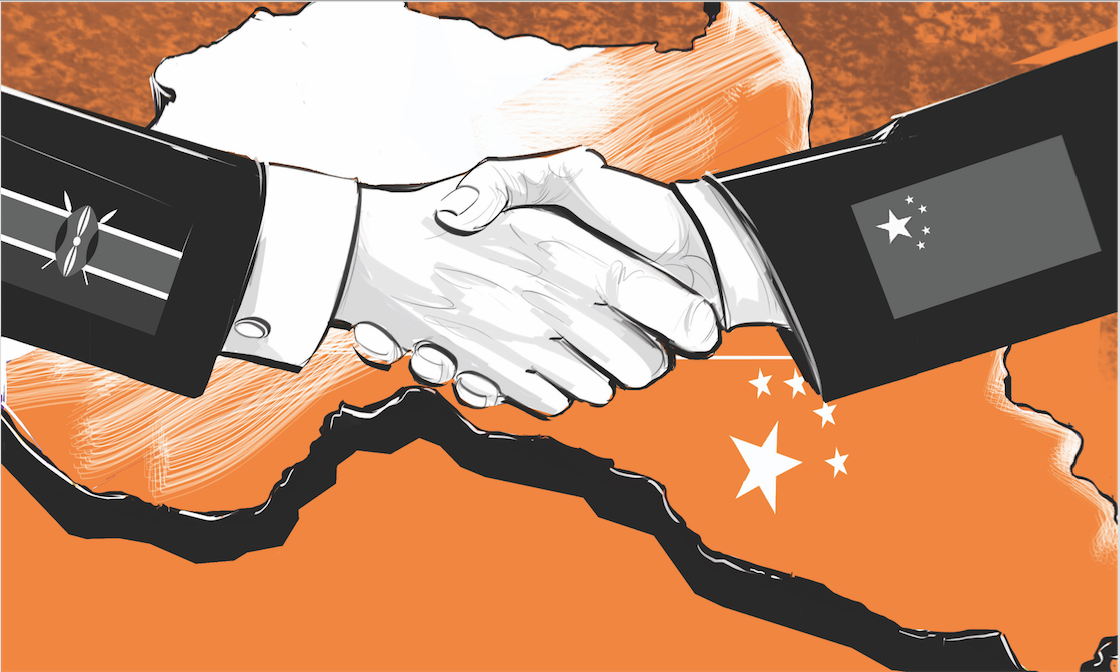
China’s Belt and Road Initiative,
launched in 2013, was never meant to be a Chinese monopoly on infrastructure, as
often insinuated.
Official Chinese policy, from the State Council white papers
to Foreign Ministry statements, defines it from the lens of “extensive
consultation, joint contribution, and shared benefits,” and explicitly frame
the BRI as a platform for equal participation by partner countries and
international actors. For instance, the 2023 white paper, ‘The Belt and Road
Initiative: A Key Pillar of the Global Community of Shared Future’, calls for “a
long-term, stable, sustainable and risk-controlled investment and financing
system with innovative models and diverse channels,” with the intention of pooling
funds beyond Chinese policy banks like the Eximbank.
China classifies BRI projects via
public announcements, MoUs and forums like the Belt and Road Portal while emphasising
strategic alignment over rigid lists or any obvious criteria. Peripheral
additions include infrastructur-enhancingg connectivity projects, often with
co-financing from African Development Bank (AfDB), the World Bank and host country
financing. Yet, global perceptions cling to a “China-led debt trap” narrative,
ignoring Beijing’s own vision. It is time to detach the BRI label from
exclusive Chinese financing, embracing the multilateral reality Chinese policymakers
envisioned from inception.
This evolution is already underway
in East Africa, where implementation delays, debt concerns and reduced Chinese
lending have forced hybrid models that prove the BRI’s open architecture works.
Tanzania’s Standard Gauge Railway, a BRI-associated corridor is a prime example.
While China Railway Engineering Group (CREC) secured a $2.15 billion
construction deal last year for parts of it, AfDB led by syndication, with a $696
million for phase 2 linking it to Burundi and DRC in 2023, together with a $1.2
billion mobilised with Deutsche Bank, Société Générale and Standard Chartered
banks. Spain’s Export Credit Agency pledged $3.24 billion in 2024, with the Turk
Eximbank co-financing early sections, and World Bank supporting phased funding.
This blend diminishes China’s grip, delivering connectivity without sole
reliance on Beijing, precisely living up to the “joint contribution” mantra
that China advocates.
Kenya exemplifies the shift most
starkly. The Kenyan SGR’s early phases (phase 1 from Mombasa to Nairobi and phase
2A from Nairobi to Naivasha) depended on Chinese loans, but phase 2B (Naivasha
to Kisumu, extending toward Uganda) pivoted in late last year to public-private
partnership, prioritising speed and oversight over Eximbank debt concerns. This
avoids the delays plaguing Chinese-financed extensions, like phase 2A’s
bottlenecks and aligns with BRI’s non-exclusive financing ethos.
Uganda’s story mirrors the same
pragmatism. The Karuma and Isimba hydroelectric dams saw China Eximbank cover
85 per cent of costs, with Uganda’s government equity filling the rest,
evidencing host-nation contributions integrated into BRI principles. In line
with the same principle, the Ugandan SGR link to Kenya, once BRI-branded,
stalled amid feasibility and financing shortfalls. Uganda appointed America’s
Citibank to lead syndication and structure the financing, with Turkish firm
Yapi Merkezi signing a deal to handle design, construction, procurement,
electrification and signalling in place of China Harbour Engineering Co.
(CHEC), which was dropped in 2023 after failing to secure Eximbank financing, signaling
a broader pivot, as Kampala seeks Western capital to bypass Beijing’s hesitancy
post-debt audits.
Even Ethiopia, a BRI early adopter
via its 2016 MoU, weighs alternatives. While Chinese firms built the
Addis-Djibouti Railway, recent talks have focused on rescheduling debts rather
than fund expansions, prompting explorations of AfDB and EU loans for light
rail upgrades. Tanzania, too, diversified after Chinese bids faltered. It
tapped Standard Chartered’s $1.46 billion 2020 loan for the Dar es
Salaam-Makutupora SGR line, blending Sinosure guarantees with commercial depth.
These cases debunk the myth of BRI
as “Chinese-built, Chinese-paid.” Beijing never mandated exclusivity and projects
gain BRI status through MoUs and announcements, rather than funding sources.
Reduced Chinese outflows, occasioned by domestic slowdowns, have accelerated
this trend, with East African states leveraging AfDB’s $170 billion annual
infrastructure call, Western financing as well as domestic sources. The
Uvinza-Musongati SGR, for instance, started with AfDB’s $696 million as primary
funding before CREC’s supplemental role, reflecting blended trends over
replacement.
Detaching BRI from Chinese
dominance benefits all. For Beijing, it sheds “debt trap” stigma, validating
its multilateral rhetoric evident in connectivity projects that are BRI aligned
but Multilateral Development Banks led. For recipients, it means alternative
and faster delivery. Kenya’s PPPs outpace SGR delays, Uganda avoids Eximbank
renegotiations. Globally, it fosters true “multilateralism,” pooling BRI
infrastructure financing risks via diverse funders and models.
Critics might argue this dilutes
BRI’s essence, however, China’s own words counter this argument. The lack of a
centralised register reinforces Chinese primacy whilst ambiguity allows
“BRI-aligned” flexibility. Therefore, East Africa’s pivot isn’t rejection but rather,
a realisation that BRI is a multilateral venture, geopolitics notwithstanding.
As Citibank, Deutsche, and AfDB step up, the BRI evolves from Beijing’s
blueprint to a global mix, fulfilling its founders’ vision. Policymakers in
Nairobi, Dar-es-Salaam and Addis Ababa should champion this publicly, urging
forums like the next Belt and Road summit to codify diverse financing. The
tracks are being laid; the world will need to run the trains.
The writer is an Africa-China analyst and International relations practitioner




![[PHOTOS] The new Ngong –Naivasha Road viaduct](https://cdn.radioafrica.digital/image/2026/06/64d4f771-4432-4aee-ba3c-2f304c4436ec.jpg)







![[PHOTOS] 'Mr Speaker Sir' Gen Z protester in court](https://cdn.radioafrica.digital/image/2026/06/b3e62d8e-25c3-4780-90f9-4eb48b1ce8a7.jpg)