In the Gospel of Matthew, Jesus delivers what scholars call the Sermon on the Mount. He covers a remarkable amount of ground in a short space, the beatitudes, murder, adultery, divorce, oaths, and loving your enemies.
But tucked in the middle of this sermon is a teaching that has confounded rulers, presidents, generals, and ordinary men for two thousand years. He says, whosoever shall smite thee on thy right cheek, turn to him the other also.
For two millennia, this instruction has been read as a counsel of submission. Pacifists cite it as the foundation of non-resistance. Conquered peoples were told to accept their condition with it.
It has been used to disarm the oppressed, to shame the retaliator, and to clothe political passivity in the language of virtue. Others, including activists from Gandhi to Martin Luther King Jr read it not as submission, but as a specific act of defiance where the left cheek, freely offered, forces the aggressor to strike as an equal rather than as a superior.
However, the theologian Walter Wink who published Jesus and Nonviolence: A Third Way, gives us this analysis: In first century Judea, the left hand was reserved for unclean purposes.
It was never used to strike another person in a social context. This means that a strike to the right cheek, delivered by a right-handed person, could only be one thing: a backhanded slap.
In that culture, a backhanded slap was not combat. It was the physical language of hierarchy. It was the gesture a master used on a slave, a Roman soldier on a Jewish civilian, a husband on a wife, or a superior on anyone he wished to remind of their inferiority. It was a dominance display, not a fight. The person being struck was not being attacked as an equal. They were being put in their place.
Now consider what happens when the victim turns the other cheek. The only way to strike the left cheek is with an open-handed blow, which in that same culture was the strike exchanged between equals. You cannot backhand the left cheek. Physically, the geometry does not work.
So what Jesus was actually instructing was not submission. It was the precise opposite. He was saying, do not run (murife don’t run), but refuse to accept the role your aggressor has assigned you. That of an inferior. Wink called this the third way, neither fight nor flight, but a creative refusal to be humiliated on the aggressor’s terms.
In recent days, we have had our own rendition of calls for President William Ruto to turn the other cheek because not doing so is not presidential. Allow me to contextualise this.
A couple of weeks ago, former Deputy President Rigathi Gachagua attended the funeral of the Kiambu Senator’s mother. In the presence of mourners, he chose this occasion to taunt the President, claiming he had lost weight to the point that his ears had become big because the opposition was giving him sleepless nights.
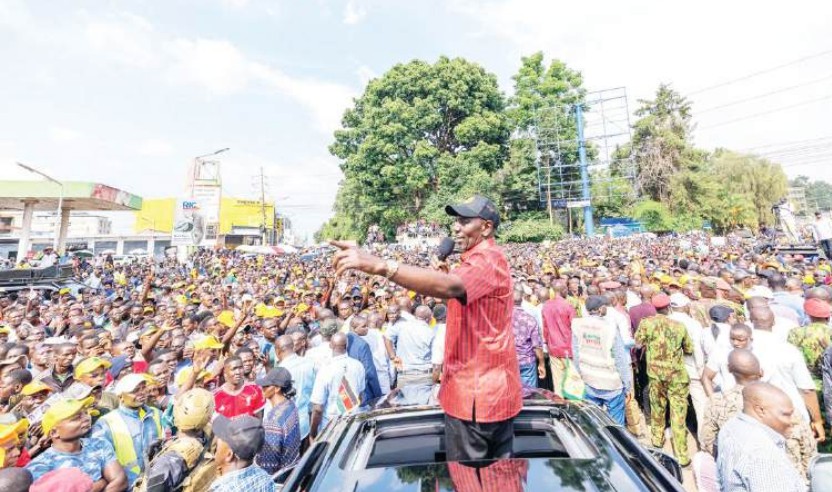
The following day, the President hit back and he did not limit himself to Gachagua. He worked through the opposition roster methodically. He mocked the opposition leaders’ physical fitness, lethargy while attending meetings, family abandonment, and lack of development initiatives.
The public reaction was swift and predictable. Civil society called the President’s remarks deeply unpresidential. Opposition politicians called for his impeachment, and the clergy called it a public shame and stain on the country and asked the two to get into a bunker and insult each other privately. The chorus was unanimous. The President must be presidential.
That begs the question. Should President Ruto have turned the other cheek?
There is a principle of power that states that a ruler need not be loved, and can survive being feared, but cannot survive being held in contempt. A ruler who absorbs insults without response does not appear dignified. He appears irresolute and weak. And these are not private conditions. They are public signals that radiate outward to every political actor watching. The silence of the powerful is never read as grace. It is read as an inventory of what you can take from him.
Another principle that is equally precise is that unanswered attacks become accepted truths. If Gachagua says from a funeral podium that Ruto is psychologically besieged, and Ruto stays silent, the silence is processed by the public as confirmation.
The clergy’s counsel, that the President rise above it, is, in political terms, an instruction to let the opponent write the narrative unchallenged. In a country such as ours, where political perception shapes everything from investor confidence to the 2027 ballot, that is not statesmanship. It is abdication.
Consider also the specific nature of Gachagua’s taunt. According to Wink, it was a backhanded slap. It was a gesture designed to establish dominance and signal that the President is rattled. Asking Ruto to turn the other cheek in that context presupposes that he and Gachagua are equals. They are not equals. Following his impeachment, Gachagua is an ordinary citizen, while the President holds his office as a trustee for 55 million Kenyans. The Scripture, properly read, does not ask the higher party to absorb the lower party’s dominance play in silence. It asks them to refuse the role of inferior.
But let’s make the harder argument. Not because we enjoy watching the President trade jabs from a sunroof. But because the reflexive calls for presidential restraint contain an asymmetry that we should address honestly.
The insults from the opposition leaders are not whispered criticisms in some private chambers. They are amplified, deliberate and personal delivered from funeral podiums, church pulpits, public rallies, and reproduced across newspapers and social media platforms across the country. Those insulting him are called brave.
When he responds, he is called unpresidential. The standard being applied is one that is used to disarm incumbents while arming challengers. This is not a principle. It is an asymmetrical privilege.
I submit, that the President should occasionally not turn the other cheek. Because silence in the face of sustained and deliberate public humiliation is not civility. It is a concession. And in politics, concessions compound. A man who absorbs every blow without response does not appear above the fray. He appears available for more.
The President’s occasional grit to enter the murky arena, is not a lapse in leadership. It is a necessary signal that resets the political calculus of those who would otherwise conclude that the incumbent can be insulted without consequence. The key word, however, is occasionally.
Finally, my unsolicited advice is to President Ruto.
Do not let unanswered attacks become accepted truths. There is nothing inherently unpresidential about wrestling in the mud. History’s most effective leaders from Churchill to Lyndon Johnson, could make a senator weep and a journalist bleed in the same afternoon. They understood that dignity is not the same as distance, and that a leader who is too elevated to be provoked is also too elevated to be believed.
Sometimes the mud is exactly where the fight belongs. Sometimes the public needs to see that the man they elected is not made of glass. Sometimes silence in the face of sustained, deliberate, public humiliation is not grace. It is surrender wearing grace’s clothing.
So fight back. Show the mettle. But fight like a President, not like a man who has been provoked. Understand what kind of fight you are in because the distinction matters more than it sounds. There is a difference between a president who fights and a president who brawls. The fighter chooses his moment, his ground, and his words. The brawler swings at whatever is in front of him.
This is not an argument for silence. It is an argument for selection.
A president who never fights back invites escalation because the calculation becomes simple. There is reward and no risk to those who insult you. When you fight back occasionally, unpredictably, and with sufficient sharpness, it disrupts that calculation entirely.
That unpredictability is worth more than any single comeback delivered from a sunroof. So be measured, unhurried and surgical in your response.
This kind of response says something no insult can. That the man delivering it is in control of himself, and therefore in control of his audience, and therefore in control of the country.
So yes. Fight. Fight in the mud. Occasionally. On your terms. When you choose. At a moment that serves your argument rather than your opponent’s narrative.
Then get up, dust yourself off, and go back to governing so that the fight and the record exist in the same frame, and the contrast between a president working and an opposition brawling becomes, by itself, the most devastating rebuttal available.
Because governing is the fight those insulting you cannot enter, and it is the only fight that matters in August 2027.



![[PHOTOS] The new Ngong –Naivasha Road viaduct](https://cdn.radioafrica.digital/image/2026/06/64d4f771-4432-4aee-ba3c-2f304c4436ec.jpg)







![[PHOTOS] 'Mr Speaker Sir' Gen Z protester in court](https://cdn.radioafrica.digital/image/2026/06/b3e62d8e-25c3-4780-90f9-4eb48b1ce8a7.jpg)