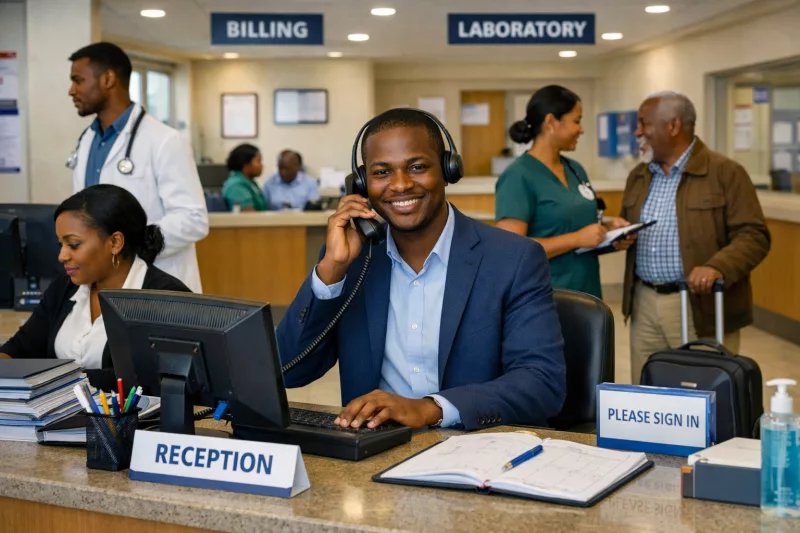
In August 2021, while waiting for a future I could not yet see, my phone rang.
“Hello, is this George Ooro?”
“Yes,” I replied.
“My name is Sharon Spheranza from the Human Resources Department at Aga Khan Hospital Kisumu.”
Her voice was calm and professional. Then came the words every recent graduate hopes to hear. She was calling to offer me an internship.
A few days earlier, I had applied for an internship position in Public Relations and Communications. Instead, the opportunity waiting for me was in the Customer Service Department.
It was not the role I had imagined. But at that stage of my life, an opportunity mattered more than the title attached to it. I accepted.
I had no idea that a phone call lasting only a few minutes would become the beginning of the most important chapter of my early career.
I was in my final year on campus. Like many young people entering the professional world for the first time, I carried ambition, curiosity and uncertainty in equal measure. I was eager to learn, but I was also aware of how much I did not know.
Healthcare was unfamiliar. Corporate life was unfamiliar. Everything about the environment I was entering felt bigger than me.
On my first day at Aga Khan Hospital Kisumu, I walked into a world where every interaction carried weight. Patients arrived seeking answers. Families arrived carrying fear and uncertainty. Healthcare workers moved with urgency and precision. Behind every counter, every office and every department was a responsibility connected to someone's health and well-being.
I was assigned to the Customer Service Department under Reshma Patel. At the time, I did not know she would become one of the most influential people in my professional journey.
I was young and inexperienced. I wanted to make a good impression, but I did not yet understand the details that separate enthusiasm from professionalism. My early days revealed that gap quickly.
There were mornings when I arrived at work with a wrinkled shirt and worn-out shoes, unaware that the smallest details of presentation communicated something about how seriously I approached my responsibilities. There were moments when a client asked for directions in the hospital, and I confidently pointed them to the wrong destination. I quickly learned that in a healthcare environment, even a simple mistake could create frustration for someone who was already anxious and searching for help.
I struggled with complex billing and credit control questions. I found myself trying to understand laboratory processes and respond to clients who expected clarity when I was still learning the systems myself. I often felt like I was trying to keep pace with a world that already knew the rhythm.
But Reshma saw something in me that I could not yet see. She understood that I did not need to arrive as a finished professional. I needed someone willing to help me become one.
She corrected me when I made mistakes, challenged me when I became comfortable and encouraged me when I doubted myself. She taught me lessons that were not written in any textbook: how to communicate with confidence, how to take responsibility, how to treat people with dignity and how to approach work with discipline.
Her mentorship did not happen through one dramatic moment. It happened through hundreds of small ones. A correction after a mistake. A conversation after a difficult interaction. A reminder that improvement comes through consistency.
Some of the most important lessons, however, came from the people I served. Some days, the customer service desk became a place where professional responsibilities met human suffering.
I remember sitting with a recently bereaved family to discuss available services and pricing. They were navigating one of the most painful experiences a person can face: the loss of someone they loved and the difficult decisions that follow.
During that conversation, a client became intensely focused on a minor discrepancy in the paperwork. What began as a request for clarification quickly turned into anger directed at me. The frustration escalated, and I found myself on the receiving end of emotions that felt much larger than the issue before us.
At first, it was difficult not to take it personally. I was still learning. I wanted to provide answers, solve problems and prove that I belonged there. Being confronted so strongly made me question whether I was handling the situation correctly.
But that moment taught me something I have carried throughout my career. Sometimes people express their deepest pain through the things they can still control.
The paperwork could be questioned. The pricing could be challenged. A detail on a document could be corrected. But the loss itself could not be undone.
I began to understand that the anger in front of me was not only about the transaction. It carried the weight of grief, financial pressure, exhaustion and the helplessness that comes when life changes without warning. That realisation changed how I approached difficult conversations.
I learned to listen beyond the words being spoken. I learned that a frustrated client was often not just a client. They were a person carrying circumstances I could not see. Customer service, I realised, was not simply about answering questions or resolving complaints.
It was about meeting people with patience and dignity, especially when they were experiencing some of their hardest days. The challenges did not end there.
Like many workplaces, the hospital had different personalities and working styles. There were moments when navigating difficult relationships with colleagues tested my patience and maturity. I learned that professionalism was not only about how we treated clients; it was also about how we worked with one another.
I learned to communicate better, to manage my emotions and to focus on the purpose of the work even when circumstances were uncomfortable. Growth was not only an emotional journey. It was also a physical one. During the height of the Covid-19 pandemic, I travelled nearly 25km every weekday from my parents’ home in Kowuor village, Ahero, to Aga Khan Hospital in Kisumu’s central business district.
Some mornings, the hardest question was not whether I was ready for work. It was whether I could afford to get there. Bus fare was not always guaranteed. My parents did everything they could to support me, but there were days when resources were stretched. Sometimes they managed to raise the fare. Other times, I had to call friends and ask for help.
Those moments were humbling. I wanted to appear independent. I wanted to feel like I was already becoming the professional I hoped to be.
But I learned that progress is rarely achieved alone. Every journey to the hospital was made possible by sacrifices from people who believed in me before I had achieved anything worth celebrating.
One of the things I will always appreciate about Aga Khan Hospital Kisumu was how it supported its interns. We were provided with free meals, a gesture that might have seemed ordinary but meant a great deal during that season. When every shilling mattered, those meals eased a burden and reminded us that we were valued. The internship also changed the way I understood healthcare.
I learned that hospitals are not built by doctors and nurses alone. They are powered by entire teams: administrators, customer service professionals, laboratory personnel, finance officers, technicians and countless others whose work often happens away from public attention. Every role mattered. Every person mattered.
That realisation changed how I viewed leadership, teamwork and service. Beyond the work itself, the internship gave me relationships that have lasted years.
I met doctors, nurses, pharmacists, radiographers, administrators, cashiers and colleagues across different departments. Some became mentors. Others became friends. Many remain part of my personal and professional journey.
At the time, I thought I was simply starting an internship. I did not realise I was entering a community that would shape my future. Today, my career has taken me to other respected healthcare institutions in Kenya. But every opportunity that followed was built on a foundation created during those early months at Aga Khan Hospital Kisumu.
When I look back, I return to that phone call in August 2021. Sharon Spheranza reviewed an application from a young campus student she had never met and chose to create an opportunity. Reshma Patel welcomed that student into her department and invested in his growth.
They did not know exactly where their decisions would lead. Neither did I. But their actions taught me that careers are not built by ambition alone. They are built by people who choose to extend trust, offer guidance and open doors for others.
I now understand that the greatest impact we have on people's lives is not always through grand gestures. Sometimes it begins with a phone call.
Sometimes it begins with a person choosing to believe in someone before there is much evidence to justify that belief.
One day, I hope to do the same. To recognise potential before it becomes obvious. To encourage someone who is still finding their way. To open a door for someone standing where I once stood.
Just as Sharon Spheranza and Reshma Patel did for me.