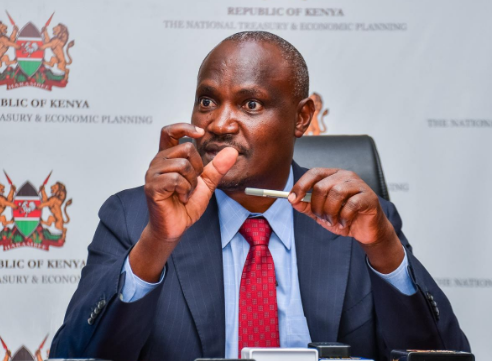
At a time when citizens anticipated tangible Pay As You Earn (PAYE) relief from the government, its absence in the Finance Bill 2026 has undermined confidence and deepened economic pressure on families.
This is because it was publicly promised first, by the National Treasury Cabinet Secretary John Mbadi, and later became more pronounced by President William Ruto.
That, to many Kenyans was not just mere talk, it was a policy pronouncement. Easing PAYE would not only fulfill the government’s pledge but also increase disposable income, boost household spending and stimulate broader economic growth.
For anyone opposed to this proposal, the question would be: where do we get the resources to fill the revenue gap? Any resulting revenue gap can be responsibly addressed through more progressive taxation measures targeting wealth and high-value assets, ensuring a fairer and more balanced system for all Kenyans.
Parliament must honour the government’s earlier promise to ease the tax burden on ordinary Kenyans, particularly low- and middle-income earners by delivering meaningful PAYE relief in the Bill. This is the right thing to do.
Instead of tightening the fiscal noose on low-income earners, Parliament must look toward a progressive wealth tax. Evidence shows that a properly structured wealth tax could raise about Sh130 billion annually. This alternative revenue stream could fundamentally transform public financing while directly addressing Kenya's severe economic inequality.
The economic justification for shifting our tax architecture is irrefutable. Kenya’s revenue base remains unsustainably over-reliant on regressive consumption taxes, which account for 56.2 per cent of total tax revenue. This framework places an unyielding burden on the poorest households while allowing high-net-worth individuals to significantly minimise their tax exposure.
According to the World Inequality Database, the top 10 per cent of Kenyans control roughly 63 per cent of the national wealth, whereas the bottom 50 per cent collectively survive on a mere four per cent.
Specifically, Kenya is home to an estimated 7,200 dollar-millionaires with assets exceeding Sh129 million, and 16 centi-millionaires whose net fortunes cross Sh12.9 billion.
Yet, despite this massive concentration of capital, the country lacks an effective and enforceable framework to ensure the ultra-rich contribute equitably. This is the debate that Parliament must have.
Lawmakers should, by law mandate a sequenced, phased approach, directing the National Treasury and the Kenya Revenue Authority to build three foundational pillars before a net wealth tax is fully launched.
First, the KRA must deploy structured voluntary disclosure programmes specifically tailored for high-net-worth individuals. By providing limited amnesty and reduced penalties for early self-declaration, the state can foster compliance and build institutional trust.
Lawmakers should compel tax authorities to adopt "soft enforcement" strategies similar to those used successfully in Uganda and Rwanda, prioritising relationship-building, taxpayer education and moral persuasion over heavy-handed penalties.
Second, Parliament must legislate the establishment of a centralised and comprehensive wealth database housed within the Business Registration Services. Kenya’s asset information is currently fragmented across disparate land and company registries, paralysing real-time verification.
A unified platform tracking equities, real property and beneficial ownership structures is vital, provided it strictly honours the privacy safeguards of the Data Protection Act, 2019.
Third, Kenya must cement international transparency mechanisms by fully aligning with the Organisation for Economic Co-operation and Development’s Common Reporting Standard.
The opacity of cross-border transfers allows elites to obscure their fortunes in tax havens. Finalising information-sharing agreements with foreign jurisdictions is non-negotiable to curb offshore tax evasion and wealth flight.
While these multi-year structures are put in place, Parliament can take immediate, actionable steps within the Finance Bill 2026 to lay the groundwork. Lawmakers should harmonise capital gains tax rates, which currently sit at a low 15 per cent with the prevailing corporate income tax rate of 30 per cent.
This adjustment can be implemented immediately, ensuring that wealth-related returns are not privileged over hard-earned salaries. Parliament should know that hustlers are watching.
The writer is senior communications and advocacy officer, Institute of Public Finance
![[PHOTOS] The new Ngong –Naivasha Road viaduct](https://cdn.radioafrica.digital/image/2026/06/64d4f771-4432-4aee-ba3c-2f304c4436ec.jpg)










![[PHOTOS] 'Mr Speaker Sir' Gen Z protester in court](https://cdn.radioafrica.digital/image/2026/06/b3e62d8e-25c3-4780-90f9-4eb48b1ce8a7.jpg)