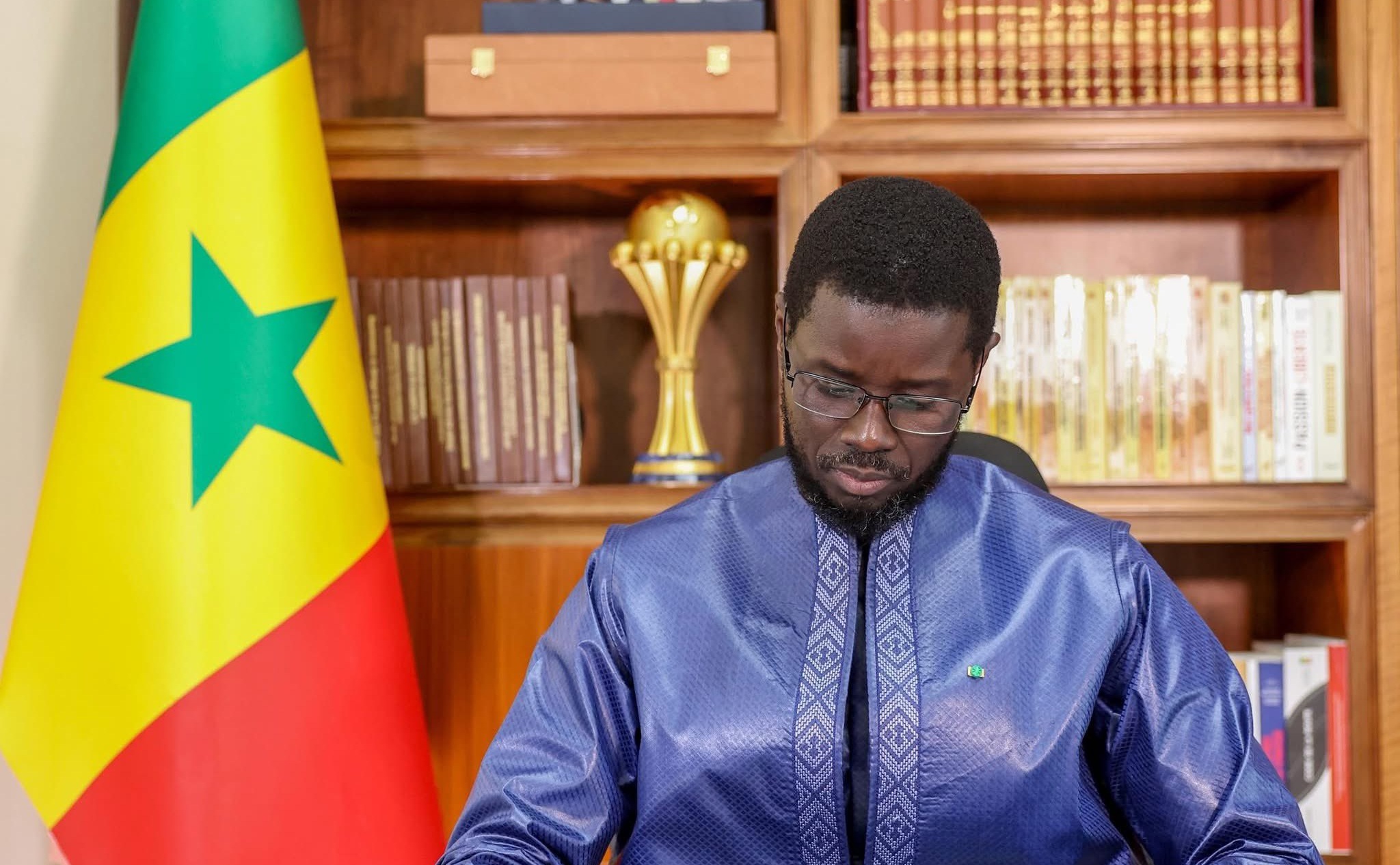
The story of Bassirou Diomaye Faye and Ousmane Sonko was once the stuff of legend. Two men who endured repression, arrests and persecution, who carried the hopes of Senegal’s restless youth, who promised to break the chains of a tired political order.
They were hailed as symbols of resistance, as proof that courage could triumph over tyranny. Yet today, their revolution lies in tatters, undone not by external enemies but by the iron law of power itself.
Many critics have rushed to explain the rupture in terms of betrayal, ego, or the corrosion of ideals. They lament that the dream has been squandered, that the revolution has been devoured by the very appetites it sought to tame. But this reading misses the deeper truth.
The fallout between
Faye and Sonko was not an accident of personality. It was bound to happen. Why?
Because no government can sustain two centres of power.
History is merciless on this point. Courts have one ruler at a time. Cabinets, however collegial, ultimately answer to a single head. Revolutions may be born in collectives, but states are governed by hierarchies.
Sonko’s party dominance in Parliament propelled Faye to the presidency. Sonko himself, as Prime Minister, was instrumental in shaping the government. Yet the presidency is not a co-chairmanship. It is singular, sovereign and final.
President Faye’s reminder that Sonko “serves at the pleasure of the president” was not arrogance—it was constitutional reality. The presidency is not a gift to be shared, nor a trophy to be co-owned. It is an office defined by singular authority. Sonko may have made Faye president, but once sworn in, the presidency ceased to be “theirs.” It became Faye’s alone.
The clash was ideological, not personal. Sonko’s assertiveness in Parliament and public forums may have been rooted in conviction, but it inevitably collided with the prerogatives of the presidency.
Undermining the head of state in public, however principled, was bound to trigger confrontation. No president, however indebted to allies, can tolerate being challenged on the floor of the House or contradicted in public forums. To do so would be to abdicate authority.
This was not betrayal of the revolution but the natural consequence of its structure. Revolutions often falter when charismatic figures fail to reconcile their roles within formal institutions.
The Senegalese youth who saw Faye and Sonko as twin beacons of hope must now confront the sobering reality: institutions demand clarity of command. The dream of dual leadership was always a mirage.
The tragedy lies not in the inevitability of the fallout but in the expectations that preceded it. Young Africans were sold a vision of unity, of shared struggle, of collective triumph.
They believed that Faye and Sonko could defy the gravitational pull of power politics. They believed that friendship and shared sacrifice could override constitutional hierarchy. They believed, in short, that two crowns could rest on one throne.
But politics is not built on sentiment. It is built on structures, rules and authority. The Senegalese revolution faltered not because its leaders were corrupt or treacherous, but because its architecture was flawed.
A government cannot be both presidential and parliamentary in spirit. It cannot be both singular and dual. It must choose. And Senegal’s constitution had already chosen: the presidency reigns supreme.
The lesson is harsh but necessary. Revolutions are not sustained by personalities but by institutions. Charismatic figures may ignite change, but unless they submit to the discipline of governance, their movements collapse under the weight of competing egos.
Faye and Sonko’s fallout is a cautionary tale for all who dream of dual leadership. It reminds us that power, once formalised, demands singularity.
Senegal’s young democracy must now decide whether this rupture weakens its promise or clarifies its path. If it weakens, then the revolution will be remembered as another false dawn, another dream betrayed.
If it clarifies, then perhaps Senegal will emerge stronger, with institutions that outlast personalities and a polity that understands the unforgiving logic of power.
In the end, the Faye–Sonko saga is not a story of betrayal. It is a
story of inevitability. One throne, one crown. That is the law of politics. And
no revolution, however noble, can escape it.
The writer is a political commentator, [email protected]

![[PHOTOS] The new Ngong –Naivasha Road viaduct](https://cdn.radioafrica.digital/image/2026/06/64d4f771-4432-4aee-ba3c-2f304c4436ec.jpg)









![[PHOTOS] 'Mr Speaker Sir' Gen Z protester in court](https://cdn.radioafrica.digital/image/2026/06/b3e62d8e-25c3-4780-90f9-4eb48b1ce8a7.jpg)