If you have undertaken even the most elementary study of economics, you will have learned that it all boils down to economics being the study of how people respond to incentives.
Within this definition then, public policy involves the balancing of such incentives and attempting to ensure that the incentives available to key stakeholder groups, combine to produce the desired outcomes.
The recent controversy over the management of the Amboseli National Reserve, is a good example of how difficult it is to come up with policy proposals which satisfy all such stakeholders.
In this case, where the key issue is that of wildlife and environmental conservation, the objective is clear enough: we must preserve the Amboseli ecosystem in its pristine state, so that it remains an authentic wilderness area, which will attract tourists.
But how to secure such protection is by no means easy.
First, and perhaps most importantly, the local Maasai communities must have what we nowadays call “the lived experience” of being substantial beneficiaries.
Second is that the local authority, the Kajiado county, must – as the institutional representative of the local communities – have a clear financial stake in the conservation project, and receive a share of the revenues accruing, which they will presumably use for the benefit of local residents.
And third, there is the Kenya Wildlife Service as the representative of the national government, and the overall manager and guarantor of security for all the national parks in the country.
It all amounts, effectively, to a “three-legged stool”, which as is well known, promptly collapses if any one leg does not play its role in keeping the stool upright.
In short, a game park like the Amboseli cannot thrive unless all three stakeholders work in harmony.
I personally lean towards the argument that the most crucial component of this three-legged stool, is the local community.
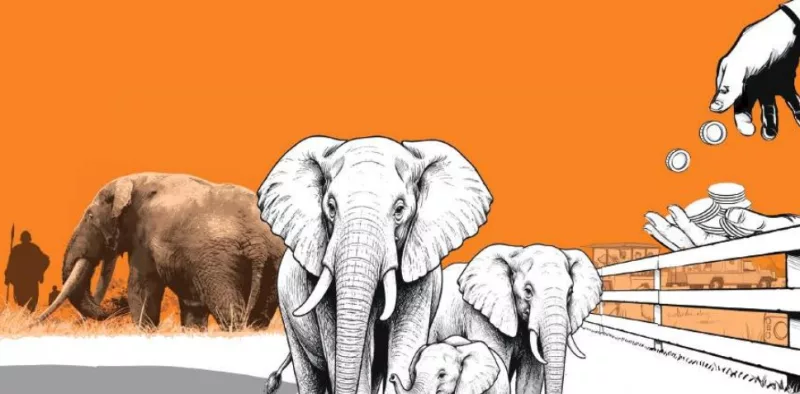
The Amboseli is famous for its large bull elephants, some of which have very large tusks. The two tusks of such a large elephant, for example, if successfully smuggled to the illegal ivory markets in East Asia, could be worth as much as $60,000 to $100,000 according to some sources.
That would be Sh7 million to Sh13 million.
If you bear in mind that these elephants can also be a constant danger to those whose villages are closest to the official game park boundaries, the question arises: why would the local communities not collaborate with sophisticated gangs of poachers to do away with this potential danger posed by elephants, even if the poachers only paid them 10 per cent of what such tusks would ultimately be worth in illegal ivory markets?
Given the high incentive that the possibility of killing a large elephant and stealing its tusks presents to the poachers, how then could this be countered with incentives to local communities which would effectively make them place a higher value on living elephants, than on the ivory of a dead elephant?
It is such
questions that effective wildlife conservation policy must address.
In any case, the interests of the local communities have to be paramount. Without their acquiescence and active participation in the conserving of these elephant populations, these elephants would be doomed.
When it comes to the KWS and the Kajiado county, their roles are essentially a matter of the management of the revenues accruing.
Here is where we find the clearest clash of incentives.
The KWS will naturally be incentivised to get as much of that money as possible for its operational costs – well-equipped game rangers have to be available at all times to confront any potential poachers with superior firepower and the more game rangers KWS can hire, the better.
But the county government, which is the institutional representative of the local communities will be even more incentivised to conclude that this money really should be directed at local priority areas, with KWS only taking a small slice of it.
Complicating matters further, within the said communities, there will be those planning to seek elective office in the 2027 general election, who will be incentivised to declare that the money from this valuable source being received by the county government, is being squandered on vanity projects and inflated contracts.