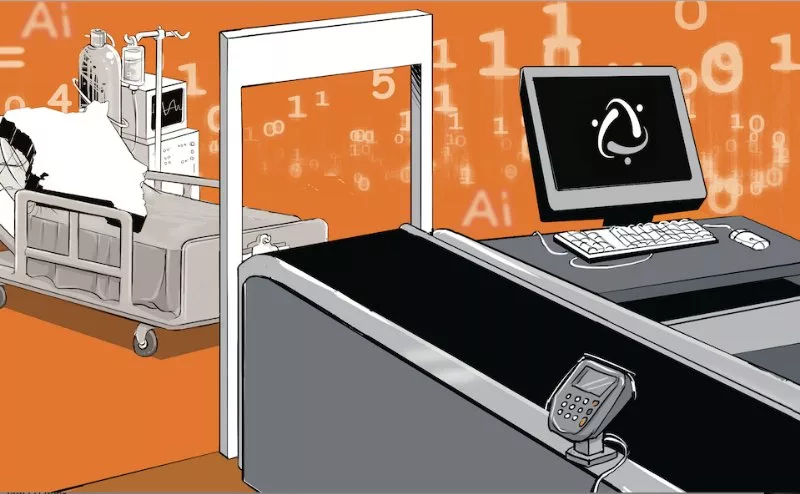
A woman with a suspected bone cancer walks into a public hospital and pays a small fee at every door. Sh50 to register, Sh50 at imaging, Sh50 at pathology, Sh50 at the pharmacy.
At each step of her care, a screen asks for the same amount before it lets her through.
That Sh50 is not the hospital's. It is a convenience fee added by eCitizen, the government's online payment system that now sits between citizens and almost every public service. On its own, it is nothing.
To a patient already borrowing to pay for scans and drugs, it is one more hand held out at one more door. In March 2025, the Auditor General said as much in a special report.
In hospitals, the fee is charged over and over in a single visit, and it falls hardest on the poor and the chronically ill, the people the government promised to protect.
But the fee is only a symptom. The real problem is that the government has lost control of the system charging it.
On paper, the state owns eCitizen. A private company built it, and in 2017, the software and contracts were handed to the Treasury.
Yet by 2023, that same company was back in control, so firmly it had to sign a fresh agreement to hand the platform over a second time.
The auditor could not explain how. And even then, the report found, the government still could not freely look inside the system, change it or secure it without the vendor.
One company had become
a single point of failure for the rail that now carries most public services.
The state owned the house but had lost the keys.
Now count how often the patient pays for the same thing. She pays first as a taxpayer, because the system was built with a World Bank loan that every Kenyan is helping to repay.
She pays a second time as a patient, the Sh50 at every door, a fee the auditor found was often wrong and, before 2023, improperly collected to more than Sh1.5 billion.
She pays a third time without ever seeing it, because the government itself pays the vendor to run the platform, on the strange logic that a state should rent a thing it already owns.
Taxed to build it, taxed to use it, taxed again to keep a private company at the controls. The technology works. What has failed is control.
This matters because we are about to repeat it, on a far larger scale, with artificial intelligence. The pitch is everywhere: import a ready-made system to diagnose patients, mark exams, screen borrowers.
But one question decides everything, the one eCitizen failed. Who holds the keys? Who can look inside the system, who can change it, who owns the data it feeds on and who can switch it off?
Look across the border. Rwanda, Africa's digital showcase, partnered in 2016 with a British firm, Babylon, to build the continent's first digital-first health service, Babyl. It worked.
Close to one in five Rwandans signed up, some two and a half million, wired into the national insurance scheme and reaching a clinician by phone. Independent researchers found it delivered faster, cheaper and better care than a clinic visit.
Then, three years into a 10-year partnership, the parent company collapsed abroad under its own debt, none of it to do with any Rwandan patient. Babyl was shut down.
Two and a half million
lost their doorway to care almost overnight, and Rwanda's Health Minister was left
in emergency meetings to save a service his government did not own. The
patients were Rwandan. The company was not. When it fell, everything built on
top of it fell too.
Kenya owns a system it cannot control. Rwanda relied on one it did not own. Different failures, the same missing thing.
The honest objection is that building your own is slow, costly and fails too, and that importing on the right terms can be legitimate and faster to the patient. That is true.
The answer is not to build everything ourselves, nor to refuse good tools out of pride, which only keeps care from the people who need it.
The answer is control, the terms that keep the keys in our hands even when the tool is someone else's. Rules and oversight agreed before a system goes live, not after the scandal.
Data kept under our own law. The right to look inside, not just admire the output. The staff to run and repair it, so that needing help does not harden into being owned. And a contract we can leave.
None of this slows progress. It is the difference between a tool a country owns and a landlord it feeds.
The measure of a digital state is not how many services it lists or how many billions move through it in a day.
It is whether the woman with a suspected cancer and an empty pocket can trust that it was built to serve her, not to bill her, and that it will still be there tomorrow.
We built a payment system and lost its keys within a decade. Our neighbour built a health service on someone else's balance sheet and lost it in an afternoon.
Artificial Intelligence will be harder to take back than either, once it is the thing holding your diagnosis. Control is not what you negotiate last. In the race to adopt AI, it is the only thing worth winning.