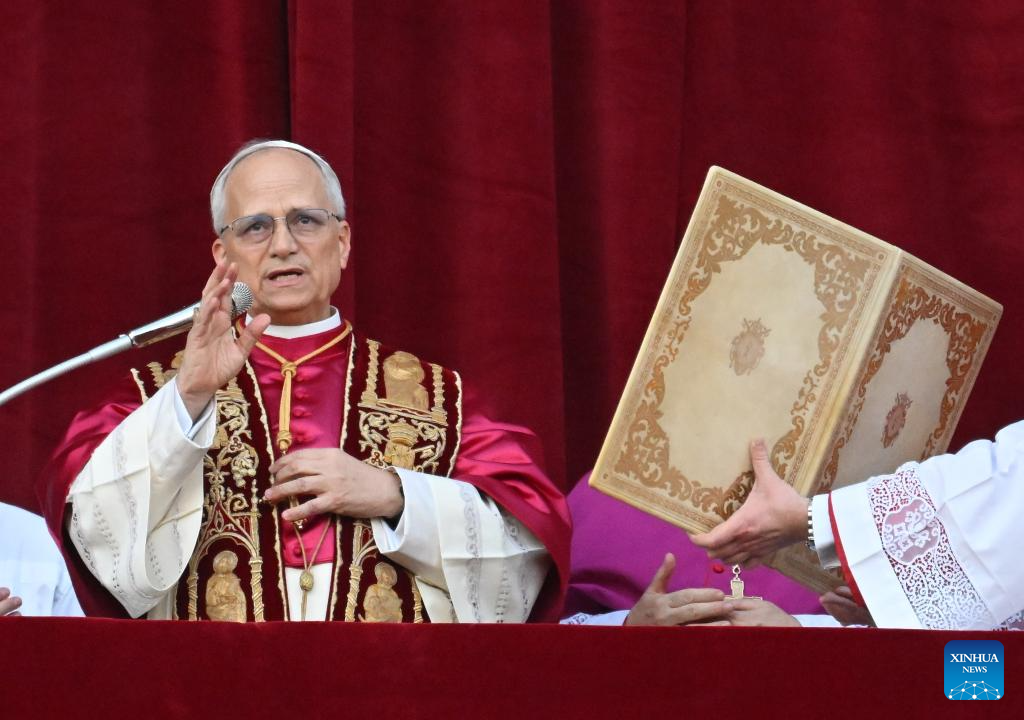
 Pope Leo XIV addresses the crowd in Vatican City on May 8, 2025. (Photo by Alberto Lingria/Xinhua)
Pope Leo XIV has used his first encyclical to deliver a sweeping moral warning on artificial intelligence, arguing that technological progress must never come at the expense of human dignity, peace and freedom.
In Magnifica humanitas: On Safeguarding the Human Person in the Time of Artificial Intelligence, released and detailed by Vatican News, the pontiff presents AI as one of the defining challenges of the modern era and calls for stronger ethical safeguards to prevent technology from dominating humanity.
The document, divided into five chapters, builds on the Church’s long-standing social doctrine while addressing emerging concerns over digital power, surveillance, warfare, inequality and the future of work.
While acknowledging the benefits of technology, Pope Leo warns that AI is not neutral because it reflects the values and interests of those who create and control it.
According to Vatican News, the Pope urges governments, corporations and societies to ensure technological development serves “the common good” and preserves what makes people human.
“Technology is never neutral,” the Pope states in the encyclical, warning that unchecked digital systems risk reducing human beings to objects of profit, productivity and control.
A central theme of the document is the protection of human dignity, which the Pope says cannot be measured by economic output or social status.
He warns against ideologies and economic systems that treat people merely as resources to be exploited, insisting that every person possesses inherent value from conception to natural death.
The encyclical also strongly defends the rights of minorities and women, calling for greater inclusion in education, employment and political life.
Pope Leo further condemns attempts to dominate or erase nations, describing any effort to subjugate a people as “gravely immoral and therefore unacceptable”.
On artificial intelligence, the Pope calls for clear regulations, ethical oversight and international accountability to govern how AI systems are developed and deployed.
He cautions that decisions about morality, justice and public life cannot be left in the hands of a few powerful actors controlling digital technologies.
According to Vatican News, the Pope warns that AI systems lack moral conscience, empathy and spiritual understanding despite their growing sophistication.
“A more moral AI is not enough if that morality is determined by a few,” he says.
The pontiff also raises concern over the environmental cost of advanced technologies, noting that AI systems consume enormous amounts of energy and water.
One of the strongest warnings in the encyclical focuses on warfare and the use of AI-driven weapons.
Pope Leo criticises the global arms race and argues that artificial intelligence risks making conflict more impersonal and easier to justify.
“There is no algorithm that can make war morally acceptable,” the Pope says, according to Vatican News.
He argues that automated warfare lowers the moral threshold for violence by turning human lives into data and making killing more detached from human responsibility.
The Pope also calls for the world to move beyond the traditional theory of “just war” and instead prioritise diplomacy, dialogue and forgiveness.
The encyclical further warns about digital manipulation, disinformation and surveillance, saying online platforms are increasingly designed to exploit human vulnerabilities and shape behaviour.
Pope Leo describes profiling and behavioural prediction as “a new form of power” that could discriminate against vulnerable groups and threaten personal freedom.
The future of work also features prominently in the document, with the Pope cautioning that AI should not force workers to adapt to machines purely for efficiency and profit.
Instead, he argues that technology should support human labour and improve people’s wellbeing without creating unemployment or deepening inequality.
The encyclical also addresses migration, describing refugees and displaced people as a “litmus test” for social justice and urging countries to provide humane and lawful pathways for migrants.
At the same time, the Pope calls on the Catholic Church itself to confront abuse, inequality and failures of accountability within its own structures.
According to Vatican News, Pope Leo says the Church must listen to victims of spiritual, sexual, institutional and economic abuse while pursuing justice and transparency.
The pontiff concludes by urging Christians to resist what he calls a “culture of power” and instead promote a “civilisation of love” rooted in truth, peace and solidarity.
Even in an age shaped by artificial intelligence, he says, humanity must not lose its moral compass.
“Even in the age of AI, we may bear witness to the grandeur of humanity, in which God has made His dwelling,” the Pope concludes.

![[PHOTOS] The new Ngong –Naivasha Road viaduct](https://cdn.radioafrica.digital/image/2026/06/64d4f771-4432-4aee-ba3c-2f304c4436ec.jpg)








![[PHOTOS] 'Mr Speaker Sir' Gen Z protester in court](https://cdn.radioafrica.digital/image/2026/06/b3e62d8e-25c3-4780-90f9-4eb48b1ce8a7.jpg)