


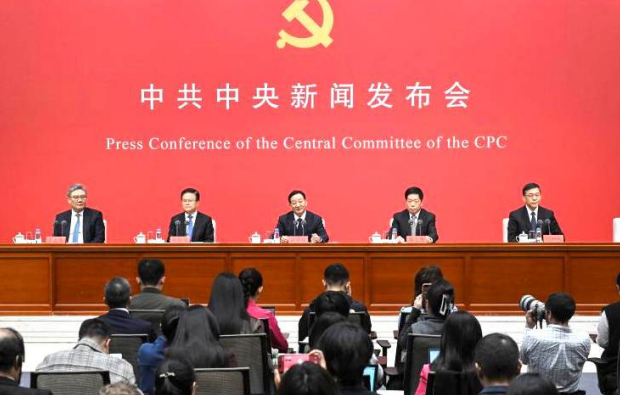
 Central Committee of the Communist Party of China holds a press conference on the guiding principles from the fourth plenary session on October 24 /XINHUA
Over the past decade, China’s population trend has
reversed dramatically, forcing the government to take drastic steps to
forestall a full-blown crisis.
Xi Jinping’s ‘The Governance of China’ series reveals
the urgency with which China is responding to the age crisis, which has been
shifting from slow growth to ongoing decline.
The book speaks to China employing a shift from
regulating the size of population to upgrading the quality of the same.
It is also keen on stabilising the size, improving the
demographic structure, and maintaining smooth flows.
China population has been on a dangerous decline, marked
by fewer births, an aging population, and huge demographic divergences.
This is the effect of the family planning policy – one
child policy, which tremendously curbed population growth.
The policy was lifted in 2015, allowing two children but
low fertility rates saw population change by a paltry 0.43 per cent in five
years.
China’s fertility rate has for years been below the set
metrics, estimated at 1.02 children per woman in 2025, one of the lowest in the
world.
Despite a review which saw families allowed to have up
to three children, high living costs, childcare expenses have discouraged large
families.
Changing social attitudes especially among the
population of reproductive age has also worsened the situation.
The median age is 40.1 years and rising. With deaths
outpacing births, UN estimates the population to fall to around 1.3 billion by
2050.
CPC is alarmed as such a long term decline presents
challenges for economic growth, healthcare systems, and pension sustainability.
It posits that the decline is nearly overstretching its
industrial workforce, therefore threatening its modernization dream, with Xi
calling for efforts to mitigate any “potential harms”.
“We should be aware that China has reached a point of
declining birth rate and population aging before realizing modernization,” Xi
said during the first meeting of the Commission for Financial and Economic
Affairs under the 20th CPC Central Committee.
China, working with NGOs, is now managing population
related work through guidance and incentives, not just regulation.
Xi also guided on catering to the “people’s expectations
for a better life”, so that the “quality of population matches with high
quality of life”.
He vouched for “sound population services that cover the
entire life cycle and all demographic groups”.
The government functionaries were directed to coordinate
aspects such as marriage, birth, childcare, education, employment, medical
care, housing, and eldercare.
To sustain the growth curve, China has refined its
policy system to boost birth rates.
Xi pledged to make childcare services accessible to all,
reinforce support policies, scale up care for children between ages 0 to 6
years, and increase avenues for financial support.
The government also deliberately allocates more
resources to relevant child support services in line with the president’s
pledge.
As such, the government has also reduced the financial
burden of childbirth, childcare, and education on families.
CPC top organs also directed relook into maternity
insurance system and expand its coverage.
Xi pledged to ensure maternity leave provisions are
fully implemented and mechanisms put in place where childcare costs are shared
by the government, employers, and families.
The president also pledged refine support policies for
housing, education, and employment in what he termed as efforts to build “a
birth friendly society”.
In a clarion call, he asked the Chinese families to
reinforce family values and traditions “to foster a new culture of marriage and
childcare”.
He also asked that wedding customs be reformed to “do
away with outdated conventions and practices such as excessive betrothal
gifts”.
In China, the government has been helping young people
in finding jobs or starting businesses to encourage them to have families.
Xi also directed that agencies safeguard women’s birth
rights and increase their employment opportunities.
To respond to the aging population, financial security
is assured ‘to ensure a meaningful and happy life for the elderly’.
In the package is a basic eldercare services, with
medical and healthcare as the crucial pillars.
The CPC top leadership has pledged to consolidate the
social security system, create a multi-pillar pension system, and adjust
medical insurance benefits.
The party leadership was thrust to the core of managing
the population and to coordinate the efforts to advance high quality population
development.
“At the local level, party and government leaders must
be personally engaged in and take overall responsibility for this work, and the
results of implementing population policies should be incorporated in their performance
assessment,” Xi stated.
The current "three-child policy and supporting
measures" framework includes financial incentives and systemic support.
There are annual subsidies for young children (e.g.,
3,600 yuan per child in some areas) and expanded tax deductions for childcare.
Other strategies include extending maternity leave,
promoting paternity leave, and banning workplace discrimination against
pregnant women.
Experts remain skeptical, saying such measures may not
quickly reverse the trend, citing failures in Japan and South Korea.
Thus the goal, as recently stated, is now to
"stabilize the scale of new births" rather than to return to high
growth.