Global fertility trends in 2025 continue to show major differences across regions, reflecting varying population growth rates, economic conditions and social dynamics.
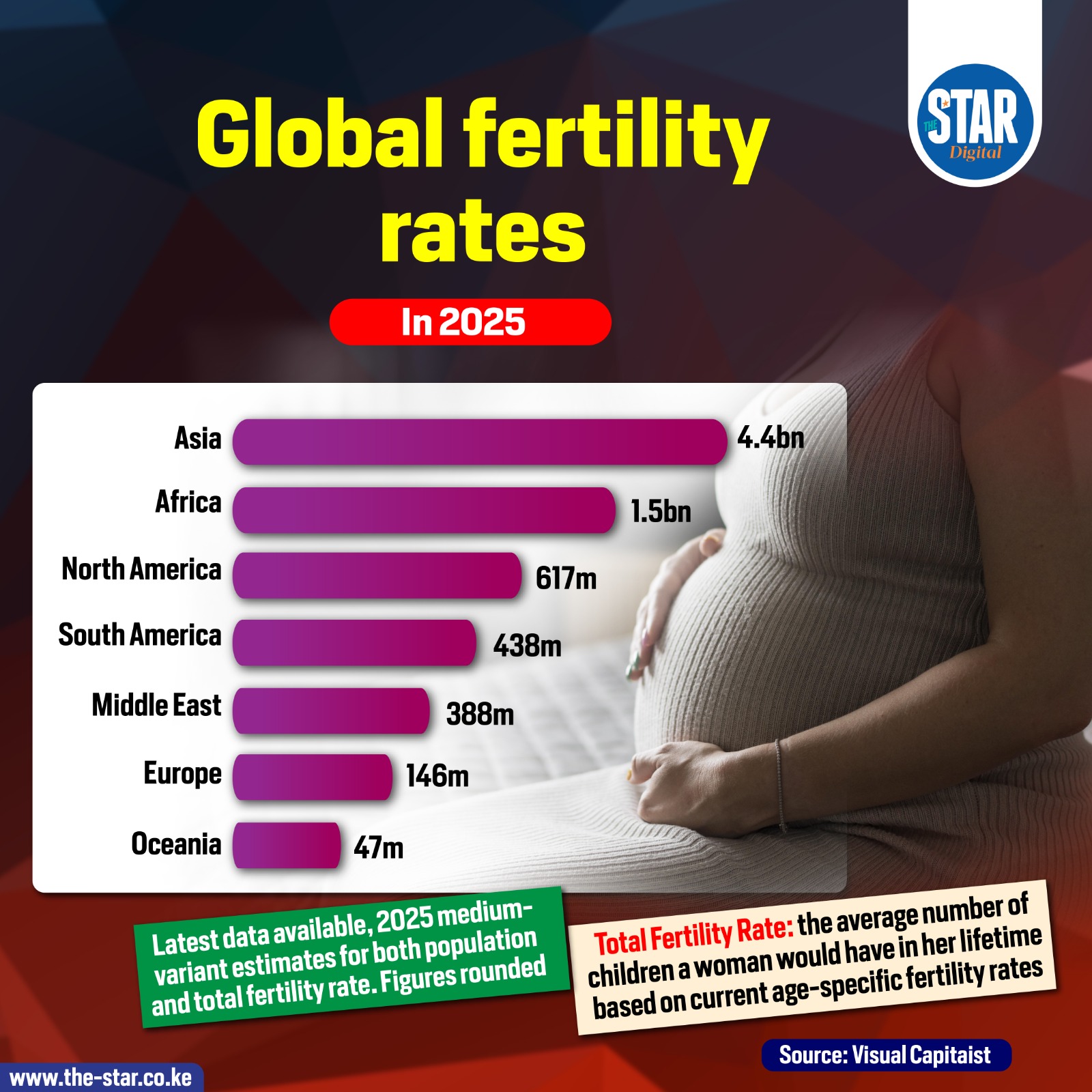
According to data compiled by Visual Capitalist, Asia remains the world’s most populous region with about 4.4 billion people, followed by Africa at 1.5 billion.
North America’s population stands at approximately 617 million, while South America has around 438 million people.
The Middle East accounts for about 388 million, Europe 146 million and Oceania 47 million.
The data also highlights the global conversation around fertility rates, defined as the average number of children a woman is expected to have in her lifetime based on current age-specific fertility patterns.
Experts say fertility rates are influenced by factors such as access to healthcare, education, urbanisation, employment opportunities and cultural practices.
Many developed regions are experiencing declining birth rates, while Africa continues to record relatively high fertility and population growth levels.



![[PHOTOS] The new Ngong –Naivasha Road viaduct](https://cdn.radioafrica.digital/image/2026/06/64d4f771-4432-4aee-ba3c-2f304c4436ec.jpg)











![[PHOTOS] 'Mr Speaker Sir' Gen Z protester in court](https://cdn.radioafrica.digital/image/2026/06/b3e62d8e-25c3-4780-90f9-4eb48b1ce8a7.jpg)