A major fuel price hike in Kenya has sparked a wave of public discontent, driving transport operators to launch a widespread strike across most towns on May 18.
The sudden economic strain has triggered sharp, polarising reactions from the country's political leadership, exposing deep divisions over who bears responsibility for the crisis.
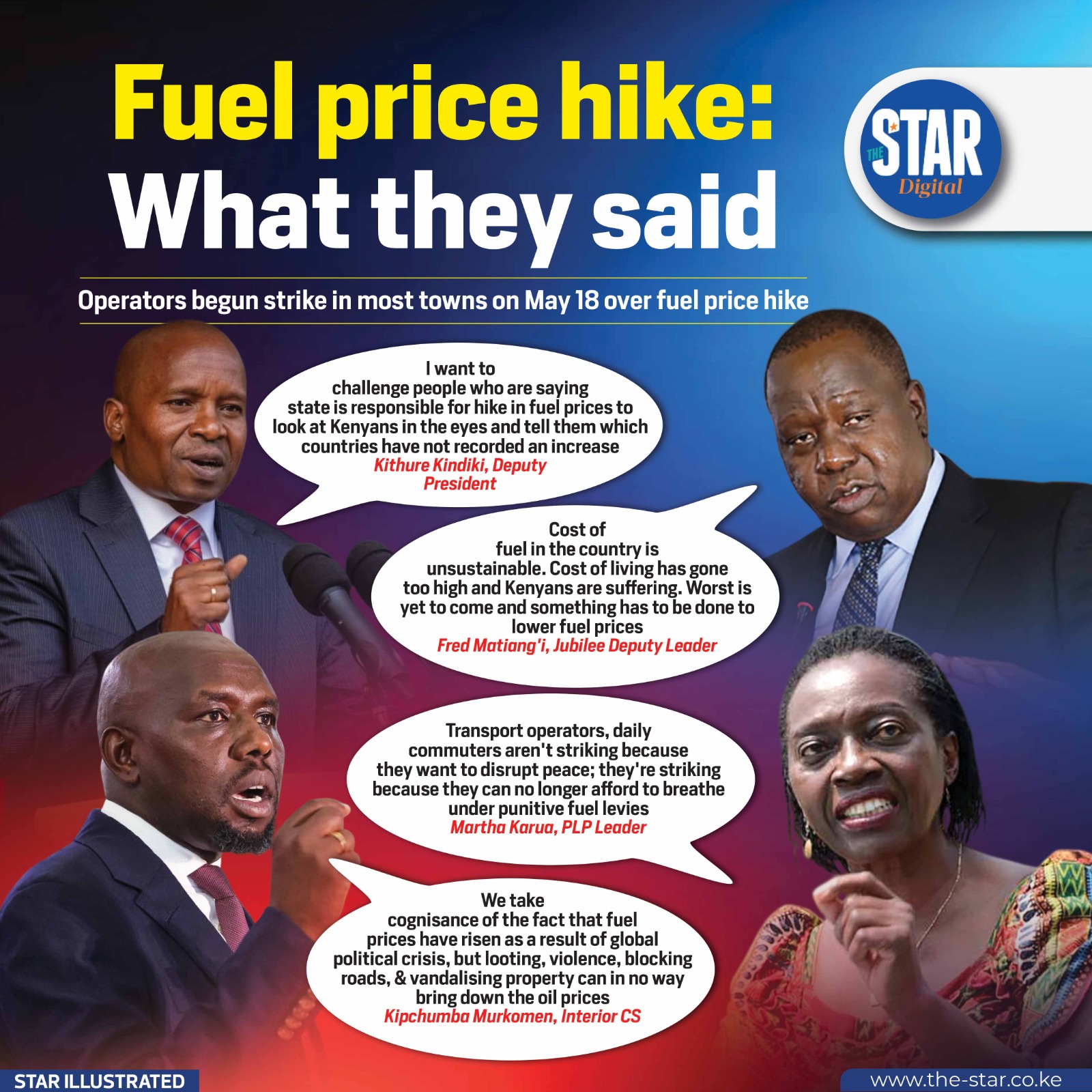
Defending the administration, Deputy President Kithure Kindiki challenged critics blaming the state, arguing that the surge is part of a global trend and pointing out that nearly all nations are recording similar increases.
Interior Cabinet Secretary Kipchumba Murkomen echoed this stance, acknowledging that the rising fuel prices stem from a global political crisis.
However, Murkomen issued a stern warning against the unfolding unrest, stating that looting, violence, blocking roads, and vandalizing property will in no way bring down oil prices.
In stark contrast, opposition figures have heavily criticized the government's approach, framing the crisis as a direct failure of governance.
Jubilee Deputy Leader Fred Matiang'i declared the current cost of fuel unsustainable, warning that the cost of living has risen too high, Kenyans are suffering, and the worst is yet to come unless immediate action is taken to lower prices.
Aligning with the striking workers, PLP Leader Martha Karua defended the demonstrations, asserting that transport operators and daily commuters are not striking to disrupt peace.
Instead, she emphasised that citizens are taking to the streets simply because they can no longer afford to breathe under punitive fuel levies, setting the stage for an intense political standoff over the country's economic direction.

![[PHOTOS] The new Ngong –Naivasha Road viaduct](https://cdn.radioafrica.digital/image/2026/06/64d4f771-4432-4aee-ba3c-2f304c4436ec.jpg)








![[PHOTOS] 'Mr Speaker Sir' Gen Z protester in court](https://cdn.radioafrica.digital/image/2026/06/b3e62d8e-25c3-4780-90f9-4eb48b1ce8a7.jpg)