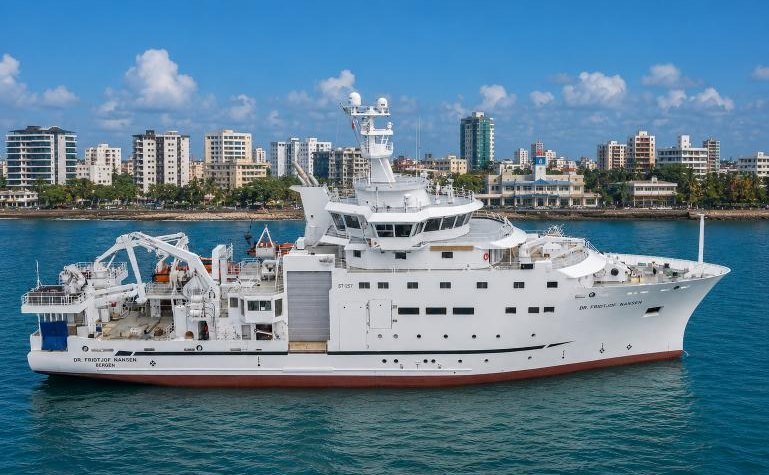
One of the highlights of the recent 11th Our Ocean Conference was a visit to the MV Dr Fridtjof Nansen, the ocean science research vessel docked at the Port of Mbaraki in Mombasa.
The Dr Fridtjof Nansen is one of the world’s most advanced ships dedicated to marine and fisheries research. It is the only ship that flies the United Nations flag.
The media was invited to a tour of the ship, a cutting-edge marine research vessel operated by Norway’s Institute of Marine Research (Havforskningsinstituttet), one of the biggest in Europe.
Our Ocean Conference has become one of the world’s leading platforms for ocean action, translating policy ambitions into measurable commitments, investments and partnerships.
Former US Secretary of State John Kerry, who addressed the historic gathering in Mombasa, launched Our Ocean Conference in 2014 to fill a then-existing gap in global ocean governance.
It is today an overarching forum for dialogue involving governments, intergovernmental organisations, academia, the private sector and non-governmental organisations (NGOs) that discusses and promotes a common vision for ocean conservation and action.
Reflecting Kenya’s role as a regional hub for ocean research, technological innovation and community-led ocean management, the Dr Fridtjof Nansen illuminated conference participants with the latest insights in marine and fisheries research.
RICH HISTORY
The vessel has a rich history in ocean science. Named after renowned Norwegian scientist, explorer and humanitarian Fridtjof Nansen, it serves as a key platform for international cooperation in ocean science and sustainable resource management.
Fridtjof Nansen was celebrated for his significant contributions to Arctic exploration and his advocacy for refugee rights. Nansen's early career was marked by a pioneering expedition across Greenland's ice sheet, and his subsequent drift across the Arctic Ocean on the ship Fram, where he provided valuable insights into oceanic currents and polar geography.
In addition to his exploratory achievements, Nansen was an accomplished scholar, serving as a professor of zoology and oceanography at the University of Christiania. His humanitarian efforts became particularly prominent after World War I, where he worked tirelessly to aid refugees and was appointed as the League of Nations High Commissioner for Refugees.
Nansen's dedication to humanitarian causes earned him the Nobel Peace Prize in 1922, which he generously donated to relief efforts. His legacy extends beyond exploration to include significant diplomatic contributions, particularly in negotiating Norway's peaceful separation from Sweden. To date, Nansen remains a symbol of integrity and strength in Norway, embodying a commitment to both scientific inquiry and social responsibility.
COASTLINE SURVEY
During the tour inside the research
vessel, the Star learned that the ship named after him is at
the heart of the EAF-Nansen Programme.
This is a partnership backed by the Kingdom of Norway through the Norwegian Agency for Development Cooperation (Norad) that supports developing countries to improve the management of marine resources through scientific research.
Dr Fridtjof Nansen has been conducting a survey along the Kenyan coastline with scientists from the Kenya Marine and Fisheries Research Institute (KMFRI) under the Ministry of Mining, Blue Economy and Maritime Affairs, the Royal Norwegian Embassy and the Food and Agriculture Organisation (FAO) partnership.
The vessel has also conducted surveys in Madagascar, Port Louis in Mauritius and the coasts of East and West Africa. President William Ruto visited the vessel, straight from attending the G7 Summit, before he officiated at the closing ceremony of the Our Ocean Conference.
A year ago, Mbaraki welcomed Dr Fridtjof Nansen for the 50th anniversary of the EAF-Nansen Programme — the longest running fisheries development initiative of FAO and Norway to celebrate achievements and confront emerging challenges in sustainable ocean management.
For Kenya, this arrival was a homecoming of sorts. It was one of the first countries visited by the original research vessel, five decades ago.
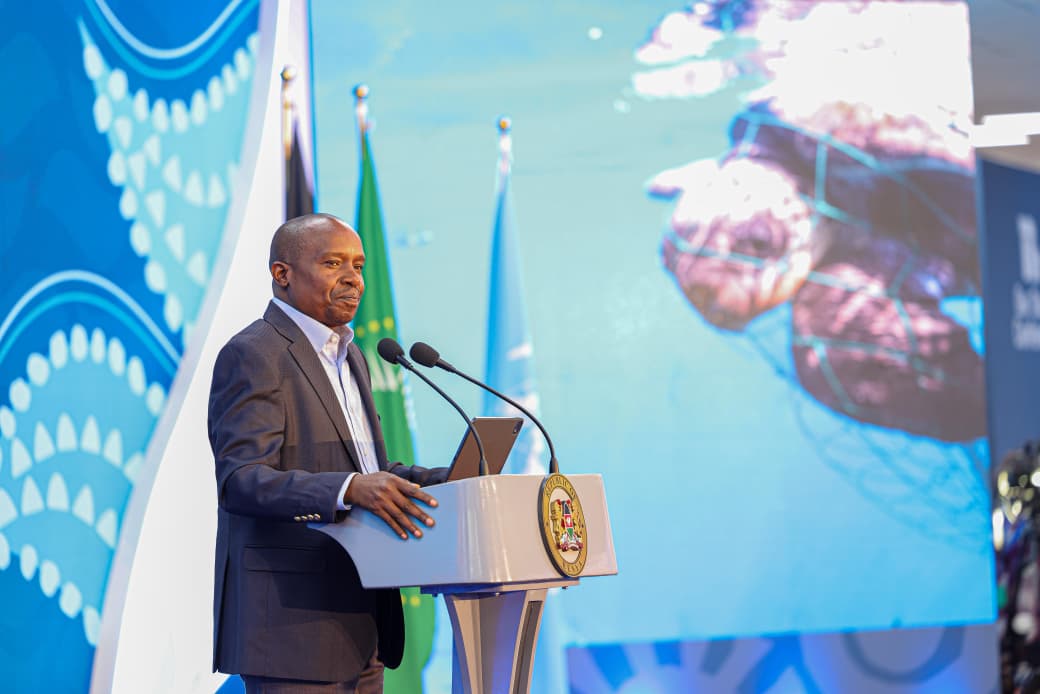
11th Our Ocean and African Ocean Governance ministerial meeting chairman, Mining, Blue Economy and Maritime Affairs CS Hassan Joho, said Kenya is committed to charting new frontiers in pursuit of a science-driven, sustainable blue economy.
Blue Economy PS Betsy Njagi called for concerted efforts to study the ocean.
“There is a need to deepen collaboration among government, academia, the private sector and our development partners and to engage youth and institutions in marine science and innovation to drive sustainability, technology and resilience,” she said.
The current Dr Fridtjof Nansen is the third vessel to carry the name and began operations in 2017, replacing its predecessor. It has continued a research legacy that dates to 1975.
The first ship launched in 1974 operated for nearly two decades, while the second entered service in 1993 and travelled more than 605,000 nautical miles before being retired in 2016.
STATE-OF-THE-ART
The $80 million (Sh10.3 billon) vessel was designed by Norwegian ship design company Skipsteknisk and built by Spanish shipyard Astilleros Gondan.
Its builders describe it as “a super-silent scientific research platform whose propulsion configuration, laboratory and working deck layout are purposely designed and built to comply with ICES CRR 209, the most restrictive standard for vessel underwater noise control.
“Thanks to its wide range of cranes, winches and miscellaneous deck equipment, Dr Fridtjof Nansen can conduct complex, multidisciplinary, multi-investigator research both through direct observation as well as through the deployment of autonomous vehicles and installations.”
Dr Fridtjof Nansen is equipped with state-of-the-art scientific technology designed to study marine ecosystems in detail. Its operations cost about Sh5 million daily.
Measuring 74.5m in length and 17.4m in breadth, the vessel was constructed to meet stringent international standards that minimise underwater noise, ensuring accurate scientific observations.
On board are several specialised laboratories, including facilities for fish and plankton analysis, oceanographic research, climate studies, seawater testing and photographic documentation. It houses a large operations centre, offices, a library and dedicated scientific workspaces.
Its scientific equipment includes advanced water-sampling systems, weather-monitoring instruments, acoustic sensors and sonar technologies capable of mapping the ocean floor and tracking marine life at various depths.
These tools allow researchers to assess fish stocks, monitor ocean conditions and study marine biodiversity with a high degree of precision.
The vessel also features sophisticated echo-sounding systems, acoustic current profilers and high-definition underwater cameras that support real-time observation and data collection during research missions.
It also measures salinity through a primary conductivity, temperature, depth (CTD) oceanographic instrument. Its equipment calculate salinity indirectly by measuring the electrical conductivity of seawater, while simultaneously recording temperature and depth (pressure).
NAVIGATION
SYSTEM
Capt Aron Hapoldoy showed the visiting journalists the main navigation system and the ship’s echo-sound and acoustics equipment that send signals deep into the sea and estimate the biomass of fish.
“However, we don’t have the multibeam mapping equipment for bottom mapping of the sea, which is very expensive,” he told the Star.
The soundproofed vessel produces its own electricity and freshwater.
Capt Hapoldoy is a prominent Norwegian shipmaster who has commanded the vessel on numerous international development and scientific surveys. His global expeditions with the Dr Fridtjof Nansen have sailed to various international ports, including stops in Myanmar, Sri Lanka and Western Africa.
KMFRI chief research scientist Dr Gladys Okemwa, who accompanied Capt Hapoldoy, praised the vessel’s achievements in ocean science research, especially in biological taxonomy (the filing system for all life on Earth) and comparisons in different fish species.
Research in the vessel has led to the identification of 91 new fish species globally for the first time after 42 years, she said.
The vessel’s flow meter also monitors climate change and has uncovered a collection of microplastics (tiny plastic fragments smaller than 5mm) suffocating fish.
Microplastics are a severe and pervasive crisis in the marine environment. An estimated 1.3 million metric tons enter the oceans annually. They originate from degraded macro-plastics, tire wear, synthetic textiles and cosmetic microbeads, and now threaten more than 1,200 marine species.
Microplastics are a danger to human health. They enter the body through contaminated seafood, drinking water and the air. Ongoing research indicated that exposure is linked to oxidative stress, cellular damage and immune system disruption.
Dr Okemwa says the survey is being conducted along the 536km Kenyan coastline, stretching from the Kiunga National Reserve near the Somalia border in the north to the fishing village of Vanga at the Tanzanian border in the south.
“The fisher resource and ecosystem survey found fish stocks are increasing. The October-April closure of fishing aligning with the monsoon cycles protected spawning mother fish and enhanced fish stocks, allowing depleted marine stocks to recover,” he said.
KMFRI research scientist Justus Andati said in the survey, they conduct fish species validation, name the fish and compare taxonomies and biological aspects.
On display in the vessel were Shark, Tuna, Pufferfish, the luminous blue-scaled Parrotfish, Kingfish (Nguru), Smallfin Gulper Shark and the Flatfish, which lives at the bottom of the ocean.
As the tour of the vessel ended, its crew of 15 and the Kenyan research scientists expressed satisfaction with the increased sampling intensity of second survey of the Kenyan coastline that obtained good data, soon to be showcased.
Meanwhile, the Dr Fridtjof Nansen continues with its mission of promoting the ecosystem approach to advanced ocean science research on pollution, marine biodiversity and capacity development for policymakers and scientists.
The world’s principal ocean science research ship is training experts in sustainable fisheries management, monitoring fisheries resources and the environment, advancing ocean science, mitigating climate change impacts and safeguarding the ocean.