Dangers of informal e-waste recycling
May cause adverse health effects in children
a y agoHillary BettInfographics
Brian Otieno recycles plastic and glass waste into stylish home decor


Audio By Vocalize
Things are slowly changing, however, one step at a time. If you wander down the right alley, you’ll smell the distinct scent of melting glass and hear the rhythmic clinking of a hammer shaping metal.
In this simple outdoor workshop buzzing with activity, a quiet yet determined movement is taking shape. Led by artist and environmentalist Brian Otieno, his small workshop, Ultimate Art Stores Nairobi, is more than just a business, it’s a quiet revolution.
Using tools like pliers and blowtorches instead of protests, he and his group have tackled waste since 2011. The items that once blocked drains and fuelled toxic fires are now being carefully transformed into valuables.
Early on a bright Friday morning, we meet the artist behind this change. He works with focus similar to that of an orchestra leader conducting music. His eyes scan over a pile of plastic jerricans and glass bottles shining in the sunlight.
To him, this isn’t ‘taka taka’, as residents used to call it, it’s an artist’s palette.
“It took a while for locals to get what we aimed to create here,” he says proudly, while watching a young apprentice heat the neck of a bottle. His eyes track the change happening before them as the dirty glass starts to glow with promise.
“But now,” he adds with a slight smile, “they’re starting to notice, too. You can sense the shift in the air and on cleaner streets. That change in our community, it fills me with pride.”
HOW HE STARTED
Otieno’s journey began in 2011, fuelled by environmental concern and an artist’s view.
“I looked around and saw plastic everywhere. It clogged our drains and when it rained, floods would come,” he says.
“People burned it and kids got sick from the smoke. I felt like I had to use my art for something.”
He sensed that the ugliness hid beauty inside it. He began collecting, which was met at first with bemusement.
“People thought we were mad,” he recalls. “They would ask me, ‘Why are you picking up our garbage?’ as they wondered if bottles could be used to build a house. They couldn’t see what we saw as valuable.”
Nowadays, that worth is becoming undeniable and shows up as intricate flower vases, drinking glasses and shiny mosaics, which are slowly finding their way into homes throughout the city.
The workshop has turned into an informal hub for teaching about the environment, where talks on conservation often accompany the delivery of a bag full of bottles.
Otieno is confronting a crisis of a staggering scale. As of 2025, Kenya generates more than 22,000 tonnes of solid waste daily, with Nairobi contributing about 3,500 tonnes, according to Nema and the Kenya National Bureau of Statistics.
A significant portion of this waste is non-biodegradable, dominated by plastics, glass and metal, which persist in the environment for centuries.
In densely populated neighbourhoods like Kayole, this waste clogs drainage systems, intensifying seasonal flooding and damaging infrastructure.
The situation is worsened by the widespread practice of open burning, which releases carbon dioxide, dioxins and fine particulate matter (PM2.5) — pollutants linked to respiratory illnesses, cardiovascular diseases and climate change.
According to Nema’s 2024 enforcement update, such practices are now under stricter surveillance, with penalties for non-compliance at designated dumpsites.
This isn’t just an environmental challenge, it’s a public health emergency unfolding quietly across urban Kenya.
WASTE ECONOMY
Otieno’s efforts are a direct, hands-on challenge to these numbers. The artist has set up a group of young boys to serve as first responders by building a small economy centred on collecting waste.
“Liquor bottles are what we go around picking,” he says. “I just get together with local boys. They collect for me and then I pay them.”
This system offers a crucial income source for young people and directly cuts down on the amount of waste that would otherwise linger in the environment for hundreds of years.
When it comes to plastic jerricans, which are central to his creations, acquiring them is more deliberate.
“For jerrican art, buying is the only choice. We don’t find them in trash bins,” he says while showing off a brightly coloured container.
He has tapped into a unique market: small, fast-food joints that use 5-litre jerricans for sauces and need to get rid of them. Otieno is offered them at throwaway prices.
“Someone might approach you and say they have 200 available, just bring 200 or 500 shillings to pick them up,” he says.
This hands-on, circular approach is reshaping how folks in Kayole view environmental issues and aligns with national goals even before they’re fully achieved.
Recognising the severe waste problem, the Kenyan government enacted the Sustainable Waste Management Act in 2024. This law mandates separating waste at its origin.
Despite this, the KNBS reports that recycling rates remain under 10 per cent, highlighting a significant gap between policy and action.
Otieno’s workshop addresses that gap. The people who live in Kayole feel the effects most. Pamela Otin, who has lived in the community for a long time, has seen the change for herself.
“Before this work became well-known, this place was full of plastic waste,” she says. “You would see kids burning plastic and the smoke would be everywhere.”
The channels are clearer now. There is less random dumping. People are thinking twice before they throw.
CHANGING LIVES
Otieno’s workshop has proven helpful and empowering to residents. They no longer see used jerricans as rubbish but as a potential asset.
“Rather than trying hard to dispose of these things or even paying someone to remove them, I just keep them aside,” Lilian Olocho says.
“Once I gather enough, I bring them to the artist. It’s a small income for my family, but more importantly, it has made getting rid of waste easier. We’re discovering that what we call ‘waste’ actually holds value.”
Wendy Nelly says the habit is transforming daily life at home. “My kids remind me to save the bottles and jerricans for ‘the artist’,” she says. “They see it as a way to earn a bit of money, but more crucially, they’re learning something about their surroundings.”
In the workshop, changing items involves an intriguing blend of rough and refined art techniques. The gentle sound of a gas kiln fills the air. Glass bottles are marked, heated up and skilfully reshaped.
A bottle’s base turns into an elegant drinking glass, while its curved part transforms into an attractive serving bowl. A collection of broken green glass pieces comes together under skilled hands to form a stunning mosaic that plays with light beautifully.
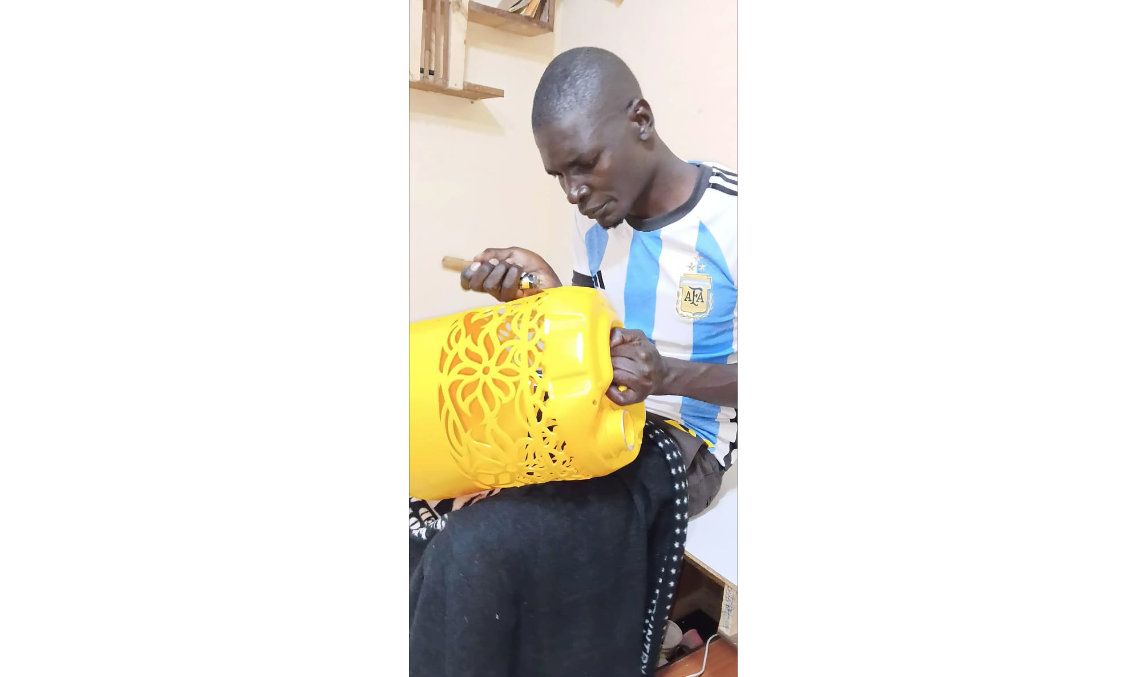
“The jerricans are a different story,” the artist says, holding up a brightly coloured plastic container.
“We cut, we sand, we melt and we shape.”
That plastic that used to hold water or oil for a few weeks can now last for decades as a sturdy flower vase, a one-of-a-kind lampshade or a set of colourful coasters.
“We don’t just recycle, we also upcycle,” Otieno says. “We’re giving it a new life that’s more beautiful.”
The things that were once just useful have turned into a wide range of stylish home decor. Carol Rody, a sales associate, runs the small showroom at the workshop. It is a sign of how things have changed.
“Our clients are often amazed when they learn the origin of the pieces,” she says, arranging a set of jewel-toned vases.
“They see the beauty and quality first. The fact that it’s made from waste, that it has a positive environmental story, is a powerful bonus.”
FUTURE PLANS
Otieno’s vision now stretches beyond his workshop’s walls. Recently, he taught an apprentice from Migori county, equipping him with the skills and knowledge to replicate this circular economy model in Western Kenya.
The apprentice, Nixtone Ambiche, has begun a similar business on the side, indicating that this grassroots approach might spread.
Otieno is happy to have inspired him. “I was in his shoes once, seeing a problem but lacking the tools to solve it,” he says.
“That’s why I’m so keen to pass on this knowledge. Teaching someone these skills is more than just giving them a job. It’s offering them a new perspective on the world and a practical way to change their own economy and environment.”
With this success as a foundation, his future plans are bold and clear. He envisions creating a larger training centre, a place where more young people from around the country can learn about upcycling.
“If we can find more space and additional equipment,” he says, “we can take on more apprentices.”
His plan is to expand the human network central to this model.
“We must train additional trainers, who can return to their regions and set up their own centres,” he says.
“This way, we can tackle more of this waste and convert it not only in Kayole but everywhere.”
One bottle at a time, one jerrican at a time, the Kayole story is being rewritten. The collective clatter of creation is taking the place of the silent acceptance of a contaminated environment. This workshop serves as a potent, living model, demonstrating that innovation, community and a fundamental rethinking of value can overcome even the most formidable environmental obstacles.
A finished vase, a discarded bottle and a gathered jerrican are not isolated items in this context. They are the steadfast, unwavering pulse of a community that is deciding to create a new, cleaner future for itself, one in which each piece of trash has the capacity to be beautiful, meaningful and a meaningful second chance.
May cause adverse health effects in children