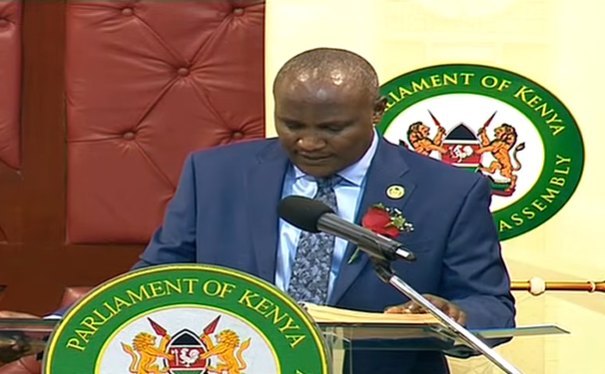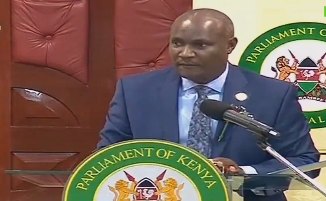
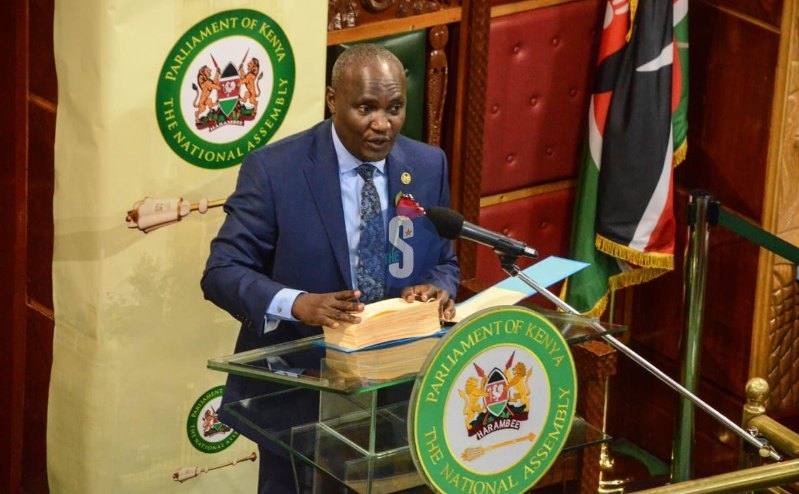
The government will increasingly rely on private capital, public-private partnerships and proceeds from the sale of state assets to fund major infrastructure projects as it seeks to reduce dependence on borrowing and ease pressure on public debt, Treasury Cabinet Secretary John Mbadi has said.
Presenting the 2026/27 Budget Statement in Parliament, Mbadi said Kenya is changing its approach to financing development amid growing fiscal constraints and rising debt-servicing obligations that have squeezed spending on critical sectors such as health, education and social protection.
“Kenya's infrastructure financing deficit stands at approximately USD 5 billion every year. Our development budget, while growing, cannot close that gap alone,” Mbadi said.
“The era of financing every road, every power line, and every dam through government borrowing and taxation is over, not because we lack ambition, but because we have learnt from the consequences of that model.”
The CS said debt-financed infrastructure had left the country with heavy repayment obligations that continue to crowd out resources needed for essential public services.
To address the challenge, the government is shifting towards enhanced use of Public-Private Partnerships (PPPs) and the newly established National Infrastructure Fund (NIF), which will mobilise private investment for priority infrastructure projects.
“We are shifting from a model where Government borrows to build, to enhanced use of Public-Private Partnerships and the recently established National Infrastructure Fund in funding priority infrastructure through private sector finances,” Mbadi said.
The NIF, established in March this year following the enactment of the National Infrastructure Fund Act, 2026, is expected to become a key vehicle for financing large-scale infrastructure projects while reducing reliance on taxation and public debt.
According to Mbadi, the fund will pool resources from diverse sources including pension funds, sovereign wealth funds, private equity firms, banks and development finance institutions to support commercially viable projects.
The government expects the fund to finance investments in roads, airports, seaports, electricity generation, information and communications technology, water projects and irrigation schemes.
A significant portion of the fund's initial capital will come from the privatisation of state assets.
Mbadi disclosed that proceeds from the Kenya Pipeline Company (KPC) initial public offering conducted in March this year, which raised Sh106.3 billion, will form part of the seed capital for the fund.
The government also expects to inject an additional Sh204 billion from the planned partial divestiture of its stake in Safaricom to South Africa-based Vodacom.
“In this respect, proceeds from privatisation will be channelled into the fund, thus ensuring transparent revenue flow in financing national priority projects,” the CS said.
The Treasury believes the new financing model will help bridge the country's infrastructure funding gap while attracting long-term domestic and international investors into strategic projects.
Mbadi pointed to the ongoing Rironi-Nakuru-Mau Summit Expressway as an example of the new approach to infrastructure financing.
He said the project is being financed through a partnership involving the National Social Security Fund (NSSF) and international investors, reducing the need for direct government borrowing.
“What makes this project truly historic is not the speed of delivery; it is how it was financed,” Mbadi said.
“Through the participation of the National Social Security Fund both as a debt and equity investor alongside international investors, a major national highway is being built with Kenyan capital, by Kenyan workers, for the Kenyan people.”
Beyond infrastructure financing, the government is also banking on stronger domestic revenue mobilisation and expenditure reforms to sustain public spending and reduce fiscal deficits.
Mbadi said the fiscal policy framework for the 2026/27 financial year is anchored on a fiscal consolidation strategy aimed at supporting the Bottom-Up Economic Transformation Agenda while safeguarding debt sustainability.
The Treasury projects that the fiscal deficit will gradually decline from 5.5 per cent of GDP in the 2026/27 financial year to 3.3 per cent by 2028/29.
“The strategy will be supported by continuous domestic revenue mobilisation and expenditure rationalisation through targeted tax and expenditure reforms,” Mbadi said.
The budget comes at a time when Kenya continues to face mounting pressure to contain public debt while financing development programmes and meeting growing demands for public services.
The government has in recent years faced criticism over rising debt levels and the increasing share of revenue allocated to servicing loans.
By leveraging private capital and monetising public assets, Treasury hopes to unlock new funding streams for development while easing the burden on taxpayers and protecting the country's fiscal sustainability.
The strategy marks one of the most significant shifts in Kenya's development financing model in recent years, signalling a move away from debt-driven growth towards greater private-sector participation in funding national projects.
Mbadi has projected total government revenue collections of Sh3.63 trillion in the 2026/27 financial year.
He said the projected revenue represents 17.4 per cent of the country’s Gross Domestic Product (GDP).
Of the total revenue target, ordinary revenue is expected to contribute Sh2.99 trillion, equivalent to 14.3 per cent of GDP, while Appropriations-in-Aid are projected at Sh644.8 billion, accounting for 3.1 per cent of GDP.
The government also expects to receive grants amounting to Sh43.6 billion, equivalent to 0.2 per cent of GDP.
The total government expenditure for the financial year beginning July 1, 2026, is projected at Sh4.82 trillion, representing 23.2 per cent of GDP.
A significant portion of the expenditure will go towards recurrent spending, which is projected at Sh3.57 trillion or 17.1 per cent of GDP.
Recurrent expenditure largely caters for salaries, pensions, debt servicing and the day-to-day running of government operations.
Development expenditure has been allocated Sh750 billion, equivalent to 3.6 per cent of GDP.
County governments are set to receive Sh502 billion in shareable revenue from the national government.