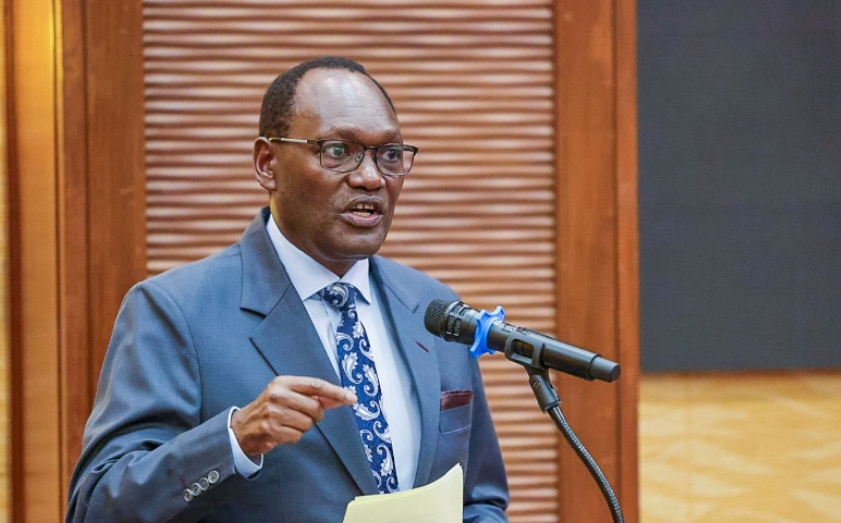
 COTU Secretary General Francis Atwoli./HANDOUT
The Central Organisation of Trade Unions (COTU-K) has launched a spirited defence of the National Social Security Fund (NSSF), accusing sections of the private pension industry of orchestrating a misinformation campaign aimed at undermining the state-run retirement scheme.
In a strongly worded statement signed by Secretary General Francis Atwoli, COTU claimed that some private pension players are engaging in "misinformation, skulduggery and fearmongering" to mislead workers and frustrate the growth of NSSF into what it described as a strong and competitive national social protection institution.
The workers' umbrella body said the opposition to the implementation of the NSSF Act, 2013, is largely driven by commercial interests rather than genuine concern for workers.
"COTU (K) has reason to believe that most of the noise currently being generated around the implementation of the NSSF Act of 2013 is not motivated by concern for workers, the sole beneficiary of the enhanced benefits, but by commercial interests of some private insurance schemes determined to preserve their long-standing dominance over workers' retirement savings," the statement said.
The union argued that the emergence of a stronger, better-performing and better-regulated NSSF has made some private pension providers uncomfortable because it is increasingly competing for the confidence of Kenyan workers.
COTU traced the origins of NSSF to 1965, when the government under founding President Jomo Kenyatta, with support from then Cooperative Development Minister Masinde Muliro, established the fund to protect workers against old-age poverty.
According to the union, NSSF remains Kenya's primary social security pillar and is aligned with international labour standards, including ILO Convention No. 102 on Social Security and ILO Recommendation No. 202 on Social Protection Floors.
COTU also took aim at the Association of Pension Trustees and Administrators of Kenya (APTAK), cautioning pension providers and their umbrella organisations against what it termed deliberate attempts to create confusion over the role of NSSF, the status of the NSSF Act and recent Court of Appeal developments.
The union specifically singled out APTAK Secretary General Boniface Mwangangi, warning that it would expose what it called "anti-worker positions, contradictions and commercial interests" if the alleged campaigns continue.
COTU further criticised the Agricultural Employers Association (AEA) for issuing a circular advising employers to abandon the enhanced NSSF contribution framework and revert workers to the old Sh200 contribution regime.
The union termed the move "dishonest and unfortunate", arguing that it particularly disadvantages vulnerable and low-income workers in the agricultural sector.
It also questioned the legality of the AEA's position, noting that the same circular reportedly advises employers who had opted out of Tier II contributions to continue remitting funds to private retirement benefit schemes established under the very NSSF Act they now oppose.
COTU defended the enhanced contribution framework, saying workers should embrace Tier II contributions because NSSF has recently posted some of the strongest investment returns in its history.
The union said the fund recorded returns of approximately 11 per cent in the 2023/24 financial year and 17 per cent in the 2024/25 financial year, performance it said many pension schemes would envy.
At the same time, COTU claimed it had become aware of what it described as a coordinated anti-NSSF campaign by the Association of Retirement Benefits Schemes (ARBS).
The union cited a February 23, 2026 letter by ARBS chairperson Jane Nzau, alleging that it called for resource mobilisation and strategic alignment aimed at stifling the growth of the NSSF.
Despite its criticism of private pension providers, COTU said it is not opposed to private retirement schemes but would not remain silent when workers are allegedly misled into believing that NSSF threatens retirement security.
The union further argued that even if all private pension schemes ceased operations, the State would still retain a constitutional obligation to provide social security under Article 43 of the Constitution.
"Retirement savings of workers belong to workers and not to private pension interests or financial intermediaries," COTU said, vowing to continue defending NSSF as a critical pillar of social protection and champion reforms that guarantee dignity in old age for Kenyan workers.