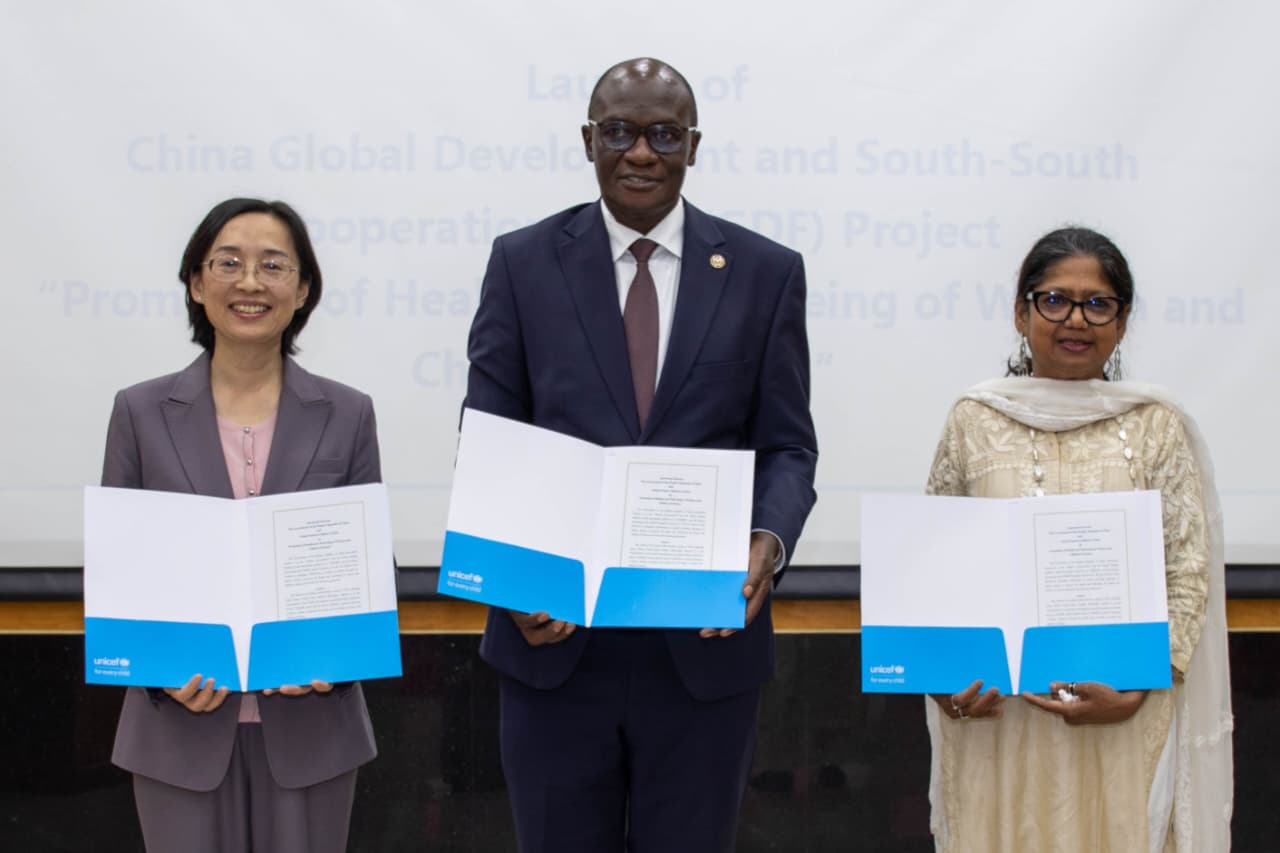
The Chinese government, in partnership with UNICEF, has launched a major maternal and child health initiative aimed at reducing preventable deaths among mothers and newborns in Kenya’s most vulnerable counties.
The Sh390 million programme, funded through the China Global Development and South-South Cooperation Fund (GDF), will target Garissa, Wajir and Mandera counties, where maternal and neonatal mortality rates remain significantly above the national average due to limited access to healthcare services.
The project, officially titled “Promotion of Health and Well-being of Women and Children in Kenya,” was launched in Nairobi on Tuesday and is expected to directly benefit more than 652,000 people while reaching an additional 630,000 indirectly.
Speaking during the launch, Chinese Ambassador to Kenya Guo Haiyan said the initiative reflects China’s long-term commitment to global development cooperation and Africa’s health agenda under the Global Development Initiative (GDI).
“Maternal and child health cooperation has always been a key priority of Global South cooperation as it serves to protect basic human rights and safeguard human dignity,” she said.
Ambassador Guo said the programme is not an isolated intervention but part of a broader framework of South-South cooperation that China has expanded over the past five years.
“The implementation of this project fully embodies the vision of China’s Global Development Initiative proposed by President Xi Jinping in 2021,” she said.
“It is not a castle in the air; it delivers real benefits.”
She noted that China has mobilised more than USD 23 billion under the GDI framework globally and scaled up its Global Development and South-South Cooperation Fund to support hundreds of projects across more than 60 countries.
Guo added that the Kenya initiative follows agreements reached during President William Ruto’s state visit to Beijing in 2025, where both countries committed to strengthening cooperation in health and development.
“We are ready to work hand in hand with UNICEF and the Ministry of Health to ensure high-quality, people-centred delivery of this project,” she said.
She outlined three key pillars of the programme: demand-driven cooperation, capacity building and strict project accountability.
“First, we will ensure precision cooperation based on actual needs,” she said.
“Second, we will invest in capacity building of health workers. Third, we will uphold strict and standardised management of resources.”
She added: “An African proverb says, ‘A friend is someone you share the path with.’ China is committed to walking this path with Kenya.”
UNICEF’s Representative to Kenya Shaheen Nilofer welcomed the partnership, saying it will strengthen health systems and improve service delivery for women and children.
“This partnership helps us turn commitments into practical action where it is needed most,” she said.
“There is no doubt that this alignment sets the stage for real change.”
She noted that the programme will strengthen maternal and newborn care systems, improve nutrition, education, emergency response and expand access to essential services.
“China has been a valuable partner over the years, supporting programmes across Africa and Asia,” she said. “This support is helping UNICEF expand life-saving services for vulnerable children.”
Nilofer said the project will strengthen health systems in high-need areas and help close persistent inequality gaps.
“The budgeted project will reach over 652,000 beneficiaries directly and more than 630,000 indirectly,” she said.
She added that the initiative is aligned with Kenya’s broader development agenda.
“This is about closing gaps, not only improving services, but ensuring those services reach every family,” she said.
Speaking on behalf of Health Cabinet Secretary Aden Duale, Director General of Health Patrick Amoth said the initiative complements Kenya’s national reforms aimed at reducing maternal and newborn deaths.
“The Government of Kenya expresses sincere appreciation to the Government of China for this investment in the health and well-being of women and children,” he said.
He noted that while Kenya has made progress in maternal and child health, significant inequalities remain, especially in arid and semi-arid lands.
“Some counties continue to experience unacceptably high maternal mortality rates. These deaths are preventable and must be addressed collectively,” he said.
Amoth highlighted ongoing government interventions, including increased health financing, recruitment of health workers and expansion of maternal health services under the Social Health Authority.
He said the project will directly support Kenya’s Rapid Results Initiative on maternal and newborn survival.
“The programme focuses on strengthening health systems, improving emergency readiness, and equipping facilities with essential commodities,” he said.
He added that community health systems will play a central role in the initiative.
“Community health promoters will support early identification of pregnancies, referrals, and promotion of healthy behaviours,” he said.
The project will also strengthen water, sanitation and hygiene (WASH) systems in health facilities to reduce infections that contribute to maternal and newborn deaths.
Newborn deaths are mainly attributed to prematurity, birth asphyxia and neonatal infections.
The intervention is therefore designed to improve outcomes by strengthening primary healthcare systems, upgrading facilities and training health workers.
The programme also prioritises data systems and accountability, enabling counties to track progress and respond quickly to emerging gaps.
The launch comes at a time when Kenya is accelerating efforts to achieve universal health coverage and reduce regional disparities in healthcare access.
“Together, we are bringing hope where it is needed most,” Nilofer said, adding that every mother deserves to survive childbirth, and every child deserves a healthy start to life.