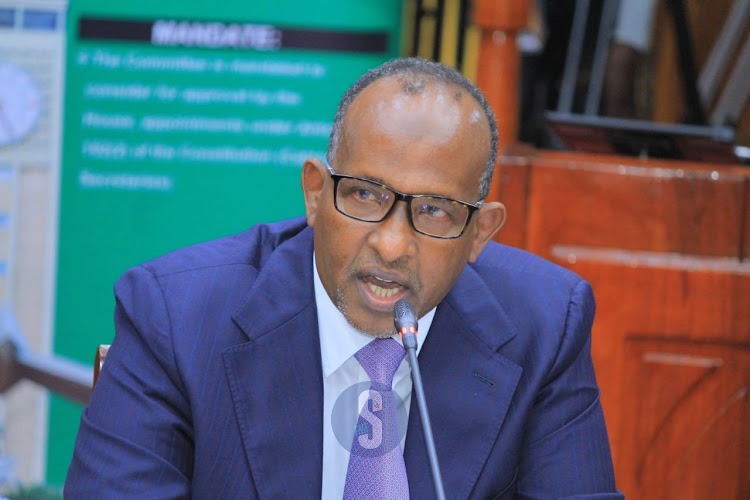
 Health CS Aden Duale/FILE
Health Cabinet Secretary Aden Duale has defended the government's Ebola preparedness measures, saying authorities do not require public consultation before implementing interventions aimed at protecting the country from a potential outbreak.
Speaking in Parliament on Wednesday, Duale said the government has a constitutional and legal obligation to act swiftly whenever there is a public health threat.
"We are not going to consult citizens. Under the Public Health Order, it does not require any consultation," Duale told lawmakers.
He said delaying critical interventions could expose the country to significant risks if Ebola were to enter Kenya.
"God forbid if Ebola is in the country, this House will call me back here," he said.
The CS maintained that the government has a responsibility to safeguard the health of both Kenyans and foreigners travelling through the country.
"We as a government have a moral and constitutional responsibility to protect Kenyans and non-Kenyans who transit within our country," Duale said.
His remarks came as the Ministry of Health outlined a raft of preparedness measures following the Ebola outbreak reported in neighbouring Uganda and the wider regional threat linked to the ongoing outbreak in the Democratic Republic of Congo.
The ministry has intensified screening at airports and border points, enhanced surveillance systems and activated emergency response structures across the country.
Duale told MPs that screening at points of entry has been strengthened through health declaration requirements, temperature checks, symptom assessments and referral protocols.
Thermal scanners, holding rooms and ambulance systems are also being reviewed and activated at major airports and high-volume land border crossings.
The government has designated four laboratories for Ebola testing, including the National Public Health Laboratory, KEMRI facilities in Nairobi and Kisumu, and a mobile laboratory positioned to support rapid diagnosis in border regions.
The World Health Organization has also supplied 1,000 Ebola personal protective equipment kits that are being prepositioned in strategic facilities and high-risk entry points.
The CS further revealed that Kenya has identified 12 counties as very high risk for Ebola infection and a further 13 counties as high risk as authorities step up preparedness efforts.
The counties classified as very high risk include Nairobi, Mombasa, Uasin Gishu, Busia, Kisumu, Bungoma, Trans Nzoia, Siaya, West Pokot, Turkana, Homa Bay and Migori.
The additional high-risk counties include Vihiga, Kakamega, Nakuru, Kericho, Nandi, Kiambu, Machakos, Makueni, Kilifi, Taita Taveta, Isiolo, Elgeyo Marakwet and Garissa.
Duale also disclosed that the ministry has so far investigated 22 Ebola alerts reported across nine counties and that all samples tested negative for the virus.
The suspected cases were detected through the country's enhanced surveillance system as health authorities intensified monitoring following regional outbreaks.
The government has repeatedly assured the public that Kenya has not recorded any confirmed Ebola cases.
Earlier, the ministry reported that three travellers with a recent history of travel from the Democratic Republic of Congo were isolated and tested after presenting with symptoms associated with other illnesses.
Four additional contacts were also tested, and all results returned negative.
According to the ministry, more than 42,000 travellers have undergone screening at points of entry as authorities continue to implement enhanced surveillance measures.
Rapid response teams have been placed on standby while hundreds of healthcare workers across the country have undergone sensitisation and training on Ebola detection and response.
Duale told Parliament that while the country's laboratory capacity remains strong, additional resources will be required to sustain preparedness efforts should the regional situation worsen.
The ministry has urged members of the public to remain calm, observe hygiene measures and rely only on official information from health authorities as Kenya continues to monitor developments in the region.
![[PHOTOS] The new Ngong –Naivasha Road viaduct](https://cdn.radioafrica.digital/image/2026/06/64d4f771-4432-4aee-ba3c-2f304c4436ec.jpg)






![[PHOTOS] 'Mr Speaker Sir' Gen Z protester in court](https://cdn.radioafrica.digital/image/2026/06/b3e62d8e-25c3-4780-90f9-4eb48b1ce8a7.jpg)