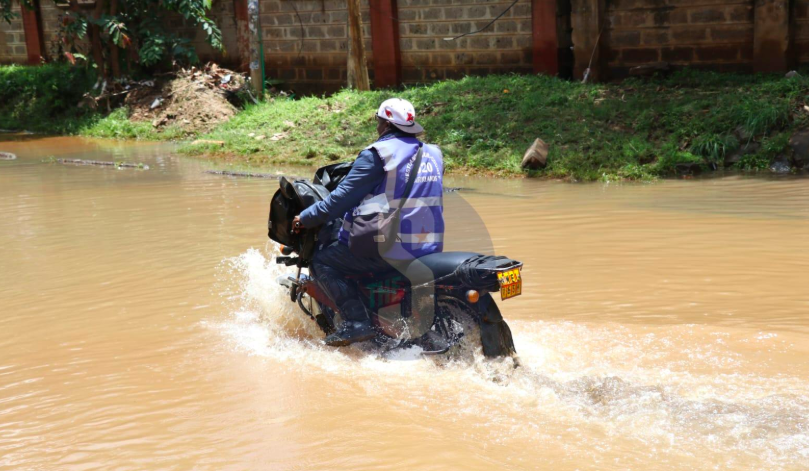
 A motorist manoeuvres through a flooded path following the heavy downpour at Parklands Avenue, Nairobi, on March 8, 2026/ FILE
Narok Senator Ledama Ole Kina has urged counties to prioritise disaster preparedness as the World Meteorological Organization forecasts the return of El Niño conditions that could trigger extreme weather and flooding.
The Narok Senator said counties risk severe human and economic losses if they fail to prepare for the anticipated weather phenomenon.
He called on governors to shift their attention from politics and focus on emergency planning, citing recent flooding incidents in Nairobi that have resulted in deaths, destruction of property and displacement of residents.
“Listen, this is very serious, and you must act now or you will suffer the consequences of inaction. The coming El Niño is not a warning; it is a direct threat to lives, infrastructure, and entire local economies,” Ledama said.
“Governors, stop political campaigns and focus immediately on disaster preparedness. We have already seen the danger: in Nairobi County, floods have killed residents, destroyed homes, and stranded families without warning.”
Ledama expressed particular concern about Narok County, warning that several areas could become inaccessible if heavy rains cause rivers to overflow.
He singled out the Double Cross area and the Mara Bridge within the Maasai Mara ecosystem as critical infrastructure requiring urgent attention.
“In Narok County, the risk is even greater. Narok West, Emurua Dikirr, and Narok South will become completely inaccessible without elevated, all-weather bridges. The Double Cross area and the Mara Bridge in the Maasai Mara Game Reserve are a disaster waiting to happen. Once rivers rise, crossings will be cut off within hours, shutting down tourism and trapping people without access to help,” he warned.
According to the senator, failure to strengthen vulnerable infrastructure could have devastating consequences for the local economy, particularly tourism, which is a major source of revenue and employment in Narok.
“Flooding in the Maasai Mara can shut down tourism overnight, isolate lodges, and wipe out millions in revenue. This will affect not just businesses, but entire communities that depend on tourism,” he said.
Ledama's warning comes after the World Meteorological Organization announced that El Niño conditions are developing in the tropical Pacific Ocean and are expected to influence weather patterns globally over the coming months.
The agency said there is an 80 per cent probability that El Niño conditions will emerge between June and August 2026, while the likelihood of the phenomenon persisting through November exceeds 90 per cent.
According to the WMO, unusually warm ocean waters in the tropical Pacific are driving the development of El Niño, which is typically associated with rising global temperatures and more extreme weather patterns.
“Warm ocean waters are fuelling the development of El Niño. El Niño typically increases global temperatures and drives more extreme weather and rainfall patterns, and above-average temperatures are forecast nearly everywhere for June to August,” the WMO said.
For Kenya, El Niño is commonly associated with above-normal rainfall and an increased risk of flooding, particularly during the latter part of the year. The senator urged county governments to work with engineers, national agencies, the private sector and insurance companies to protect infrastructure and livelihoods before the rains intensify.
“This cannot wait. If you fail to act, the human and economic cost will be yours to answer for. You have been warned,” Ledama said.