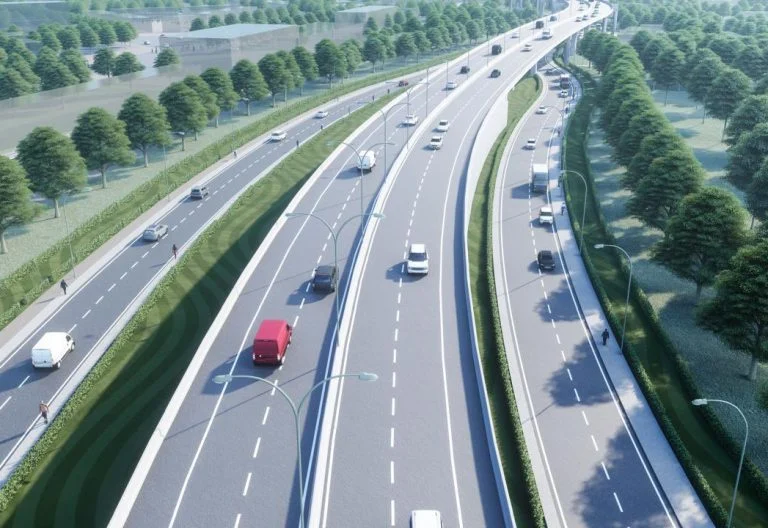
 An artistic impression of the Rironi-Mau Summit Highway/PCS
The plan by the government to extend the Rironi-Mau Summit dual carriageway to Malaba on the Kenya-Uganda border has received a major boost after Kenya secured financing from the Asian Infrastructure Investment Bank (AIIB) to prepare the project.
A notice published by the Kenya National Highways Authority (KeNHA) shows the State is seeking consultancy firms to undertake a technical feasibility study for the proposed capacity enhancement of the Mau Summit–Eldoret–Malaba (A8) Road, a move that signals the next phase of upgrading one of East Africa's busiest transport corridors.
The project forms part of a broader plan to transform the Northern Corridor into a modern high-capacity highway linking the Port of Mombasa to neighbouring countries, including Uganda, Rwanda, South Sudan and the DR Congo.
According to KeNHA, the government has received financing from the AIIB toward the preparation of the project and intends to use part of the funds to procure consulting services for the feasibility study.
"The Government of the Republic of Kenya, through the Kenya National Highways Authority (KeNHA), has received financing from the Asian Infrastructure Investment Bank toward the cost of the preparation of the project," the tender notice states.
The study will focus on capacity enhancement of the approximately 245-kilometre Mau Summit–Eldoret–Malaba road section through a Public-Private Partnership (PPP) arrangement.
The development comes as construction of the Rironi–Mau Summit Expressway gathers momentum, with the government pursuing a long-term solution to congestion along the heavily trafficked Nairobi-Nakuru-Eldoret-Malaba route.
Transport stakeholders have long identified the corridor as a major bottleneck to trade and movement of goods within the East African region.
The planned study will examine technical, environmental, social, economic and financial aspects of the project.
Consultants will also be tasked with preparing procurement documentation and advising the government on structuring the project for private sector participation.
KeNHA said the assignment is expected to last about 12 months and will include engineering investigations, traffic studies, topographical surveys, climate risk assessments and environmental impact analyses.
The authority is specifically seeking firms with experience in major toll-road developments, PPP transactions and infrastructure projects financed by multilateral development banks.
According to the tender document, consultants must demonstrate experience in advising on at least two toll-road or expressway PPP projects over the last 15 years.
The planned expansion is expected to significantly improve movement of cargo and passengers between Kenya and Uganda while reducing travel times and transport costs for businesses operating along the corridor.
For years, motorists and freight operators have complained about frequent traffic jams along sections of the highway, particularly around Nakuru, Mau Summit, Burnt Forest and Eldoret.
Government officials have argued that expanding the road into a multi-lane highway is critical for sustaining regional trade growth and supporting economic development in Kenya and the wider East African Community.
The Northern Corridor handles the bulk of cargo entering the region through the Port of Mombasa, making it one of the most important transport routes in East Africa.
By extending the planned upgrade beyond Mau Summit to Eldoret and eventually Malaba, the government hopes to create a seamless high-capacity corridor from Nairobi to the border.
Once completed, the project could unlock billions of shillings in economic benefits through faster cargo movement, reduced vehicle operating costs and improved road safety.
It aligns with Kenya's strategy of leveraging private capital to finance large infrastructure developments amid growing pressure on public finances.
Under the PPP model, private investors would be expected to participate in financing, constructing and operating sections of the highway, potentially through tolling arrangements.
KeNHA's tender documents indicate that interested firms have until June 23, 2026, to submit expressions of interest.
The consultancy study is expected to provide the roadmap for implementation, including determining project costs, traffic projections, financing options and the most suitable procurement structure.
If implemented as envisioned, the project would mark one of the largest road infrastructure investments in Kenya in recent years and significantly reshape transport links between Nairobi and the Ugandan border.
The expansion would also complement ongoing efforts to modernise the country's road network and strengthen Kenya's position as the logistics and transport hub of the East African region.


![[PHOTOS] The new Ngong –Naivasha Road viaduct](https://cdn.radioafrica.digital/image/2026/06/64d4f771-4432-4aee-ba3c-2f304c4436ec.jpg)






![[PHOTOS] 'Mr Speaker Sir' Gen Z protester in court](https://cdn.radioafrica.digital/image/2026/06/b3e62d8e-25c3-4780-90f9-4eb48b1ce8a7.jpg)