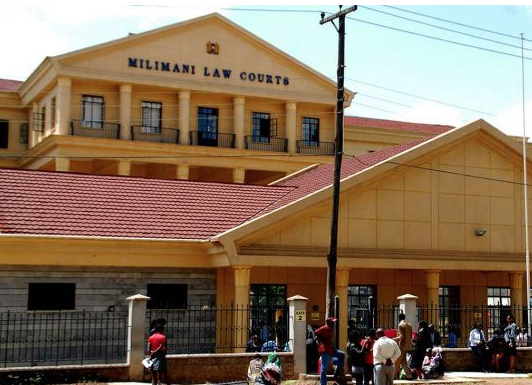
 Milimani Law Court/FILE
Katiba Institute has moved to court seeking urgent conservatory orders to block the proposed establishment of an Ebola quarantine facility in the country.
In a petition filed before the High Court, the group warns that the arrangement poses “grave and imminent risks” to public health, constitutional governance, and national sovereignty.
The governance watchdog has sued the Attorney General and the Cabinet Secretary for Health as the 1st and 2nd respondents, respectively.
It argues that the alleged discussions between the Government of Kenya and the United States amount to a constitutional concern if implemented without the required safeguards.
"The impugned arrangement is being undertaken in a manner that is not transparent and is devoid of constitutional accountability, public participation, parliamentary oversight, or full disclosure of its health, environmental, and security implications," their application states.
According to court documents, Katiba Institute contends that credible media reports indicate advanced negotiations to establish a facility in Kenya that would host individuals exposed to or infected with Ebola and other highly infectious diseases, potentially as part of a broader foreign containment arrangement.
The petitioner argues that such a development, if true, risks positioning Kenya as an “offshore quarantine hub” for foreign states.
It also faults the alleged failure to disclose whether any environmental impact assessments, biosafety evaluations, or parliamentary approvals have been undertaken prior to the reported discussions.
In its application, Katiba Institute stresses that Ebola is highly infectious and often fatal disease, as classified by the World Health Organisation.
"It poses a significant threat to public health systems, particularly in contexts of limited containment capacity, thereby presenting a direct and immediate threat to the rights to life under Article 26 and health under Article 43 of the Constitution and triggering a heightened constitutional obligation on the State to exercise maximum precaution in any related policy response," they state in their documents.
The petition specifically highlights that Ebola requires Biosafety Level 4 (BSL-4) facilities, which are equipped to handle the most dangerous pathogens.
However, the petitioner argues that Kenya’s current laboratory capacity is largely limited to BSL-1, BSL-2, and a small number of BSL-3 facilities, which are not designed to safely manage Ebola-level containment risks.
This, it warns, creates a significant gap in preparedness and could expose health workers and the general public to catastrophic consequences in the event of an accidental breach or outbreak.
The petition, supported by an affidavit sworn by Nora Mbagathi, also cites the absence of public information regarding any formal agreement between Kenya and the United States, or any clear protocols on admission, isolation, and treatment of potentially infected persons.
It argues that such secrecy undermines constitutional principles of accountability and the right to access information.
Katiba Institute is seeking several orders from the court.
"A conservatory order issue restraining the Respondents from establishing, operationalising, facilitating, approving or permitting the establishment and/or operation of any Ebola exposure, quarantine, isolation or treatment facility in Kenya pursuant to any arrangement with the United States of America or any foreign government or agency pending the inter-parties hearing and determination of this Application," reads the application.
The group is also asking court to compel the Ministry of Health to disclose any agreements, negotiations, or health risk assessments related to the proposed arrangement.
Further, the petitioner is asking the court to compel the State to present an emergency contingency plan on Ebola surveillance and response systems within 24 hours, arguing that the existence of such a plan is essential for public safety and preparedness.
Katiba Institute maintains that unless the court intervenes, there is a real and imminent danger of Kenya being exposed to avoidable health risks, potentially undermining the constitutional right to life and health under Article 26 and Article 43 of the Constitution.



![[PHOTOS] The new Ngong –Naivasha Road viaduct](https://cdn.radioafrica.digital/image/2026/06/64d4f771-4432-4aee-ba3c-2f304c4436ec.jpg)