The absence of Raila Odinga is increasingly being felt within ruling UDA and ODM, with President William Ruto now facing what analysts describe as a complicated re-election path.
What initially was a stable political arrangement under the broad-based government is facing serious headwinds after the demise of the veteran opposition chief.
Before his death, Raila played a central role in maintaining political equilibrium between ODM and the Kenya Kwanza administration.
He served as the ultimate political referee, calming tensions, balancing regional interests and keeping competing ambitions within the party under control.
Ruto publicly admitted that Raila’s death dealt him a major political and personal blow.
“Many commentators in newspapers and the media say this is a big blow for me. Yes, it is. It is a very big blow,” the President said during Raila’s burial.
Seven months after Raila’s demise, centres of power have emerged within ODM, each attempting to shape the party’s future direction, a development now threatening ODM members and Ruto’s re-election chances.
According to Coast-based gender and governance analyst Maimuna Mwidau, Raila’s death could weaken the broad political arrangement that had started taking shape.
“With Raila’s demise, you can already see ODM has split into two camps, and the faction led by Oburu does not appear to be pushing in the direction many expected,” she told the Star.
“Instead, the younger group, Linda Mwananchi, is the one gaining momentum. They are making serious inroads on the ground, especially among the youth. What we are witnessing is a struggle for control.”
Even Raila’s political backyard of Nyanza, long regarded as ODM’s most solid bastion, is showing signs of deep internal fractures.
A growing fallout between Governors Gladys Wanga (Homa Bay) and James Orengo (Siaya) has exposed widening divisions within the region, with the two leaders increasingly taking divergent political positions and allies trading accusations in public.
“Our region deserves leadership that inspires hope, not needless turf wars with a girl the age of your daughter,” Wanga said, admitting the existence of internal wars.
“If my resolve to stand with Senator Oburu Oginga as the party leader of our great party after the passing of our beloved leader, Raila, means I must endure more of these embarrassing insults and unnecessary tirades, so be it.”
The tensions have fuelled concerns that ODM’s traditional strongholds are slowly slipping into competing camps in the absence of Raila’s unifying authority.
Fresh tensions have also emerged between the Odinga family and Treasury CS John Mbadi following controversial remarks he allegedly made in Mombasa about Raila.
Mbadi has since insisted he was misquoted, but the remarks triggered political uproar, pitting him against Raila’s younger sister Ruth Odinga and EALA MP Winnie Odinga.
The confusion within the broad-based arrangement has also spilled into government operations.
Cooperatives CS Wycliffe Oparanya on Thursday publicly protested what he described as the underfunding and marginalisation of his office, even questioning whether his ministry was fully recognised within Ruto’s administration.
“I have to come here all the time to get money for my office’s operations. I don’t know if my office is recognised as one of the offices of CS in this government or not,” Oparanya said.
His remarks were interpreted as a sign of growing frustration among ODM figures serving in government and a reflection of the uncertainty surrounding the coalition arrangement following Raila’s absence.
Regions that traditionally rallied behind the broad-based government due to Raila’s influence are also rapidly turning into political battlegrounds.
The entry of the Edwin Sifuna-led Linda Mwananchi movement has further complicated the situation.
A recent poll suggested the Sifuna-aligned wing enjoys overwhelming support among ODM supporters at 73 per cent, compared to 24 per cent for the faction associated with Oburu.
The movement has increasingly adopted an anti-establishment posture despite ODM’s cooperation with UDA and, in the process, appealed to Raila’s base.
It has already hinted at working with opposition leaders to ensure Ruto becomes a one-term president.
The study by Trends and Insights For Africa (TIFA) paints a difficult picture for the head of state should opposition figures unite behind a single candidate.
It placed Ruto slightly ahead in a hypothetical presidential contest with 24 per cent support.
The poll further placed Kalonzo Musyoka at 19 per cent, Fred Matiang'i at 14 per cent, Sifuna at 10 per cent, Rigathi Gachagua at nine per cent and Babu Owino at two per cent.
Political observers argue the developments within ODM are creating fresh uncertainty for Ruto, who had hoped the broad-based arrangement would neutralise opposition resistance and secure key voting blocs ahead of next year's polls.
Instead, the President now faces the possibility of a united opposition front capable of consolidating anti-government sentiment in regions previously considered politically secure.
Analysts say Raila’s absence has fundamentally altered the country’s political matrix, leaving Ruto confronted with a far more challenging re-election battle.
Political analyst Gitile Naituli agreed that Raila’s absence has complicated Ruto’s path to a second term if the two ODM factions continue their antagonism.
“For years, Raila managed these two tendencies with remarkable precision. He allowed both wings to operate not as contradictions, but as complements,” Naituli argued.
“The party could negotiate with government while simultaneously sustaining resistance politics. It was a delicate balance that worked because there was a central figure capable of holding it together. That figure is now gone.”
Raila’s absence has also intensified supremacy battles between ODM insiders and allies of Deputy President Kithure Kindiki.
Some ODM leaders have been pushing for the second-in-command position to remain within ODM’s orbit, triggering tensions with Kindiki allies who are fighting to retain control of the seat.
The growing uncertainty presents a fresh political headache for Ruto, who must now navigate rising tensions within his own alliance while simultaneously dealing with a fractured ODM that no longer appears fully controllable without Raila’s direct influence.
The Linda Mwananchi rallies are expected to deepen divisions further, particularly in regions where ODM traditionally commands significant support.
Its populist messaging targeting ordinary Kenyans could weaken Ruto’s influence in opposition strongholds he had hoped to penetrate through Raila’s political network.
Among the regions increasingly turning into political battlegrounds are the Coast, Western Kenya, Nairobi and parts of Maasailand.
“For instance, at the Coast, Ruto is heavily relying on ODM figures aligned to Oburu to secure that bloc,” Mwidau observed.
“UDA does not have that level of grassroots strength there despite having a Secretary General from Mombasa County. Whether that strategy succeeds remains uncertain because the Sifuna-led faction has already established a strong foothold, especially among young voters.”
Instant analysis
As political realignments ahead of 2027 gather momentum, Raila’s absence is being felt far beyond ODM ranks. Inside government circles, his influence had increasingly become the glue holding together the fragile broad-based political arrangement.

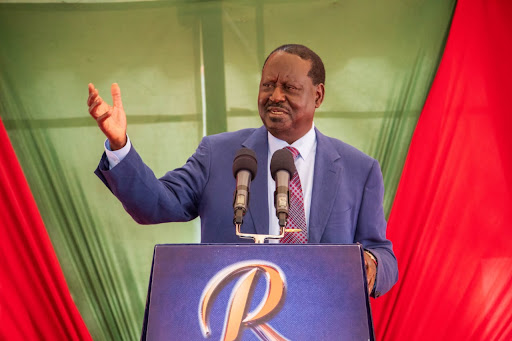
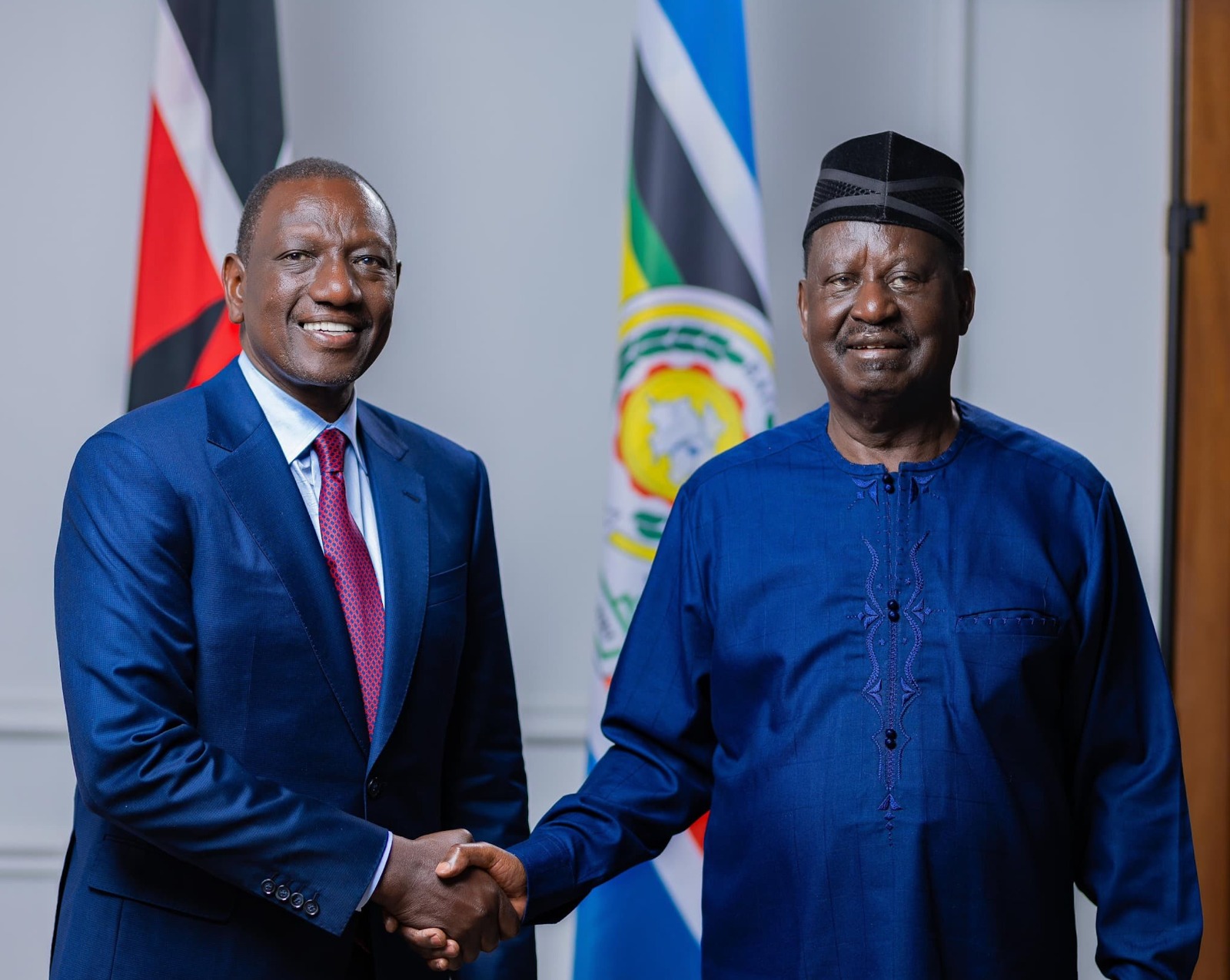 President William Ruto and Late Prime Minister Raila Odinga/FILE


![[PHOTOS] The new Ngong –Naivasha Road viaduct](https://cdn.radioafrica.digital/image/2026/06/64d4f771-4432-4aee-ba3c-2f304c4436ec.jpg)

![[PHOTOS] 'Mr Speaker Sir' Gen Z protester in court](https://cdn.radioafrica.digital/image/2026/06/b3e62d8e-25c3-4780-90f9-4eb48b1ce8a7.jpg)