How Hassan Omar’s remarks hand anti-Ruto camp fresh political artillery
Omar's statements have evolved into a wider debate over ethnic politics and the future of the President's support base in Mt Kenya.
by ELIUD KIBII
Audio By Vocalize
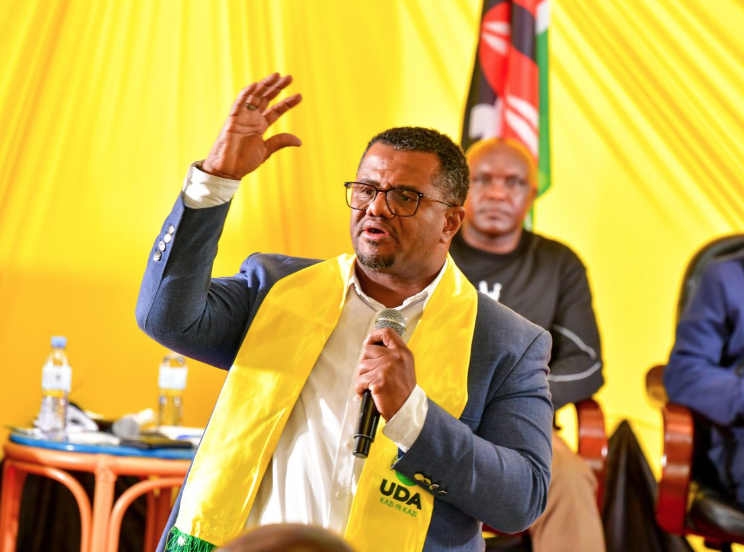
United
Democratic
Alliance
Secretary
General Hassan
Omar during
a past media
briefing /FILE
Remarks by UDA secretary general Hassan Omar Hassan have triggered a
political storm within the ruling party,
opening a fresh line of attack against President William Ruto in the
Mt Kenya region.
The remarks, which appeared to profile the Kikuyus,
have also handed the anti-Ruto axis led by the Democracy for Citizens
Party leader Rigathi Gachagua, another campaign ammunition.
What began as rally remarks during a meeting hosted
by President Ruto at the Coast have rapidly evolved into a wider debate over
ethnic politics and the future of the head of state’s
support base in Mt Kenya.
Already, vocal allies of the President in the
region, which propelled him to State House in 2022, have strongly condemned
Omar.
Some have demanded his resignation and threatened
to leave the party if he remains.
These include Nyeri Governor Mutahi Kahiga, his
Kirinyaga counterpart Anne Waiguru, Murang’a Woman Rep Betty Maina, her Nyeri
counterpart Rahab Mukami and Ndia MP
George Kariuki, among others.
Kiambaa MP Njuguna Kawanjiku told the Star that
Omar was making their work difficult in Mt Kenya, even as he sustained the call
for his resignation.
“Of course it is becoming difficult. You have a
secretary general who has made remarks that clearly indicate a certain
community that is in government is not wanted.
“How can you proceed? He has to give way and we have
a secretary general who accommodates all,” Kawanjiku said on the phone.
He said
that Omar had to take responsibility for his remarks.
Asked where the option to leave the party as
indicated by Betty was a shared position, Kawanjiku
said while it was not, it would be the alternative if they
feel unwanted.
Omar's political gaffe comes at a time when Ruto's
allies in Mt Kenya have been fleeing.
Murang'a Governor Irungu Kang’ata and former Kirinyaga Women Rep Purity Ngirici are among Ruto's high profile leaders who have left the President’s camp.
From the anti-Ruto axis, the condemnation has been
from former President Uhuru Kenyatta, Gachagua, Wiper’s Kalonzo Musyoka and a
host of their allies.
The backlash fallout has exposed growing anxiety
within UDA over deteriorating relations between the head of state and sections of Mt Kenya leaders.
But Omar’s comments could not have come at a more
politically useful moment for anti-Ruto forces in the region.
Within hours, Gachagua’s allies, Jubilee figures and even leaders allied to
the United Opposition outside the region had seized on the remarks as evidence
of what they portray as growing hostility, political betrayal and disrespect
toward Mt Kenya.
The unusually sharp backlash from within UDA, with
threats to leave as declared by Betty— itself underscored the sensitivity of
the matter.
Nyeri Governor Mutahi Kahiga, who has been
drifting back to the President’s camp, sustained the pressure by directly
demanding Omar’s resignation as he was a liability to the party.
“People like you Hassan Omar, our appointed UDA secretary general, are a great liability to the party, to Kenyans and
to all people of goodwill,” Governor Kahiga said.
“When you try to demonise an entire community just
because you think Kenyans have forgotten your role in the ICC matters, is a
tragedy.”
Kahiga referenced his own resignation from the
Council of Governors leadership as vice chairman following his controversial
remarks following the demise of former Prime Minister Raila Odinga.
“I now challenge you to do the same. Resign from
your appointed position,” he said.
Kirinyaga Governor Anne Waiguru, one of Ruto’s
most prominent allies in Mt Kenya, also strongly condemned Omar’s remarks,
warning against ethnic mobilisation.
“I have stood against ethnic-based politics when
espoused by some leaders in Mt Kenya. In equal measure, I strongly stand
against the Hassan Omar-type of ethnic
baiting that seeks to isolate the people of Mt Kenya,” Waiguru said.
“The tutam movement, to
which we remain fully committed, is a national movement that does not
legitimize the spewing of ethnic hatred, however couched.
“As a nation, we have been there before and we said
never again. That approach may excite crowds, but it is short-sighted,
undemocratic, and can ultimately only be severely injurious to the nation. He
owes our nation an apology.”
Despite Omar issuing an apology on Sunday, the
onslaught continues.
Kirinyaga Woman Rep Njeri Maina dismissed Omar’s subsequent apology, arguing it did
not address the deeper concerns raised by his remarks.
“Hassan Omar issuing an apology will not change his
tribal perspective. As a matter of fact, he can change his apology,” Njeri said.
Betty went even further, warning that Mt Kenya
leaders could reconsider their future inside UDA, if Omar remained in office.
Maina said leaders from the region would rather
support the President “from a party where they are respected” if action was not
taken.
Manyatta MP Gitonga Mukunji, a close ally of
Gachagua, yesterday escalated the onslaught, saying Omar’s were sanctioned by the President himself.
“The message was clear. It was intended to make the
region [Coast] to see Mt Kenya as their enemy, and distract them from the real problems facing them that is
high fuel prices, a social health fund that’s not working and general hardship.”
“Nobody speaks in a
presidential event without the greenlight from the top. I am saying that as a person who has been there,
having been elected on UDA,” Mukunji told the Star.
In part, Mukunji echoed remarks made by Gachagua on
Monday.
At a presser, Gachagua rejected Omar’s apology,
claiming he spoke from a script prepared at State House, Mombasa.
Mukunji said that
had the President disapproved of the remarks, he
would have corrected them in his address.
Additionally, he said that it is an emergent trend, noting that even Interior
Cabinet
Secretary Kipchumba Murkomen claimed Ruto is
facing pressure from Mt Kenya because he is not from the region — when responding to the fuel
crisis.
The Manyatta legislator also dismissed remarks by
pro-UDA members who have criticised Omar, saying if they were
honest, they would have decamped.
“These are traitors. You can’t remain in a room
where your community is targeted., We are seeing a trend where those supporting
the government criticise an issue, but do so with their gloves on,” he said.
Gachagua and his allies have increasingly accused
Ruto’s inner circle of politically marginalising the region after benefiting
from its overwhelming support during the last election.
For months, anti-Ruto figures have struggled to
find a unifying emotional issue capable of consolidating resentment across the
mountain.
Political analysts say Omar’s remarks may have
inadvertently provided exactly that.
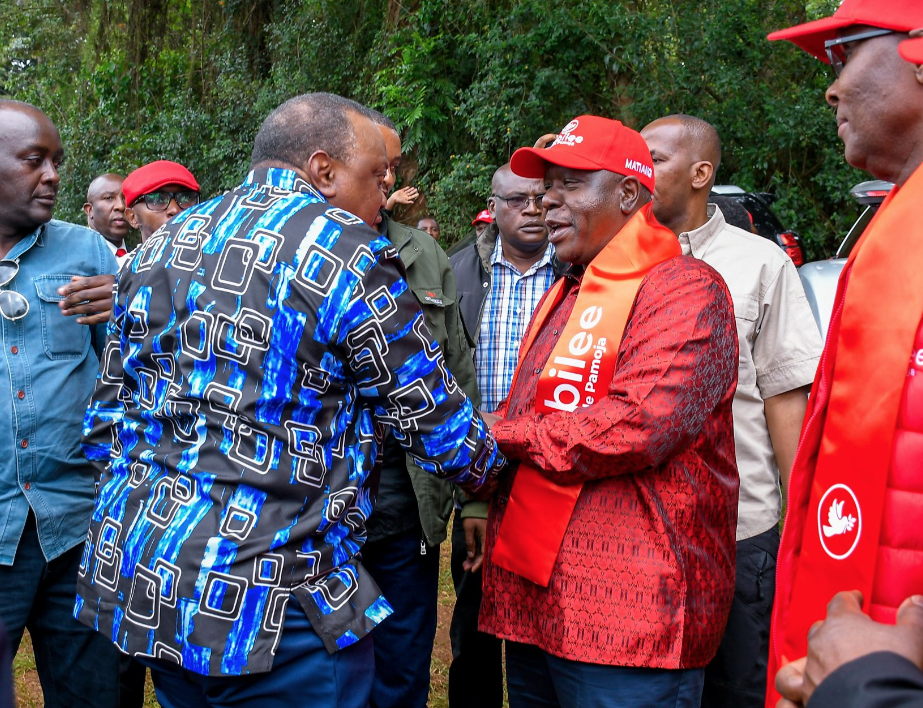
Already, Jubilee Party figures — allied to the
United Opposition — moved quickly to frame the controversy as evidence of
dangerous ethnic politics taking root within the Kenya Kwanza administration.
Jubilee deputy leader Jeremiah Kioni linked the debate
directly to concerns raised by former Uhuru on Monday over divisive
politics.
“I fully associate myself with the sentiments
expressed by our party leader and former President Uhuru Kenyatta, on the urgent need to safeguard the
unity of our country and reject the dangerous politics of division currently
creeping into our national discourse,” Kioni said.
“Jubilee Party remains a truly national movement,
built by Kenyans from every corner of our republic, transcending ethnicity, region, religion
and political convenience.”
Without directly naming anyoe, Kioni accused
political actors of fuelling “tribal arithmetic”, “regional mobilisation” and “manufactured divisions” instead of
addressing economic hardships facing ordinary Kenyans.
“The politics of tribalism, ethnic suspicion,
regional antagonism and manufactured divisions have never built nations.
“Our country cannot afford to return to an era
where leaders mobilise communities against each other instead
of uniting citizens around solutions to unemployment, the rising cost of
living, and economic empowerment.”
The dispute has also attracted the attention of
the National Cohesion and Integration Commission, which has launched
investigations into the remarks amid concerns over rising ethnic rhetoric in
national politics.
The controversy now presents the President with yet
another a delicate political balancing act.
He has for months attempted to contain the
political fallout in Mt Kenya in his bid to secure a second term.
This is premium content
Subscribe to Continue Reading
Help us continue bringing you unbiased news, in-depth investigations, and diverse perspectives. Your subscription keeps our mission alive and empowers us to provide high-quality, trustworthy journalism. Join us today to make a difference!



![[PHOTOS] The new Ngong –Naivasha Road viaduct](https://cdn.radioafrica.digital/image/2026/06/64d4f771-4432-4aee-ba3c-2f304c4436ec.jpg)



![[PHOTOS] 'Mr Speaker Sir' Gen Z protester in court](https://cdn.radioafrica.digital/image/2026/06/b3e62d8e-25c3-4780-90f9-4eb48b1ce8a7.jpg)