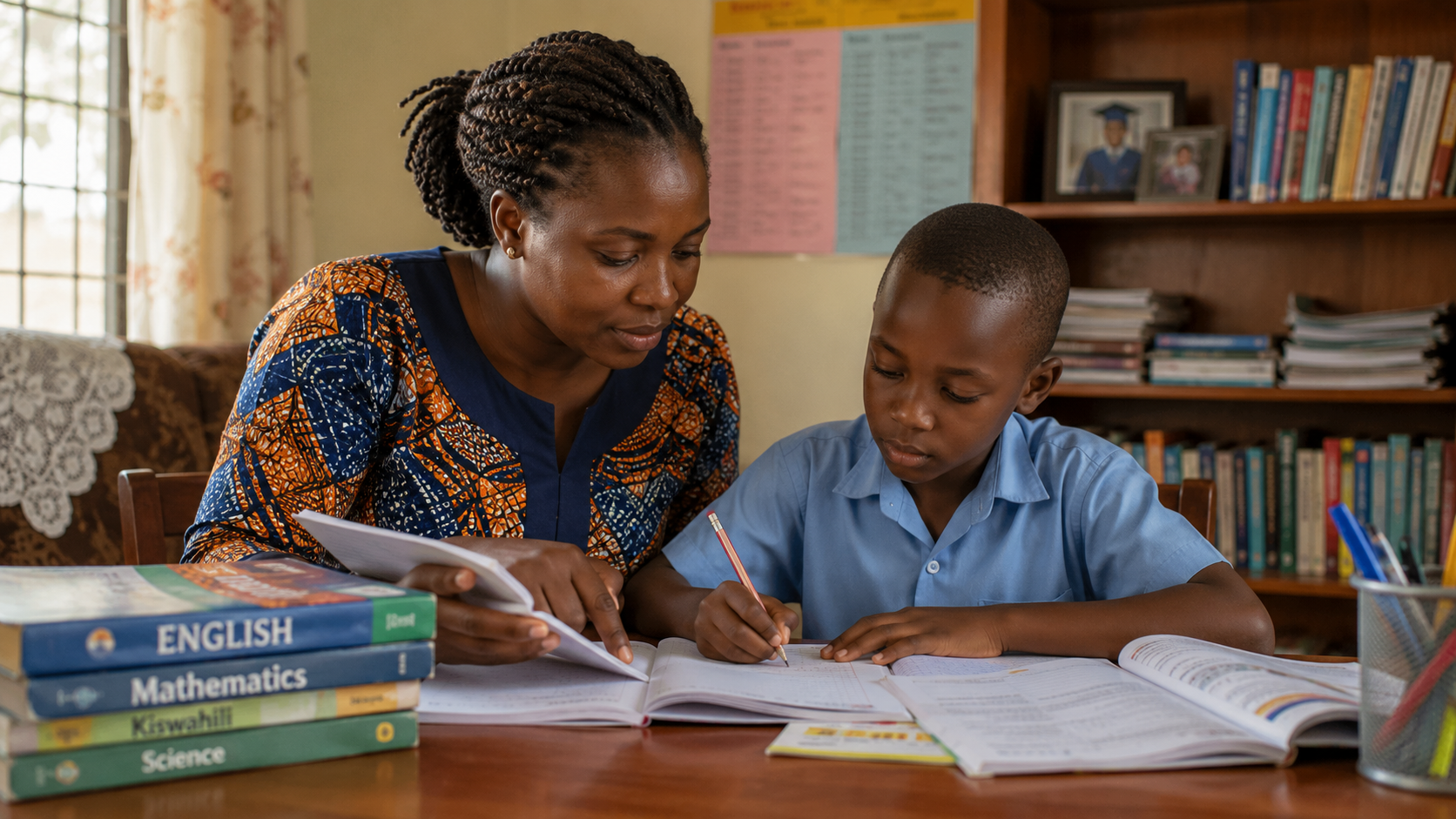
 A mother helps her child with homework at home. /AI ILLUSTRATION
A child whose mother has a university degree or higher is significantly more likely to post stronger learning outcomes than a child whose mother attained only primary education or below, a new study has revealed, highlighting the critical role parental education plays in shaping academic success.
The findings are contained in the Gender Equality in and through Education report by Usawa Agenda, which examined the state of gender equality in Kenya’s basic education sector by analysing how household characteristics influence children’s learning outcomes.
While the report found that girls generally outperform boys in key learning indicators, it also showed that a mother’s level of education remains one of the strongest predictors of a child’s performance in both mathematics and English literacy, regardless of gender.
According to the study, girls’ odds of achieving better learning outcomes in numeracy are 28 per cent higher than those of boys, while their odds of recording better outcomes in English literacy are 25 per cent higher.
However, the report notes that these broad gender patterns become more nuanced when parental background, particularly maternal education, is taken into account.
“There is a question as to whether the society has ‘overemphasised’ girls’ education at the expense of boys’ education,” observed Usawa Agenda executive director Emmanuel Manyasa.
The analysis found a clear and consistent relationship between higher levels of maternal education and improved learning outcomes among children.
For mathematics, a child whose mother attained secondary education has 1.30 odds of achieving better learning outcomes compared with a child whose mother has primary education or below.
The likelihood increases further as educational attainment rises, reaching 1.59 for mothers with diploma qualifications and 2.92 for those with a university degree or higher.
A similar pattern emerged in English literacy, underscoring the influence of maternal educational attainment across different areas of learning.
Children whose mothers completed secondary school recorded odds of 1.37 of achieving better English literacy outcomes.
The figure rises to 1.67 where the mother holds a diploma qualification and climbs to 2.31 where she has an undergraduate degree or higher.
By contrast, the odds stand at 0.01 for both mathematics and English literacy among children whose mothers have primary education or below, illustrating the sharp disparities associated with educational attainment within households.
The findings were derived from a regression analysis of learning outcomes among children aged between 10 and 15 years, including both those in and out of school, as well as learners enrolled in Grades 3 to 9 up to the age of 17 years.
Beyond parental education, the study identified several other factors associated with stronger academic performance.
Age was found to have a positive effect on learning outcomes, with children’s odds of achieving better results in numeracy increasing by 13 per cent for every additional year of age. In English literacy, the odds rise by 7 per cent for each additional year.
School type also emerged as an important determinant. Learners enrolled in private schools were found to have 40 per cent and 49 per cent higher odds of achieving better learning outcomes in numeracy and English literacy, respectively, than their counterparts in public schools.
Early exposure to formal education was another significant factor. Children who began schooling at the pre-primary level recorded 56 per cent higher odds of achieving better outcomes in mathematics compared with those who did not attend pre-primary education.
The advantage remained evident in English literacy, although at a lower level, with the odds standing at 37 per cent.
Household economic status likewise continued to shape educational outcomes. Compared with children from poor households, those from middle-income households had 16 per cent higher odds of achieving better outcomes in numeracy and 19 per cent higher odds in English literacy.
The advantage widened further among children from wealthier families. The study found that children from rich households recorded 38 per cent and 47 per cent higher odds of achieving better learning outcomes in numeracy and English literacy, respectively, than their peers from poor households.
Taken together, the findings suggest that learning outcomes are influenced by a combination of family background, educational opportunities and socioeconomic conditions.
However, the report points to maternal education as a particularly powerful factor, with the likelihood of better performance increasing steadily as mothers attain higher levels of schooling.

![[PHOTOS] The new Ngong –Naivasha Road viaduct](https://cdn.radioafrica.digital/image/2026/06/64d4f771-4432-4aee-ba3c-2f304c4436ec.jpg)











![[PHOTOS] 'Mr Speaker Sir' Gen Z protester in court](https://cdn.radioafrica.digital/image/2026/06/b3e62d8e-25c3-4780-90f9-4eb48b1ce8a7.jpg)