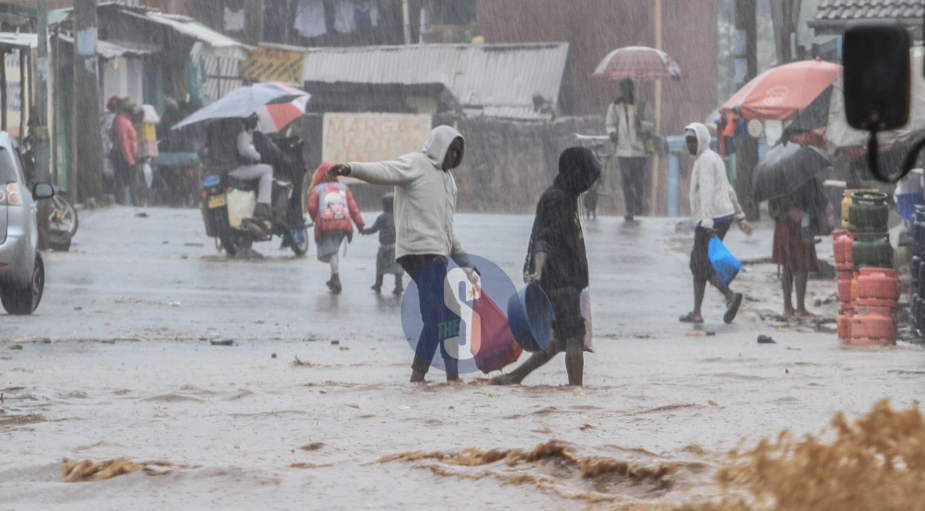
 Nairobi residents wading through water. /FILE
The Kenya Meteorological Department has announced that some parts of the country will experience continued heavy rainfall this week.
Kenya Met said the areas will experience rainfall from May 26 to June 1, warning of heavy downpours, strong winds, and sharp temperature variations across regions.
The forecast shows that rainfall is expected to persist in the Highlands East and West of the Rift Valley, the Lake Victoria Basin, the South Rift Valley, the Coast, and selected areas in Northeastern Kenya.
The forecast cautioned that some areas along the Coast and Garissa County may experience heavy rainfall events, raising the risk of localised flooding and disruptions.
Night-time temperatures are expected to drop significantly in some high-altitude regions, with minimum averages falling below 10°C in parts of the Highlands East of the Rift Valley, the Central Rift Valley, and areas around Mount Kilimanjaro.
In contrast, daytime conditions will remain hot in several lowland regions, with maximum temperatures exceeding 30°C expected in the Coast, parts of the Southeastern Lowlands, Northeastern and Northwestern Kenya.
The outlook warned of strong southerly to southeasterly winds, with speeds exceeding 25 knots (about 12.5 metres per second), expected over parts of the North Western, North Eastern, Coast and South Eastern Lowlands counties.
Residents in affected areas are advised to remain alert to
rapidly changing weather conditions, especially in regions likely to experience
heavy rainfall and strong winds, which could affect transport, marine
activities and outdoor operations.
On May 21, a new regional climate outlook warned that parts of Kenya are set to experience below-normal rainfall and above-average temperatures between June and September 2026.
The forecast, released by the IGAD Climate Prediction and Applications Centre (ICPAC) during the 73rd Greater Horn of Africa Climate Outlook Forum in Addis Ababa, shows that western and coastal Kenya are among the areas most likely to receive below-normal rainfall during the critical season.
The June to September period is a key rainfall window for agriculture, water resources and hydropower generation across the region.
While most parts of western Kenya face a likely dry spell, ICPAC noted that some areas along the coast could receive near-normal rainfall, offering limited relief to communities that depend heavily on seasonal rains.
At the same time, the region is expected to be hotter than usual. ICPAC projects above-normal temperatures across much of the Greater Horn of Africa, including Kenya.
The agency warned that the combined effect of heat and reduced rainfall could hit rain-fed agriculture, strain water availability, reduce livestock productivity and worsen food insecurity. Public health systems and hydropower generation may also come under pressure.
Pastoral communities in arid and semi-arid regions are expected to be among the most affected, with rising vulnerability already linked to climate-related shocks.
According to ICPAC, the expected conditions resemble patterns seen during strong El Niño years such as 1997 and 2023, when several parts of the region, including western Kenya, experienced below-normal rainfall.

![[PHOTOS] The new Ngong –Naivasha Road viaduct](https://cdn.radioafrica.digital/image/2026/06/64d4f771-4432-4aee-ba3c-2f304c4436ec.jpg)









![[PHOTOS] 'Mr Speaker Sir' Gen Z protester in court](https://cdn.radioafrica.digital/image/2026/06/b3e62d8e-25c3-4780-90f9-4eb48b1ce8a7.jpg)