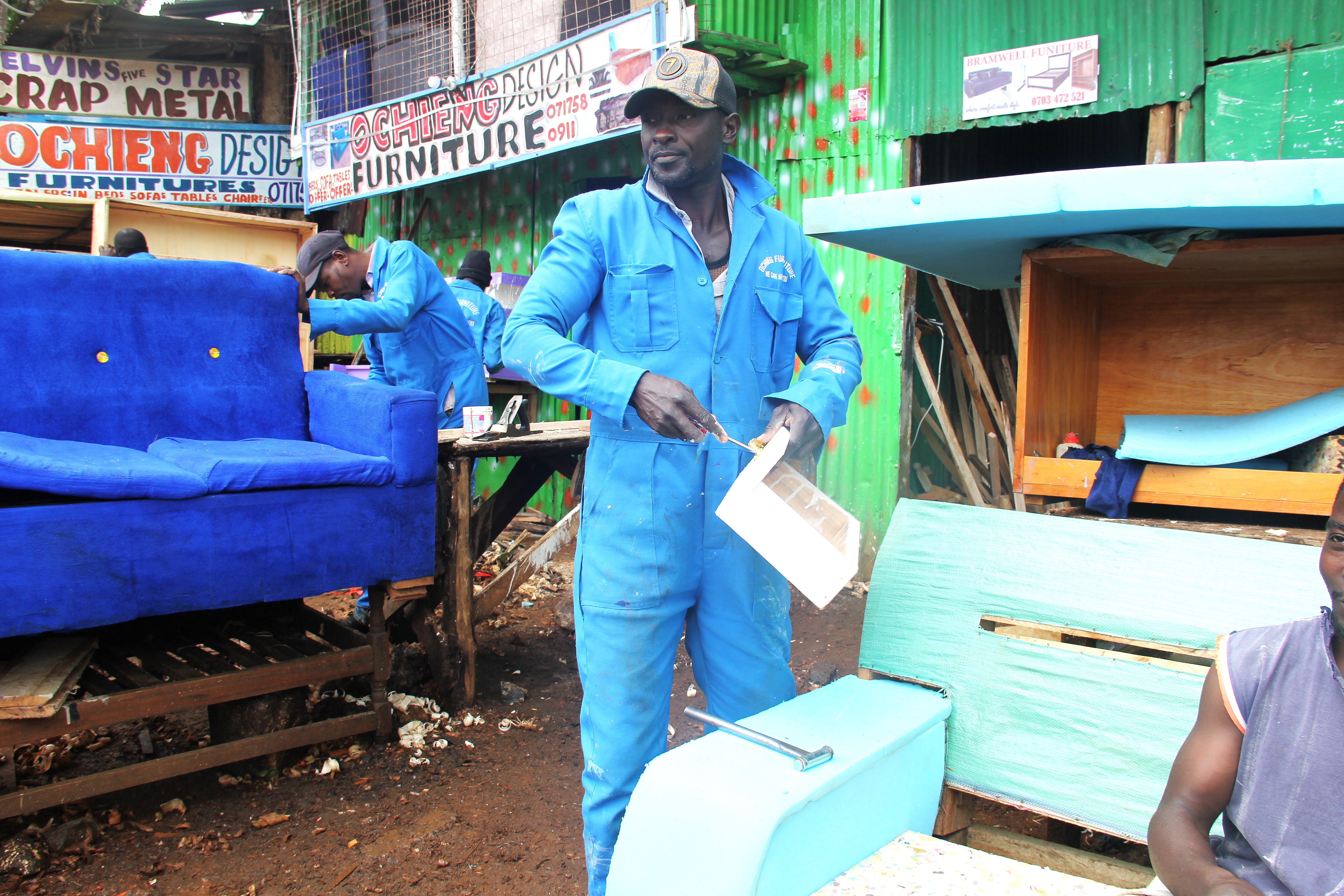
 William Ochieng works on a furniture project at his workshop in Kericho town. After acquiring vocational skills while serving a prison sentence, Ochieng rebuilt his life through entrepreneurship and now mentors young artisans and supports his family through furniture-making./KNA
The rhythmic hum of sewing machines, the scent of freshly cut timber and the steady tapping of carpentry tools fill a modest furniture workshop in Kericho town. Customers walk in to inspect elegant sofa sets, polished wall units and customised furniture carefully arranged for display.
At the centre of the buzz of activity stands William Ochieng, confidently guiding his workers and discussing designs with clients.
Few of the customers streaming into his workshop know that just a few years ago, the soft-spoken craftsman was behind prison walls serving a lengthy sentence that seemed destined to define the rest of his life.
However, Ochieng's story stands as a powerful testament to the transformative power of faith, determination, vocational training and second chances. His journey from inmate to employer, mentor and entrepreneur demonstrates how rehabilitation can unlock human potential and create opportunities that benefit not only individuals but also families, communities and the wider economy.
For Ochieng, prison did not become the end of his story. Instead, it became the unlikely springboard from which he rebuilt his life.
 A customised Arsenal-themed sofa set crafted by furniture entrepreneur William Ochieng at his workshop in Kericho town. Ochieng has carved a niche in designing football-inspired furniture for sports enthusiasts, transforming skills acquired during his time in prison into a thriving business./KNA
Despite the setbacks, he nurtured dreams of creating a better future for himself and his family. Those dreams, however, appeared to collapse in February 2019 when he was convicted of defilement and sentenced to 15-year imprisonment at Kericho Main Prison.
The custodial sentence came as a devastating blow.
Suddenly separated from his family, friends and the outside world, Ochieng found himself confronting a bleak and uncertain future. The prospect of spending more than a decade behind bars was psychologically overwhelming. For many inmates, such circumstances can breed hopelessness, bitterness and despair.
But somewhere amid the challenges of prison life, Ochieng made a decision that would alter the trajectory of his future.
Rather than allowing his circumstances to consume him, he resolved to use every available opportunity to improve himself. He chose growth over self-pity, discipline over despair and learning over regret.
“I told myself that if I ever got another opportunity in life, I wanted to be prepared for it,” he recalls. That decision marked the beginning of a remarkable transformation.
Inside prison, Ochieng immersed himself in vocational training programmes, determined to leave the correctional facility with skills that could support him and his family. He enrolled in every practical course he could access and quickly discovered a passion for technical work.
Over the years, he received training in joinery and carpentry, upholstery, masonry, tailoring, architecture and house planning. He learnt how to frame furniture, stitch sofa materials, interpret building plans and create functional designs. What began as a way of passing time gradually evolved into a personal mission.
Each new skill strengthened his confidence and expanded his vision for the future.
Fellow inmates and prison officers began recognising his dedication. While others viewed prison as a place of confinement, Ochieng viewed it as a classroom where he could prepare for life beyond the prison gates.
His transformation extended beyond vocational skills.
As a committed member of the Seventh-day Adventist Church, Ochieng found strength and guidance in his faith. He eventually became a church leader within the prison community, encouraging fellow inmates and helping nurture a sense of hope among those struggling with their circumstances.
He says spirituality became one of his strongest anchors during the difficult years of incarceration.
“There were moments when things seemed impossible, but faith kept reminding me that in every situation, God has a purpose,” he says.
As he continued learning and growing, one particular achievement would eventually capture the attention of the justice system and become a turning point in his rehabilitation journey.
Drawing on the architectural skills he had acquired in prison, Ochieng developed a detailed house plan. The project showcased not only his technical ability but also the extent of his personal transformation.
According to Ochieng, the plan was later presented during legal proceedings linked to his appeal. The work reportedly impressed a Judge who saw evidence of rehabilitation, discipline and genuine commitment to positive change.
The project became a powerful symbol of what vocational training and correctional rehabilitation can achieve when individuals embrace the opportunity to reform.
Following the appeal process, Ochieng secured his release after serving six years of his sentence and walked out of prison towards the end of 2024.
Yet freedom presented challenges of its own.The world he returned to was not the same one he had left behind.
His family had endured years of hardship during his incarceration. His marriage had broken down and his wife later passed away. The emotional burden of loss was compounded by the responsibility of rebuilding relationships and providing for his children.
One of his children was in Form Three while the younger one was in Grade Four.
Faced with the responsibility of raising his children and rebuilding his future from scratch, Ochieng knew he could not afford to waste the second chance he had been given.
The first challenge was finding work.
Like many former inmates, he encountered the harsh realities of reintegration. Employment opportunities were limited and access to capital was almost non-existent.
Undeterred, he sought employment under an established furniture craftsman in Kericho town.
The work was demanding.
He spent long hours cutting timber, assembling furniture frames, stitching upholstery materials and learning the realities of operating in a competitive market.His earnings were modest, but every shilling mattered.
His first income included Sh6,000 from furniture work and an additional Sh700 earned through stitching assignments. Rather than spending the money, he carefully saved it while continuing to build his skills and reputation.
Then came an opportunity that would change everything.
Two customers approached him with an order for a seven-seater sofa set valued at Sh6,000. The project gave him confidence that he could succeed independently.
Motivated by the trust the customers had placed in him, Ochieng continued saving until he accumulated Sh7,000, enough to establish a small furniture workshop of his own.What began as a modest venture has since grown into a thriving enterprise.
Today, his workshop manufactures a wide range of products including sofa sets, beds, cupboards and customized furniture tailored to customer specifications.
His reputation has steadily expanded across Kericho and neighbouring areas, attracting customers seeking quality workmanship and unique designs.
One of the factors that sets his business apart is his ability to combine multiple skills acquired during his years of training.
Unlike many furniture makers who focus solely on carpentry, Ochieng personally handles upholstery, stitching and interior finishing. This allows him to create products that stand out in both quality and appearance.
His workshop has also become an important source of employment.Currently, he employs five workers, including skilled artisans and trainees undergoing attachment programmes.
Beyond creating jobs, he actively mentors young people interested in learning furniture-making skills, believing that technical training offers a practical pathway out of poverty and unemployment.
At least two trainees have already benefited from his mentorship and gone on to pursue their own opportunities.
For Ochieng, every young person who acquires a skill represents another life potentially transformed.
“There is work everywhere if people are willing to learn,” he says. “The problem is that many people want quick money before understanding the value of hard work.”
He argues that unemployment is often worsened by negative attitudes towards vocational careers.
Many young people, he says, avoid physically demanding tasks such as furniture framing, upholstery stitching and finishing work despite the strong demand for such services.
According to him, dedication and consistency matter more than educational background. “Do not choose jobs. Learn the work first. Master it. Money will follow,” he advises.
His business continues to generate steady income despite fluctuations in demand.
Depending on customer orders, he earns between Sh5,000 and Sh10,000 on productive days.
A single cupboard can generate approximately Sh3,000 in profit, while customised sofa sets command significantly higher returns depending on design complexity and materials used.
Standard sofa sets sell for between Sh10,000 and Sh15,000, while premium products can exceed Sh20,000.
Yet Ochieng insists that success is not built on large projects alone. Even simple tasks contribute to growth.
“Painting five tables can earn someone Sh500. Small jobs should never be ignored because they eventually build the business,” he says.
Creativity has become another cornerstone of his success. His workshop produces unique customised furniture designed to match customer preferences and lifestyles. Increasingly, football fans are becoming some of his most enthusiastic clients.
A passionate supporter of both Gor Mahia F.C. and Arsenal F.C., Ochieng has carved out a niche by designing customised sofas inspired by football clubs.
Some clients request sofas upholstered in club colours, while others ask for personalised designs featuring team identities and themed interiors.
The concept has become popular among football enthusiasts seeking furniture that reflects their passion for the sport.
“Many fans want furniture that represents the teams they support. We create customised sofas based on their preferred colours and designs,” he explains. Football has also become an unexpected networking tool.
Conversations about matches, teams and players often help him connect with customers and build relationships that translate into business opportunities.
As his enterprise continues growing, Ochieng remains focused on bigger ambitions.
His long-term vision is to establish a large furniture and construction company capable of providing complete solutions in manufacturing, interior design and furnishing services across the country.
He believes the architectural skills he acquired in prison will eventually play a greater role in helping him diversify into the construction sector.
At the same time, he hopes his personal story can inspire other former inmates, unemployed youths and individuals facing adversity. He wants people to understand that setbacks do not have to define their lives.
“Prison can either destroy you or transform you,” he says.
“The choice depends on what you decide to do with the opportunity.” Those words carry the weight of lived experience.
For Ochieng, rehabilitation was not merely about serving a sentence. It was about rebuilding character, acquiring skills and preparing for a productive future.
Today, every sofa he stitches, every worker he mentors and every customer he serves stands as evidence that transformation is possible.
As the machinery buzzes and customers continue arriving at his workshop, William Ochieng is doing far more than building furniture.
He is building hope, restoring dignity and proving that even from the lowest moments in life, a determined individual can rise, rebuild and succeed.

![[PHOTOS] The new Ngong –Naivasha Road viaduct](https://cdn.radioafrica.digital/image/2026/06/64d4f771-4432-4aee-ba3c-2f304c4436ec.jpg)








![[PHOTOS] 'Mr Speaker Sir' Gen Z protester in court](https://cdn.radioafrica.digital/image/2026/06/b3e62d8e-25c3-4780-90f9-4eb48b1ce8a7.jpg)