President William Ruto has warned of dire consequences to his
former deputy Rigathi Gachagua for what he termed dangerous divisive rhetoric
that is fanning tribal divisions and extremism.
In a tough talk just days after returning from a
five-day foreign tour to Azerbaijan and Kazakhstan, the President said Gachagua’s
consistent branding of his opponents in Mt Kenya as “betrayers” must end.
Without mentioning the DCP leader by name, Ruto said the endless hate rhetoric
by Gachagua led to the killing of gospel musician Rachel Wandeto.
“The life of Rachel Wandeto will not go unanswered,” an agitated President
vowed.
Wandeto who tattooed an
image of President on her shoulder was doused with petrol by unknown assailants and set
ablaze.
She died in hospital.
Gachagua and his allies have
always labelled leaders from Mt Kenya, especially those who backed his
impeachment, as traitors.
Ruto said
Gachagua’s conduct amounted to “radicalisation through tribal messaging” and
warned that such conduct was responsible for deepening political intolerance in
the country.
“You, who call others traitors, you who call other Kenyan betrayers, until
Rachel Wandeto had to be killed because of your hatred, because of your
tribalism, because of the profiling you have done to other Kenyans,” Ruto stated.
“One day, one day, you will answer for what you are doing.”
“We
are telling you we will not allow you to blackmail anybody in Kenya,” he added.
Gachagua, now leading the DCP party, has been vocal in branding
some Mt Kenya leaders aligned to the President as traitors, urging residents to
reject them in the 2027 elections.
He has also accused government-aligned MPs of undermining the
region’s interests and acting as “spies” for the administration.
“All these plans that Ruto is putting in place to make us
suffer… are being strengthened by people who spy on the region for him,”
Gachagua said in a recent address.
“So even as you say you do not like Ruto, your first job in 2027
should be to chase away all the traitors so that you can choose followers who
will take care of our community,” he added.
Ruto, however, dismissed such rhetoric as dangerous and
divisive, insisting that Kenya’s progress depended on unity rather than ethnic
mobilisation.
“We are going to stand together as a nation. Our nation will not
go backward. Our nation will move forward with unity and a common destiny,” he
said.
Wandeto, a Kasarani-based musician went viral for her
public political support of Ruto, including tattooing his image and slogan “Two
Terms” on her body.
Her death has sparked widespread public debate and online
outrage, with some linking it to rising political hostility and intolerance,
although official investigations are still ongoing.
Reports that she faced family tension and possible eviction due
to her political expression have further intensified the national conversation
on the dangers of extreme political expression.
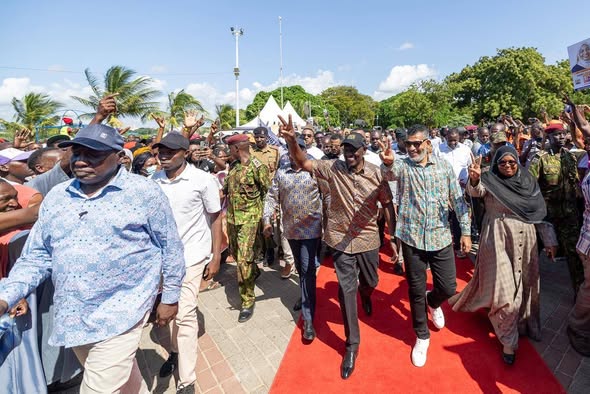
The President leveraged the tour to parade his strong team of
bigwigs whom he plans to use to lock the region.
They include Cabinet secretaries Salim Mvurya (Sports) and Hassan Joho (Mining),
Senate Speaker Amason Kingi, governors, MPs, senators and UDA secretary general Hassan Omar.
“This coastal region was left behind for so many years because
of the cheap politics of tribalism and exclusion,” he said.
“That is why we must unite all Kenyans. I formed a broad-based
government so that we can remove hatred and tribalism and ensure every part of
Kenya gets development.”
At the centre of the Coast tour was a major land reform
announcement aimed at addressing long-standing historical injustices,
particularly squatters and communities without formal ownership documents.
He also announced the development of Shimoni Fish Port, and fish
landing sites to boost the economy of the region.
Ruto announced the issuance of an additional 33,025 title deeds
across counties, including Mombasa, Kilifi, Kwale, Tana River, Taita Taveta and Lamu.
He said his administration had gone beyond issuing
documents to acquiring land for settlement, benefiting more than 200,000 households
across the Coast region.
“Land should never be a source of perpetual conflict; it should
be a source of prosperity,” Ruto said.
Ruto’s allies at the Coast strongly defended his administration
and echoed his criticism of the opposition, framing the government as focused
on development rather than political division.
Deputy President Kithure Kindiki praised the land reforms,
saying the issuance of title deeds was transforming lives and addressing long-standing
squatters’ issues.
“I salute the leaders from the Coast region for their dedication
in spearheading dialogue with absentee landlords who held title deeds while
many residents continued living on land without ownership documents,” Kindiki
said.
Sports CS Mvurya said land had long been
used as a political tool to manipulate Coast voters, but insisted the
current government was delivering real change.
“We don’t have any reason to wander with the opposition. No
opposition leader has ever implemented projects here,” he said.
Joho also defended the government, arguing that past
administrations had neglected the Coast region.
“When they were in power, they did nothing for this region,”
Joho said.
“Now we are focused on land, poverty and development.”
Speaker Kingi said the Coast region was now
firmly aligned with the government due to its development agenda.
“The opposition comes here, tells lies, then leaves. But here we
are getting development,” Kingi said.




![[PHOTOS] The new Ngong –Naivasha Road viaduct](https://cdn.radioafrica.digital/image/2026/06/64d4f771-4432-4aee-ba3c-2f304c4436ec.jpg)





![[PHOTOS] 'Mr Speaker Sir' Gen Z protester in court](https://cdn.radioafrica.digital/image/2026/06/b3e62d8e-25c3-4780-90f9-4eb48b1ce8a7.jpg)