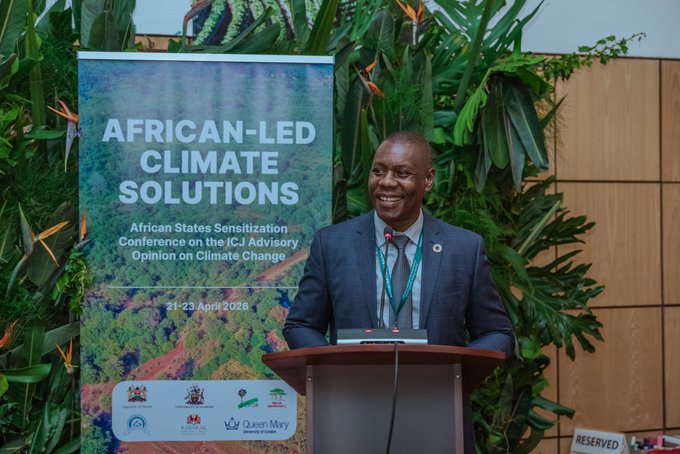
CIFOR-ICRAF Chief Operations Officer Philip Osano makes remarks during African states' sensitisation conference on ICJ advisory opinion on climate change.
The UN General Assembly
has endorsed a landmark advisory opinion issued by the International Court of
Justice (ICJ), reinforcing the view that countries have legal obligations to
protect the environment from greenhouse gas emissions.
The resolution, adopted on
Wednesday, has been welcomed by civil society groups as a major step forward in
global climate accountability.
In its July 2025 opinion, the ICJ
ruled that urgent, fair and ambitious climate action is not optional but a
legal duty for all states. The court said countries that fail to meet
these obligations may be held responsible and required to stop harmful actions,
prevent recurrence and provide compensation where necessary.
Although ICJ advisory opinions are
not legally binding, they carry strong moral and legal weight in shaping
international law.
The UN resolution was passed with
141 votes in favour, eight against and 28 abstentions. Those opposing included
Belarus, Iran, Israel, Liberia, Russia, Saudi Arabia, the United States and
Yemen.
UN Secretary-General António
Guterres described the decision as a “powerful affirmation” of international
law and climate justice, calling it “a victory for our planet.”
Civil society organisations and
climate advocates also hailed the move.
Vishal Prasad of Pacific Islands
Students Fighting Climate Change said the decision brings long-awaited
recognition to frontline communities already suffering climate impacts.
Rebecca Brown of the Center for
International Environmental Law said the resolution confirms that climate
action is a legal obligation and strengthens global accountability efforts.
Amnesty International’s Camile
Cortez said the vote reinforces states’ human rights duties in addressing
climate change, which she described as a growing global crisis.
Climate activists also urged
governments to turn the resolution into concrete action, including phasing out
fossil fuels and increasing climate finance from wealthy nations and major
polluters.
They warned that without real implementation, the legal milestone risks remaining symbolic despite its historic significance.

![[PHOTOS] The new Ngong –Naivasha Road viaduct](https://cdn.radioafrica.digital/image/2026/06/64d4f771-4432-4aee-ba3c-2f304c4436ec.jpg)








![[PHOTOS] 'Mr Speaker Sir' Gen Z protester in court](https://cdn.radioafrica.digital/image/2026/06/b3e62d8e-25c3-4780-90f9-4eb48b1ce8a7.jpg)