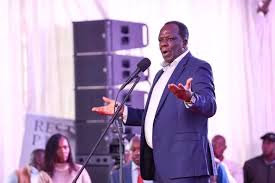
Appearing before a parliamentary committee, the CS
lamented the allocation to his office was too little to effectively
discharge his responsibilities.
He told the National Assembly’s Trade Committee the
situation had at times left him stranded during official engagements.
“I don’t know if my office is recognised as an office
of Cabinet secretary in this government, all the time I have
to come here to ask for money for operations,” Oparanya protested.
He told MPs he occasionally finds himself
unable to facilitate government activities, forcing him to seek financial help
from principal secretaries within the ministry.
“When I get out [for official duties], I sometimes get
stranded and unable to fuel and have to plead with my principal secretaries,”
Oparanya told the committee chaired by Ikolomani MP Bernard Shinali.
“I don’t want to continue to be a beggar from my
juniors. I feel my appearance is not for nothing, it is for something.”
The former Kakamega governor urged lawmakers to
consider allocating his office at least Sh200 million to enable smooth
operations and coordination of ministry activities.
“At least I need Sh200 million in that office to enable
me to operate,” he said.
He was accompanied by his PSs Patrick Kilemi (Cooperatives)
and Susan Mang’eni (Micro Small and Medium Enterprises (MSME) Development).
They were deliberating on the annual budget estimates
for 2026-27 financial year.
He argued that the current budgetary allocation does
not match the demands of the office, especially at a time when the ministry is
handling critical programmes targeting vulnerable Kenyans.
The CS further appealed to the committee to review the
ministry’s financial needs favourably in the upcoming budget cycle, insisting
that adequate facilitation was necessary for efficient service delivery.
PS Mang’eni told the committee the financial inclusion
fund (Hustler fund) did not get any allocation in the proposed budget.
This is even after the fund had been allocated Sh300
million in the Budget Policy Statement (BPS).
“The Financial Inclusion Fund has not been
provided with a budgetary allocation in the proposed FY 2026-27 Budget
Estimates,” Oparanya stated.
“However, in the Budget Policy Statement
(BPS), the fund had been allocated Sh300 million, hence the observed reduction in the GoK
allocation.
She said the fund requires additional Sh56 billion to
effectively meet the requirements of Kenyans.
“The fund currently requires Sh5 billion to enhance liquidity for
clients who have opted into the programme but are unable to access borrowing
facilities, particularly under the bridge loan product (Business Loan Product
with a Limit of Sh150,000),” she noted.
The fund, she noted, further requires
Sh110 million for recruitment of
technical personnel to strengthen institutional capacity and ensure effective
delivery of current and emerging priorities.
The PS also noted the Fund has
hit Sh87 billion across 27 million registered borrowers since 2022.



![[PHOTOS] The new Ngong –Naivasha Road viaduct](https://cdn.radioafrica.digital/image/2026/06/64d4f771-4432-4aee-ba3c-2f304c4436ec.jpg)



![[PHOTOS] 'Mr Speaker Sir' Gen Z protester in court](https://cdn.radioafrica.digital/image/2026/06/b3e62d8e-25c3-4780-90f9-4eb48b1ce8a7.jpg)