

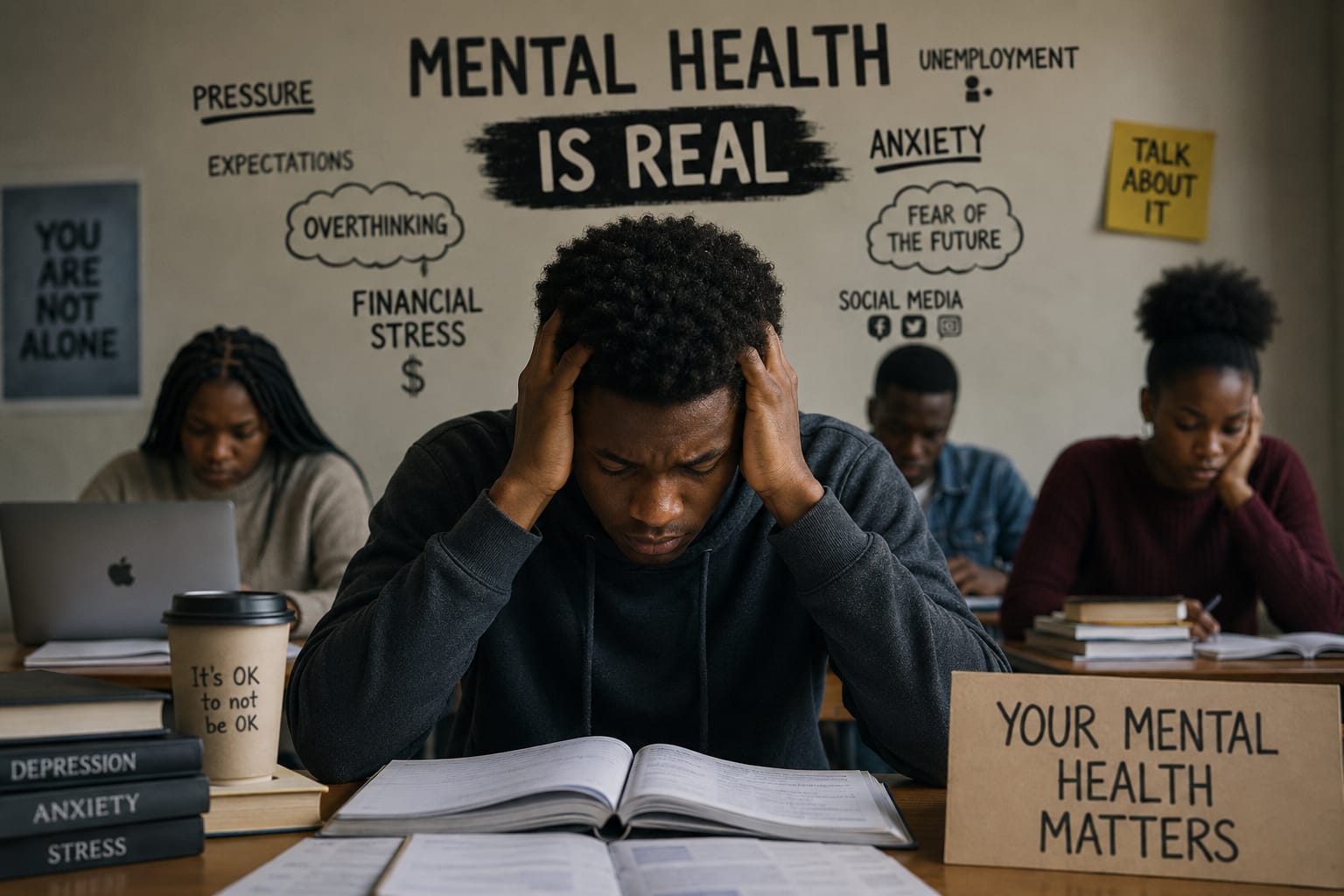
Behind lecture halls, crowded matatus, social media posts, and everyday smiles, many young people in Kenya are quietly fighting battles that often go unnoticed.
For university students and unemployed youth, the pressure to succeed, survive financially, maintain appearances, and prepare for an uncertain future is becoming emotionally overwhelming. While conversations around mental health are slowly increasing, many young people continue to struggle silently with stress, anxiety, emotional burnout and depression.
At universities across the country, students are balancing academic pressure with financial hardship, family expectations, and fears about life after graduation.
Bruce Mahero says university life is often viewed as a time for growth and opportunity, but many students are silently dealing with emotional and financial strain.
“One of the biggest challenges students face today is financial instability,” he says.
“Many struggle to pay school fees, accommodation, transport, and basic needs while trying to focus on their studies.”
According to Mahero, the pressure does not end in the classroom. Students are also dealing with relationship stress, social media influence, and the struggle to balance academics with personal responsibilities.
The fear of unemployment after graduation has also become a major concern among many young people.
“With rising competition in the job market and limited employment opportunities, many students experience anxiety and uncertainty about their future,” Mahero explains.
“This pressure often affects their emotional well-being and motivation.”
For many students, the burden becomes emotionally exhausting.
“As a university student, there are times when balancing academics, leadership responsibilities, financial challenges, and personal life becomes overwhelming,” he says.
“At some point, the pressure of meeting deadlines, attending classes, and thinking about the future affected me mentally and emotionally, leading to stress and exhaustion.”
He says he continues learning how to cope through better time management, speaking to trusted friends and mentors, and taking breaks when necessary.
Mental health experts warn that the emotional struggles facing young people today are becoming increasingly serious.
Virginia Naishoki, a psychologist and a mental health expert says many young people appear functional on the outside while silently struggling internally.
“Young people today are emotionally exhausted, overwhelmed, anxious, and psychologically strained, even though externally they may appear functional,” she says.
“What makes this issue complex is that many youths continue showing up for life — they still attend school, go to work, maintain friendships, and continue with responsibilities while internally struggling with emotional burnout and silent mental distress.”
Naishoki says today’s generation faces multiple pressures at the same time, including unemployment, economic hardship, social media comparison, relationship struggles, and family expectations.
“One of the biggest shifts we are seeing is that young people are now carrying pressures that previous generations may not have experienced at this intensity and simultaneously,” she says.
Social media, she adds, has intensified comparison culture among youth.
“Young people are constantly exposed to curated lifestyles that create unrealistic expectations about success, beauty, relationships, and achievement,” she explains.
“This contributes heavily to low self-esteem and feelings of inadequacy.”
Despite growing awareness around mental health, stigma continues preventing many young people from seeking help.
“Many youths suffer privately while trying to maintain the image that they are coping,” she says.
She notes that emotional struggles are still misunderstood in many communities, with some people dismissing mental health challenges as weakness or attention-seeking.
Student leaders are also raising concern about the growing mental health burden among university students.
Mike Simiyu says the situation among university students is serious and continues to grow.
“Many students are silently struggling with stress, anxiety, and emotional exhaustion,” he says.
“While students may appear active and engaged in academics and campus life, a significant number are dealing with internal challenges that affect their well-being and performance.”
According to Simiyu, financial difficulties and uncertainty about the future remain among the biggest causes of stress among students.
“Many students face difficulties in paying fees and meeting basic needs, which creates constant stress,” he says.
“At the same time, the fear of unemployment after graduation leaves many feeling anxious and uncertain about their future.”
He says stigma still prevents many students from openly seeking mental health support.
“There is still a perception that speaking about mental health is a sign of weakness,” Simiyu explains.
“Even when support services are available, some students hesitate to use them because of this stigma.”
As the conversation around youth mental health continues growing, community organisations are also calling for more support systems and safe spaces for young people.
Raima Kochalle says uncertainty about the future is one of the biggest emotional challenges affecting young people today.
“Many young people struggle with unemployment, financial stress, academic pressure, family expectations, and trying to succeed in a very competitive world,” she says.
“This can lead to stress, anxiety, low self-esteem, and depression.”
Raima adds that while some young people are becoming more open about mental health, many still suffer silently because of fear of judgment or misunderstanding.
She says social media has both positive and negative effects on youth mental health.
“It helps young people connect, learn, and express themselves, but it can also create pressure through comparison, cyberbullying, unrealistic lifestyles, and the need for constant validation,” she says.
Speaking from personal experience, Raima says emotional pain can deeply affect young people’s mental health.
“The experience that affected my mental health was a breakup with someone I loved, which pushed me into depression,” she says.
“But luckily, I managed to overcome it through humanitarian service, where I serve the community with passion and heart to support those who are needy.”
Experts and youth leaders are now urging institutions, families, and society to move beyond awareness and invest more in emotional support systems, counselling services, mentorship, and safe spaces for young people.
Behind every classroom attendance, online post, and public smile could be a young person silently carrying emotional weight invisible to the world.
![[PHOTOS] The new Ngong –Naivasha Road viaduct](https://cdn.radioafrica.digital/image/2026/06/64d4f771-4432-4aee-ba3c-2f304c4436ec.jpg)










![[PHOTOS] 'Mr Speaker Sir' Gen Z protester in court](https://cdn.radioafrica.digital/image/2026/06/b3e62d8e-25c3-4780-90f9-4eb48b1ce8a7.jpg)