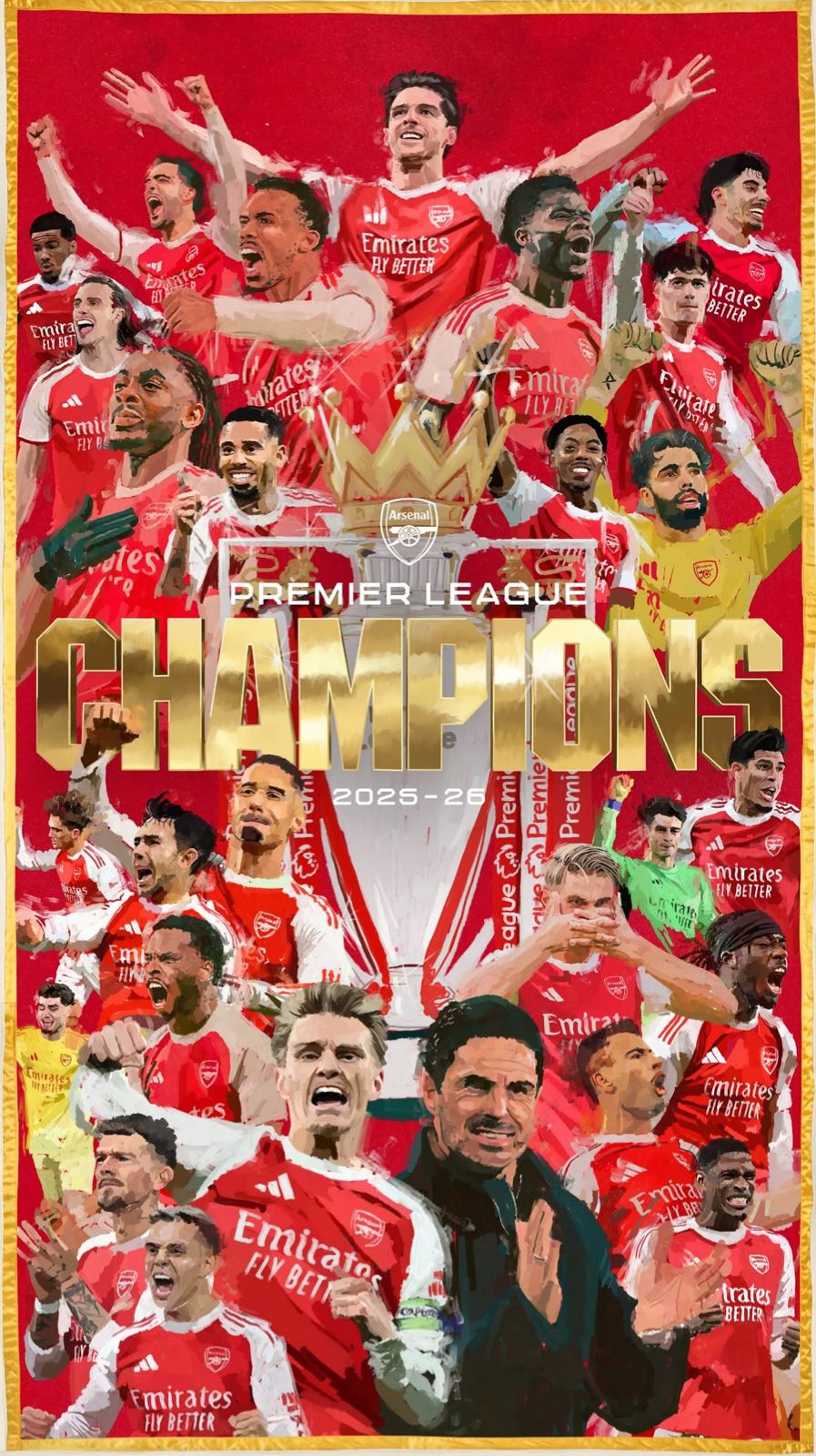
 Arsenal, Premier League champions 2025-26
For the past 22 years, supporting Arsenal Football Club in Nairobi has been an exercise in emotional endurance.
The near-misses, the
banter from rival Manchester United and Chelsea fans, and the infamous
"next season will be our season" promises has become a staple of
Kenyan sports culture.
When President William Ruto takes to his official channels to praise the “grit and resilience” of a foreign football club, it signals something beyond sport.
It reflects a reality in which European football has become embedded in Kenya’s public imagination, commanding attention across social and political spaces in ways few cultural imports ever have.
When Manchester City dropped points in a tense 1-1 draw at Bournemouth, confirming Mikel Arteta’s side as champions, the reaction in Nairobi wasn’t just online noise.
It was a shared national moment of release. And, as always with football in Kenya, it travelled quickly from living rooms to offices, from street corners to the highest office in the land.
Ruto, a self-declared Arsenal supporter, did not issue a passing congratulations. His message read more like a reflection on a long political journey than a football season.
“It has been quite an experience to follow Arsenal Football Club’s epic adventure, from times of struggle and crushing setback, to successive seasons of recovery and resurgence on their glorious path to the summit of the English Premier League,” he wrote.
The framing was deliberate. Arsenal’s long title drought and eventual triumph were described in terms that mirror familiar national narratives: perseverance, discipline and delayed reward.
It is not that football replaces politics. It is that football often borrows its emotional vocabulary. This is not new. Kenyan public figures have long used football as a bridge into popular culture. Political leaders across the spectrum have referenced European clubs to connect with younger audiences, often using the shared language of the Premier League as an informal cultural equaliser.
Former Prime Minister Raila Odinga, a well known Arsenal supporter, often used football analogies in political messaging, reinforcing how deeply the sport sits within public discourse.
Arsenal’s recent success simply sharpens that dynamic. It shows how European football has become more than entertainment. It is now part of how public emotion is collectively expressed, especially among younger demographics for whom the Premier League is a weekly social reference point.
The ripple effects were visible across Nairobi’s corporate spaces the following morning, where dress codes quietly gave way to football jerseys and subtle bragging rights.
For Arsenal supporters, the commute became a celebration. “This is the happiest I have been in a long time,” says Mike Luanda, an Arsenal fan who arrived at work in full kit. “True loyalty is sticking with the club through the hard years. Now it finally feels worth it.”
But a key part of Nairobi’s football culture is not just support, it is opposition. The “hate-watch” economy is real: fans tuning in not to enjoy, but to witness collapse.
For those hoping Arsenal would slip at the final moment, the night turned quickly.
“I watched it as a hate-watch,” admits Abdimalik Adow, a Nairobi resident. “I wanted City to win. I couldn’t stand the alternative. When it ended, I just turned everything off and went to bed.”
But escape, in a city wired into constant football conversation, rarely lasts long. “I woke up to nonstop messages. At work, it was the only topic,” he adds. “Even I have to admit it was deserved, but I know I’m going to hear about it for a long time.”
The celebrations were not confined to screens and offices.
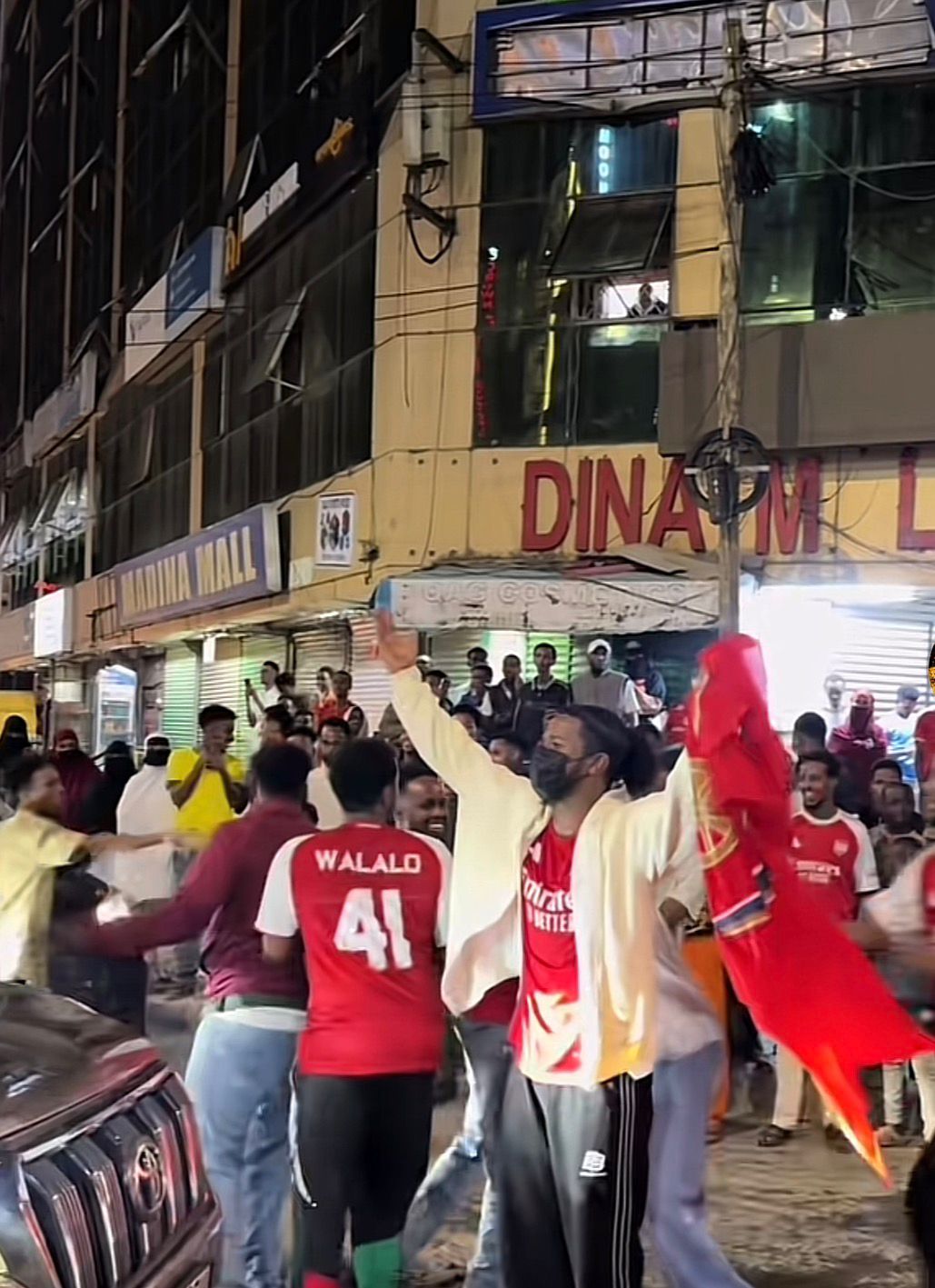 Arsenal Fans celebrating on the streets of Eastleigh, Nairobi /HANDOUT
In parts of Nairobi such as Eastleigh, the result spilled into the streets almost immediately after the final whistle in England. Videos circulating online showed fans gathering along busy roads, waving flags, chanting, and briefly turning commercial corridors into unofficial celebration zones.
For a few hours, ordinary traffic patterns gave way to something closer to a street festival, an informal expression of collective identity shaped by a club-based thousands of kilometres away.
It was not just celebration. It was participation in a shared global moment that felt locally owned. When a football club in England becomes a headline conversation in Nairobi’s streets, workplaces, and political messaging, it points to something broader than sport.
The Premier League has become part of Kenya’s cultural vocabulary. It is referenced in jokes, politics, workplace dynamics, and social identity. It offers a shared rhythm of anticipation and release that cuts across class and geography.
English football is no longer just “foreign entertainment.” For many fans, it functions as a parallel emotional calendar, one that runs alongside daily life in Kenya, shaping conversation, mood, and even political metaphor.
And so, when Arsenal wins, it is not only a sporting outcome. It becomes a shared reference point in a country already fluent in its language of struggle, patience, and reward. The 22-year wait is over. And for a moment, at least, Nairobi is red.

![[PHOTOS] The new Ngong –Naivasha Road viaduct](https://cdn.radioafrica.digital/image/2026/06/64d4f771-4432-4aee-ba3c-2f304c4436ec.jpg)






![[PHOTOS] 'Mr Speaker Sir' Gen Z protester in court](https://cdn.radioafrica.digital/image/2026/06/b3e62d8e-25c3-4780-90f9-4eb48b1ce8a7.jpg)