 Interior CS Kipchumba Murkomen with his Energy counterpart Opiyo Wandayi , Nairobi Governor Johnson Sakaja and public transport sector stakeholders at Harambee House on May 19, 2026. /MINA
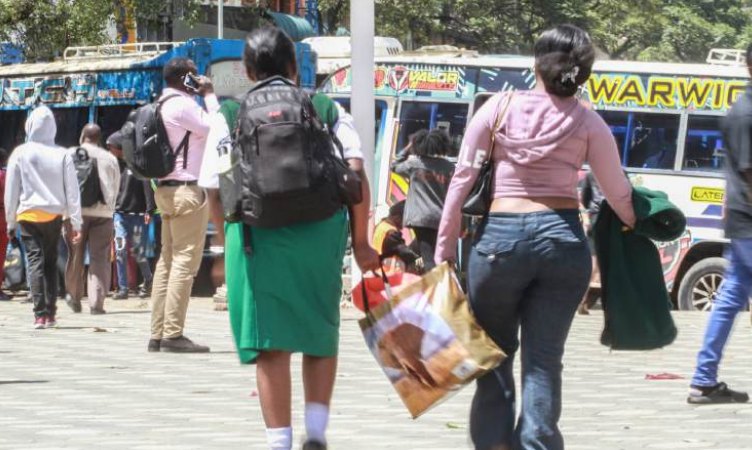
The postponement of planned transport strikes in Nairobi briefly restored movement across the city, with buses returning to the roads and businesses attempting to reopen.
However, for many residents, the disruption did not end. It only shifted into a quieter form of uncertainty, where normal routines resume on the surface while anxiety about what comes next lingers underneath.
For Nelly Amwayi, a domestic worker who lives in Pipeline and works in South C, that uncertainty began with the journey to work itself. She described a morning defined by distance and limited options long before she even reached her workplace.
“I had to walk for about an hour from home just to get a matatu,” she said. “I’m paid daily, so staying home is not an option. If I don’t work, what will I eat?”
Even after the long walk, she said transport remained scarce and increasingly expensive, forcing commuters into difficult choices between cost and survival.
“I eventually found one, but they were very few. And the fares had gone up so much,” she said. “Some people were walking to the stages then turning back when they realised they couldn’t afford it.”
While services have since resumed, she said the experience has not brought relief, but rather a temporary pause in pressure.
“It doesn’t feel like relief,” she said. “It just feels like everything has been pushed forward again. Next week might still be the same thing.”
That sense of instability is also reflected in Nairobi’s small businesses, which rely heavily on daily movement and predictable customer flow.
In the CBD, clothing business MyfitsKE was forced to shut down entirely during the disruption as activity in the city centre ground to a halt.
“We didn’t open at all,” Rebecca Mumbi, the owner, said. “There was no point, there were no customers, and I feared my store would get vandalised."
Although the business operates online as well, she said even digital operations were disrupted as deliveries could not go through, delaying orders and affecting customer trust.
“We were not able to operate online because deliveries couldn’t go out,” she said. “Some customers thought they had been scammed because their orders didn’t arrive.”
For Rebecca, the most difficult part has been the unpredictability, where planning becomes nearly impossible.
“It’s just a pause,” she said. “If it happens again next week, then we’re back to the same problem.”
The disruption also spread into the education sector, where institutions quickly adjusted to transport challenges and safety concerns.
Universities like Daystar University suspended physical classes and advised lecturers to consider virtual teaching where possible, noting that access to campus and safe travel had been affected.
Following the suspension of the strike, schools are now expected to resume normal physical learning as transport conditions gradually stabilise.
Amid these adjustments, some residents have begun to experience the return of movement as a form of relief, even if it is not fully settled.
A university student and commuter, Jane Njeri, said the resumption of transport services has allowed her to regain a sense of normalcy after days of restricted movement.
She said she was unable to leave the house during the disruption due to safety concerns raised by her family, which limited even basic daily activity.
“For the two days when everything was happening, I couldn’t even go out,” she said. “My parents were very strict about it because of safety concerns.”
With transport now running again, she said she is able to return to school, meet friends, and move around more freely.
“At least now I can move without stress,” she said. “I can go to school, I can meet my friends, I can actually have a normal day again.”
Still, she said the relief is fragile, shaped by uncertainty over what may happen next.
“It’s still worrying because we don’t know what will happen next week,” she said. “But today is better than yesterday. I’m just taking it one day at a time.”
Transport operators have since resumed services following the suspension of the strike, as industry leaders called for a return to normal operations while negotiations continue.
The Association of Matatu Owners national chairman, Albert Karakacha, said operators had been instructed to resume services immediately as talks with stakeholders proceed.
He said discussions were ongoing and expressed cautious optimism that a resolution could be reached, noting that while operators had not secured their demand for a Sh46 fare adjustment, the start of negotiations marked progress.
Separately, Federation of Public Transport Sector CEO Kushian Muchiri confirmed that members had agreed to the temporary truce after the government showed renewed commitment to engagement. He urged all drivers and conductors to restore normal transport services nationwide.
Following the national directive, major commuter fleets, including Metrotrans, confirmed the immediate resumption of operations.
In separate statements to passengers, the companies said their fleets were back on the road, while urging caution and thanking commuters for their patience during the two days of disruption.
However, even as movement returns across the city, many Nairobi residents say the experience has not fully resolved into relief, only into a temporary pause before the next uncertainty.
![[PHOTOS] The new Ngong –Naivasha Road viaduct](https://cdn.radioafrica.digital/image/2026/06/64d4f771-4432-4aee-ba3c-2f304c4436ec.jpg)







![[PHOTOS] 'Mr Speaker Sir' Gen Z protester in court](https://cdn.radioafrica.digital/image/2026/06/b3e62d8e-25c3-4780-90f9-4eb48b1ce8a7.jpg)