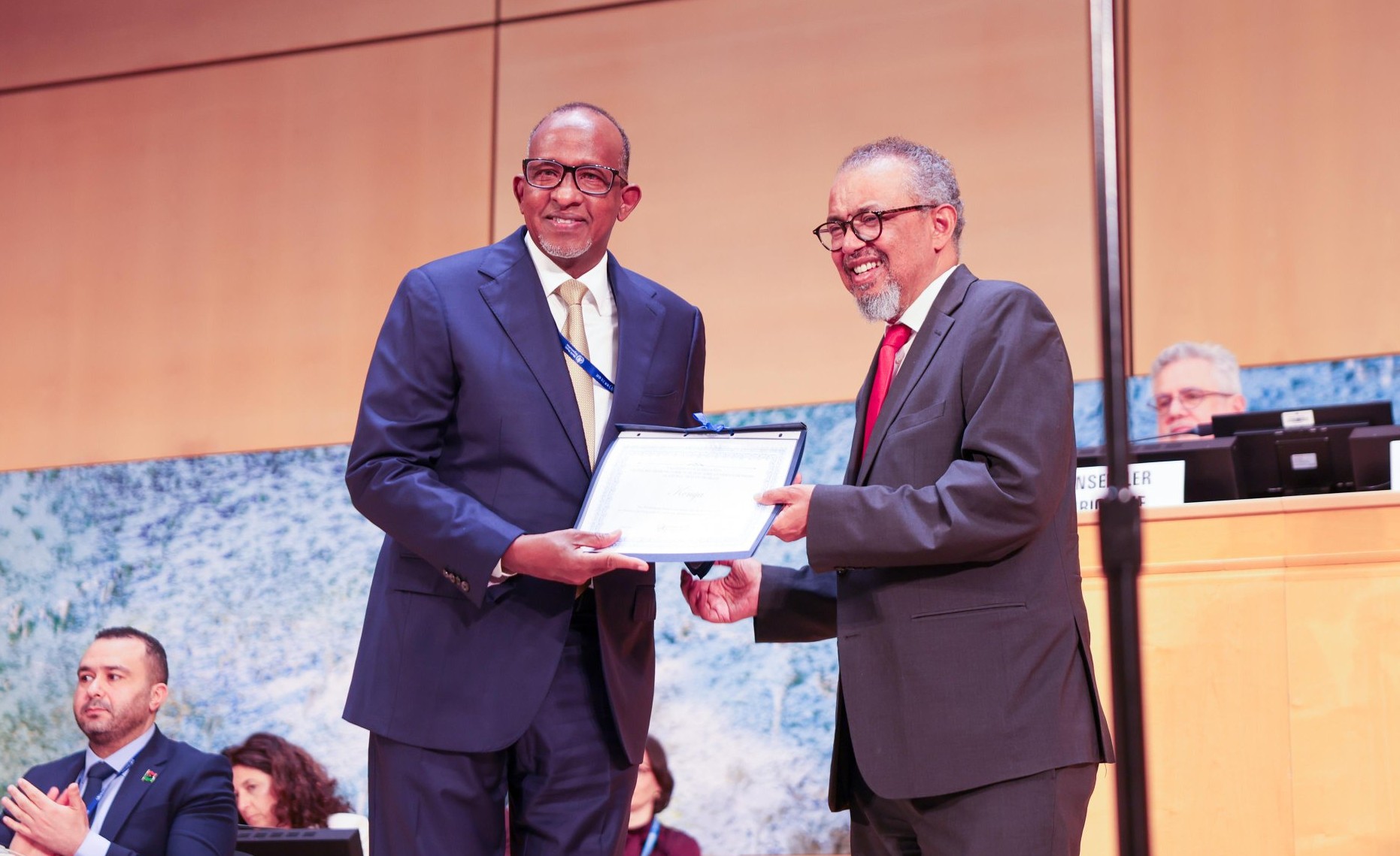
 WHO director general Tedros Adhanom Ghebreyesus presents Health CS Aden Duale with a certificate recognising Kenya for eliminating Human African Trypanosomiasis during the 79th World Health Assembly on May 19 /ADEN DUALE/X
Kenya has received global recognition from the World Health Organization for eliminating Human African Trypanosomiasis (HAT), commonly known as sleeping sickness, marking a major milestone in the country’s fight against neglected tropical diseases.
Health Cabinet Secretary Aden Duale led Kenya’s delegation in receiving the recognition during the 79th World Health Assembly, where WHO director general Tedros Adhanom Ghebreyesus commended the country for its sustained commitment, leadership and multi-sectoral collaboration in combating the disease.
WHO presented Kenya with a certificate acknowledging the achievement after the country sustained zero indigenous cases of sleeping sickness since 2009.
It validated the elimination in June 2025 before national confirmation in August 2025.
Sleeping sickness had previously posed a major health threat in counties including Busia, Bungoma, Siaya, Homa Bay, Migori and Narok, particularly in areas prone to tsetse fly infestation.
In a statement issued after receiving the recognition, Duale credited years of coordinated efforts between communities, health personnel, researchers and government institutions for helping Kenya achieve the milestone through strengthened disease monitoring and response systems.
“I commend the affected communities for their trust and participation, alongside frontline health workers, researchers, laboratory teams, county governments and national experts who strengthened surveillance, diagnosis and response systems,” Duale said.
The Health CS, however, cautioned that elimination does not signify the end of the fight against the disease, warning that continued vigilance would be necessary to sustain the gains achieved.
“Even as we celebrate, elimination is not the end. Sustaining these gains requires continued vigilance through surveillance, early detection, vector control, community awareness and integration of services into routine healthcare,” he said.
Duale said Kenya remains committed to sharing its experience and supporting wider regional efforts aimed at eliminating neglected tropical diseases across Africa.
The Kenyan delegation at the World Health Assembly also included Kenya’s Ambassador and Permanent Representative to the UN in Geneva Dr Fancy Too, director general for Health Dr Patrick Amoth, Disease Health Agency CEO Anthony Lenaiyara and Ministry of Health director of Family Health Dr Bashir Issak.
Human African Trypanosomiasis is a life-threatening parasitic disease endemic to sub-Saharan Africa and transmitted through the bite of infected tsetse flies.
Humans contract the disease from the bite of the tsetse fly (Glossina species). Rural populations engaged in agriculture, fishing, animal husbandry, and hunting are at the highest risk
Without treatment, the disease is almost always fatal after the parasite invades the central nervous system.
The disease progresses in two stages. In the early phase, the parasite spreads through the blood and lymphatic system, causing symptoms such as fever, severe headaches, fatigue, joint pain and swollen lymph nodes.
In advanced stages, it crosses into the brain, leading to neurological complications including confusion, sleep disruption, convulsions and severe lethargy — symptoms that gave rise to the name “sleeping sickness.”

![[PHOTOS] The new Ngong –Naivasha Road viaduct](https://cdn.radioafrica.digital/image/2026/06/64d4f771-4432-4aee-ba3c-2f304c4436ec.jpg)







![[PHOTOS] 'Mr Speaker Sir' Gen Z protester in court](https://cdn.radioafrica.digital/image/2026/06/b3e62d8e-25c3-4780-90f9-4eb48b1ce8a7.jpg)