For many potato farmers in Kenya, every planting season comes with
uncertainty as unpredictable weather, rising production costs and destructive
diseases continue to threaten one of the country’s most important food crops.
Among the biggest challenges is late blight
disease, a fungal infection that can wipe out entire potato fields within
weeks, especially during cold and wet seasons. Farmers often spend heavily on
fungicides to control the disease, yet many still suffer major losses.
According to the National Potato Council of
Kenya, potatoes are the country’s second most consumed staple food after maize
and support the livelihoods of more than 800,000 smallholder farmers.
Kenya produces between two million and 2.5 million
metric tonnes of potatoes annually, with major growing regions including
Nakuru, Nyandarua, Meru, Elgeyo Marakwet and Bungoma counties.
However, the sector continues to grapple with
poor quality seed, climate change, pests and diseases, high input costs and
post-harvest losses. Experts estimate that late blight alone causes annual
losses of between 30 and 60 per cent.
To address the challenge, Kenyan scientists
are conducting controlled field trials for a genetically modified potato
variety known as Shangi Kinga, developed to resist late blight disease.
Researchers say the biotech potato could
significantly reduce farmers’ dependence on fungicides while increasing yields
by up to 70 per cent.
Potato farming is not
only a source of income for thousands of households but also a critical food
security crop for millions of Kenyans.
Nakuru agriculture executive Leonard Bor says potato is a priority value chain in the county because it is the second staple
food crop after maize. “It is grown by both small-scale and
large-scale farmers and we take pride in the production of this particular
crop,” he said.
Bor noted that Nakuru county contributes about
15 per cent of the country’s total potato production. The crop is grown across nine
sub-counties and generates billions of shillings annually for farmers and
traders.
“Potato farming is transforming livelihoods
and bringing income to many farmers in Nakuru county,” he said.
For farmers such as Sarah Nduta Kinyanjui from
Mau Narok ward, late blight disease remains one of the greatest threats to production.
She said the disease drastically reduces
yields and can sometimes destroy entire crops, leaving farmers counting huge
losses.
“The spraying provider will be there all the time
and this affects the farmer because of the high cost. It also means loss of
food for the family,” she said.
Kinyanjui added that farmers may spray their
crops up to six times before harvesting in an effort to control the disease.
Dr Moses Nyongesa, the chief research scientist
and plant pathologist at the Kenya Agricultural and Livestock Research
Organisation (KALRO), said there are about one million potato farmers in the
country, many of whom continue to suffer losses linked to potato blight.
He noted that climate change has worsened the
spread of the disease.
Nyongesa said KALRO, in partnership with the
International Potato Center, developed the Shangi Kinga variety to help farmers
overcome these challenges.
“This solution has been delivered through the
use of modern biotechnology tools to fortify a previously blight-susceptible
variety called Shangi and equip it with a trait that enables the potato to
resist blight,” Nyongesa said.
“Now we have a variety with inbuilt resistance
to blight. Farmers who grow this variety will be able to overcome the
challenges they have been facing.”
The Shangi Kinga variety is currently
undergoing regulatory processes and field assessments before possible
commercial release.
Principal Biosafety Officer at the
National Biosafety Authority Eric Korir said the agency regulates the development,
handling and transfer of genetically modified organisms to ensure they are safe
for humans, animals and the environment.
Korir assured Kenyans that all GMO products
undergo rigorous scientific assessment before approval.
“The decisions are based on scientific data
and every GMO product is assessed on a case-by-case basis using internationally
accepted standards,” he said.
Dr Susan Otieno, potato breeder and Director at KALRO Tigoni Potato Research Centre, dismissed fears surrounding
the biotech potato.
She said the variety can be grown alongside
conventional potatoes without affecting farmers’ crops.
“Farmers should be ready to embrace this
technology because it will reduce the amount of fungicides applied to their
fields, increase yields and lower the cost of production,” she said.
Otieno added that scientists are working
closely with regulatory agencies including the National Biosafety Authority and
the Kenya Plant Health Inspectorate Service throughout the research process.
“We are not forcing this technology on
farmers, but we are showing them there is science behind it and the data is
available,” she said.
Scientists also see huge industrial potential
in potato farming beyond food consumption.
Dr Samson Kamunya, Director at KALRO
Biotechnology Research Centre, said potato starch has wide industrial
applications in pharmaceuticals, textiles, paper packaging and bioplastics.
He noted that the crop could create employment
opportunities for young people if the country shifts from subsistence farming
to commercial and industrial potato production.
Meanwhile, Dr James Karanja, Centre Director
at KALRO Njoro, said research must remain farmer-driven and responsive to
challenges facing farmers, including climate change.
“We
also need to build trust among all stakeholders in the value chain so that
these technologies can reach farmers,” Karanja said.
Instant analysis
Kenyan scientists are positioning biotechnology as a possible solution to one of potato farming’s biggest threats — late blight disease, which causes huge annual losses for farmers. The story highlights how the genetically modified Shangi Kinga variety could reduce reliance on costly fungicides, increase yields and strengthen food security. Beyond farming, researchers also see industrial potential in potato production through starch processing and manufacturing. However, the feature also touches on the wider debate around GMO adoption in Kenya, with scientists and regulators seeking to reassure the public about safety and oversight. At its core, the story reflects agriculture’s growing link to climate resilience and innovation.


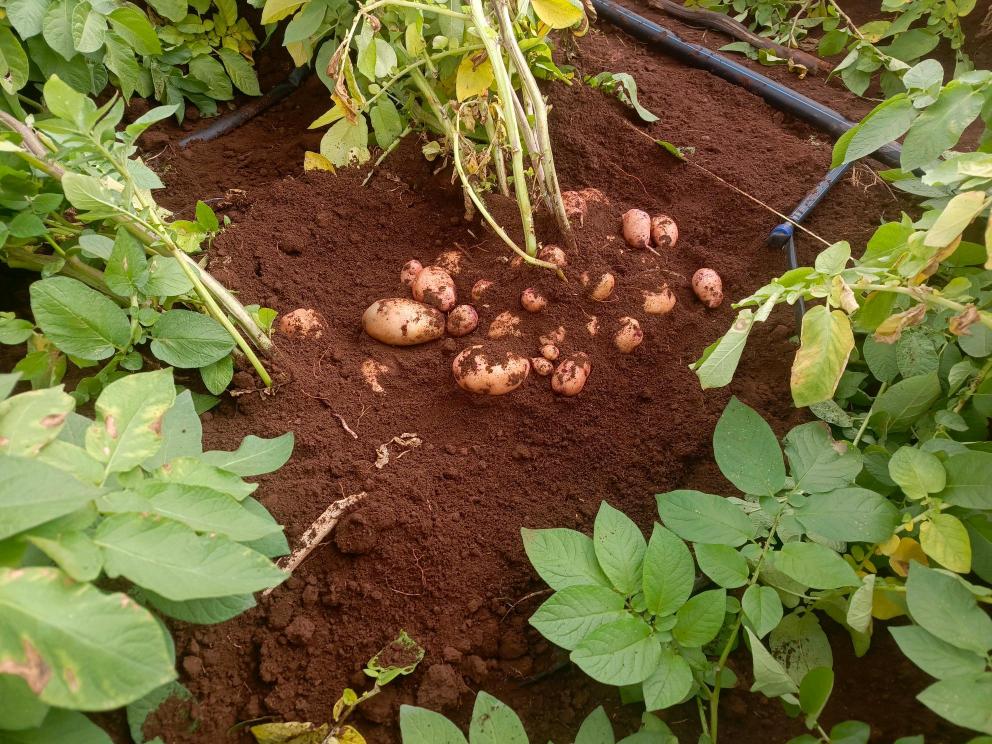 Biotech potato resistant to late blight./AGATHA NGOTHO



![[PHOTOS] The new Ngong –Naivasha Road viaduct](https://cdn.radioafrica.digital/image/2026/06/64d4f771-4432-4aee-ba3c-2f304c4436ec.jpg)











![[PHOTOS] 'Mr Speaker Sir' Gen Z protester in court](https://cdn.radioafrica.digital/image/2026/06/b3e62d8e-25c3-4780-90f9-4eb48b1ce8a7.jpg)