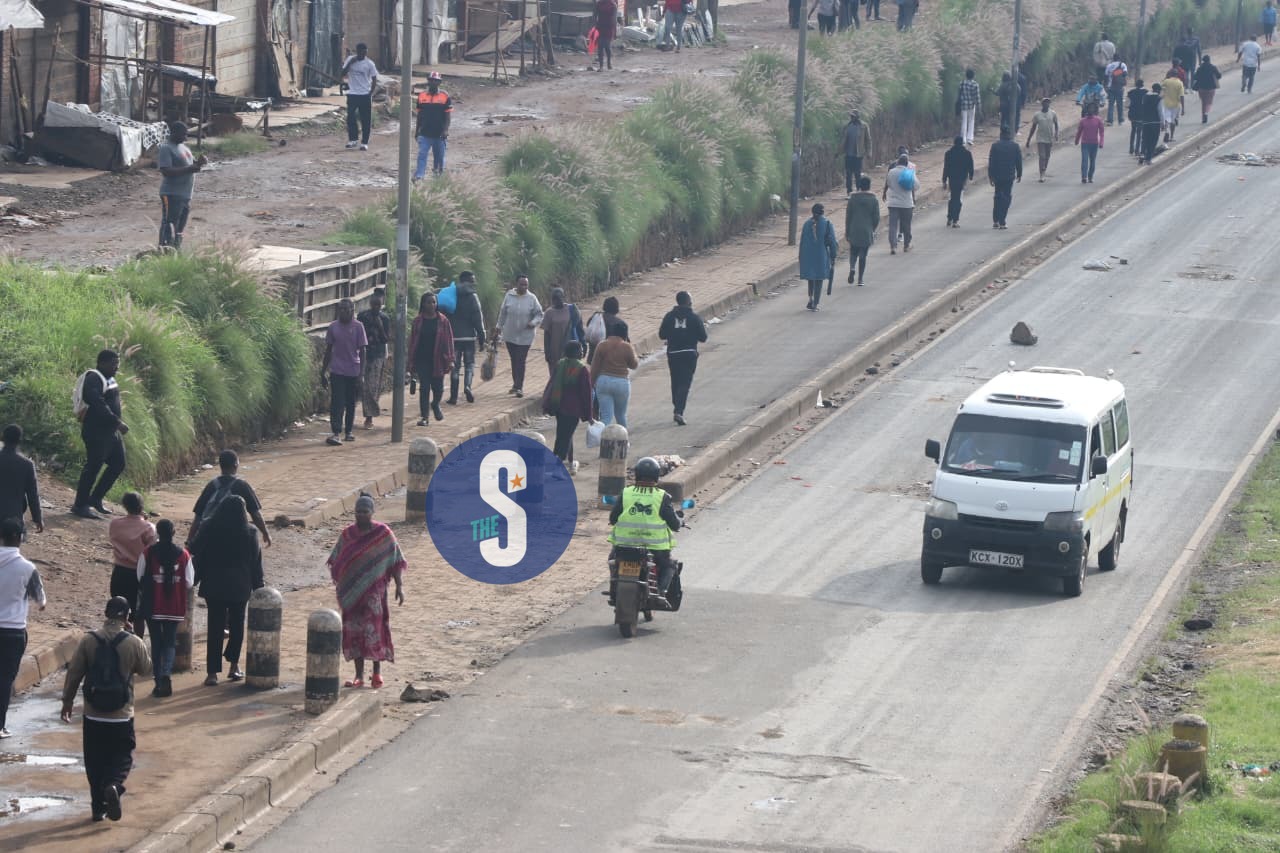
 Pedestrians on Thika Road forced to walk on the second day of matatu operators' strike over high fuel prices, May 19 /LEAH MUKANGAI
Thousands of Kenyans on Tuesday endured a second consecutive day of transport disruption after matatu operators rejected government concessions on fuel prices and vowed to continue the nationwide strike.
The prolonged standoff left commuters once again walking long distances to workplaces, schools and business premises as most public service vehicles remained off the roads in protest against soaring fuel costs.
In areas where a few matatus were operating, passengers paid more than double the normal fare as operators cited high fuel prices and fears of hostility from striking colleagues.
The strike persisted despite the government announcing a reduction of diesel prices by Sh10.06 per litre following Monday evening talks between officials and transport sector representatives.
In its revised fuel price review, the Energy and Petroleum Regulatory Authority said the decision was informed by concerns raised by public transport operators over the widening price difference between diesel and kerosene, which authorities warned could increase the risk of fuel adulteration.
EPRA consequently increased kerosene prices by Sh38.60 per litre and lowered diesel by Sh10.06 to narrow the price gap, while Super Petrol prices remained unchanged.
In Nairobi, Super Petrol, Diesel and Kerosene will now retail at Sh214.25, Sh232.86 and Sh191.38 respectively.
But the revised prices failed to calm transport operators who insisted the reduction did not go far enough.
Anticipation had been high Monday evening that negotiations between the government and matatu operators would finally end the shutdown after Energy CS Opiyo Wandayi and Transport CS Davis Chirchir held talks with sector representatives at Transcom House.
However, an awkward moment unfolded during the joint press briefing after Wandayi announced that the meeting had reached a consensus that would effectively end the strike.
Before the press conference could conclude, an official from the Matatu Owners Association emerged from behind the CS and openly contradicted the government position during the live broadcast.
“With all due respect, we did say that we are going to communicate here clearly and openly that we have not agreed so that we carry this conversation forward,” he said.
“We didn't agree, they gave us Sh10 and we did state Sh35 up to Sh30. That was the communication, with all due respect, we respect each one of us and that is what we want to go out. The strike is still on.”
The public contradiction immediately sparked debate online, with many Kenyans questioning the government’s handling of the negotiations and accusing officials of attempting to create the impression that a deal had already been reached.
“You can see why no one trusts this government. They lie, even on something you've agreed on a minute ago,” one social media user posted.
Another argued that if negotiations were still ongoing, government officials should communicate that openly instead of presenting unresolved discussions as a final agreement.
The prolonged strike continued to expose the broader economic toll of rising fuel prices on households and businesses.
Besides the immediate transport crisis, Kenyans are increasingly bearing the burden of expensive fuel through higher food prices, rising transport charges and escalating household expenses.
Fuel prices directly affect the cost of moving goods, public transport fares, electricity generation and the operating costs of businesses, with economists warning that prolonged instability could further worsen inflation.
Workers arriving late and exhausted after walking long distances are also likely to suffer reduced productivity, while others directed to work remotely may struggle because of limited internet access, unreliable electricity and inadequate home-working resources.
The matatu sector itself is also incurring heavy losses from the shutdown.
On Monday, Matatu Owners Association of Kenya president Albert Karakacha said the sector incurred losses exceeding Sh500 million in a single day alone.
The industry generates an estimated Sh250 billion to Sh300 billion annually, controls more than 70 per cent of the country’s passenger transport system and supports over two million direct and indirect jobs.
Treasury CS John Mbadi on Monday defended the government’s cautious approach to fuel subsidies, warning that exhausting the available Sh5 billion fuel stabilisation cushion could expose the country to even higher prices in the coming financial year.
“This is a world crisis and if we continue like this, it will be like Covid. It is a problem that only America and Iran have to solve. They must stop the war,” Mbadi said.
“If they do not stop the war, we will somehow have to live with some consequences.”
The sharp rise in fuel prices has been linked to heightened geopolitical tensions and instability in the Middle East, raising fears that prolonged global supply disruptions could worsen the economic strain on consumers and businesses alike.
For now, however, ordinary Kenyans remain trapped between a transport shutdown and a rising cost of living crisis, with many forced to walk to work, pay inflated fares and stretch already strained household budgets even further.

![[PHOTOS] The new Ngong –Naivasha Road viaduct](https://cdn.radioafrica.digital/image/2026/06/64d4f771-4432-4aee-ba3c-2f304c4436ec.jpg)









![[PHOTOS] 'Mr Speaker Sir' Gen Z protester in court](https://cdn.radioafrica.digital/image/2026/06/b3e62d8e-25c3-4780-90f9-4eb48b1ce8a7.jpg)