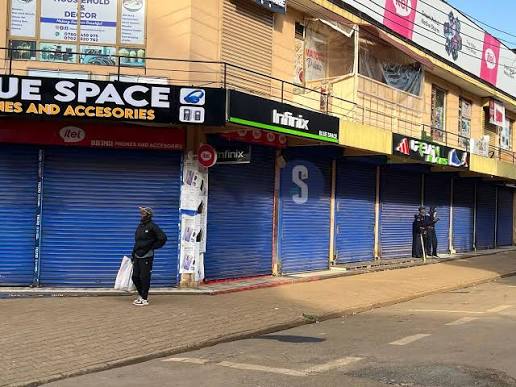
 Small business closed due to ongoing matatu strike/Handout
Barely a day into the nationwide transport strike, small traders across Nairobi are watching their perishable goods rot, their cash drawers gather dust, and their customers simply disappear.
For the millions who rely on daily hand to mouth trade, the strike has been nothing short of a slow economic strangulation.
Every morning before dawn, Elizabeth Wanja, 31, lights her charcoal stove near the Survey junction along Thika Road. By 6 am, her first cobs of roasted maize are usually sizzling, ready for matatu crew members and early commuters grabbing breakfast on the run. But this morning, the junction has been a ghost town.
"Usually, I could sell up to 100 cobs in a day. Today? I roasted 50 this morning. I have sold maybe five. The rest will go to waste by evening," Wanja says.
Wanja, a mother of two, buys her maize from korokocho market daily. But with matatus off the road, even getting stock has become a nightmare. She now pays a boda boda rider double the normal fare just to ferry a sack to her stall an expense that eats into already vanishing profits.
"Matatu crews were my best customers. The touts, the drivers, the conductors they bought two or three cobs each, every single morning," she recalled. "Now? Nothing. I am watching my children's school fees burn away in this charcoal."
"The government and matatu owners are fighting a big war. But small people like me? We are just collateral damage."
At first glance, Bruce Juma, 27, should be benefiting from the strike. With no matatus, demand for boda bodas has skyrocketed. But Juma insists that this morning has been one of his worst.
"People think we are making money. We are not," he said, ''Yes, the few customers we get pay double or triple the normal fare. But where are the customers? There are no people on the streets."
Juma explained that the strike has reduced human movement across the city by more than half. Offices are empty, schools are closed, and markets are nearly deserted. Without crowds, even inflated fares cannot compensate for the sheer lack of riders.
''A normal morning, I make five to seven trips before lunch. Today? I have made two trips," he said. "Sh300 per trip sounds good until you realize that is all you have earned by midday. I normally make Sh1,000 by now. Today I have made Sh600 but the day is young, and I have no idea if another customer will come."
"And the risk is higher now. Some of us have been attacked by striking matatu touts who see us as scabs. I am scared every time I pick a passenger."
Teresia Kawira, 32, runs a small kiosk near the bus stage in Ngara. From her stall, she sells cooking oil, sugar, bread, milk, soap, and small packets of maize flour. Her customers are almost exclusively commuters alighting from or waiting for matatus and office workers from nearby buildings grabbing supplies on their way home. Kawira has not opened her shop at all. Not because she has nothing to sell. But because she is too afraid.
Kawira explained that her kiosk is made of iron sheets secured with a single padlock. On a normal day, the constant presence of commuters, touts, and passers-by acts as a natural security barrier. But now, with the stage deserted, she fears criminals will take advantage.
"During the last major anti-government protests, my neighbour's kiosk was broken into in broad daylight. They took everything stock, cash box, even the metal shelves. The police came three hours later. By then, nothing was left," she recalled.
With no matatus, no crowds, and no security patrols in sight, Kawira has made a painful decision: leave her stock locked inside and pray.
"I have goods worth about Sh15,000 in there. If I open and someone steals everything, I lose everything. At least the goods are still there even if I am not earning."
Across Nairobi, thousands of small traders are telling similar stories. Market women who cannot transport vegetables. Street food vendors with no hungry crowds. Newspaper sellers with no one to buy. Tailors with no customers bringing clothes for repair.
The Transport Sector Alliance maintains that the strike is necessary to force government action on fuel prices. The government insists it cannot reverse global market forces.
But for Elizabeth Wanja, Bruce Juma, and Teresia Kawira and millions like them the debate over policy is a luxury they cannot afford. They are simply trying to survive this one day. And hoping the matatus return tomorrow.

![[PHOTOS] The new Ngong –Naivasha Road viaduct](https://cdn.radioafrica.digital/image/2026/06/64d4f771-4432-4aee-ba3c-2f304c4436ec.jpg)











![[PHOTOS] 'Mr Speaker Sir' Gen Z protester in court](https://cdn.radioafrica.digital/image/2026/06/b3e62d8e-25c3-4780-90f9-4eb48b1ce8a7.jpg)