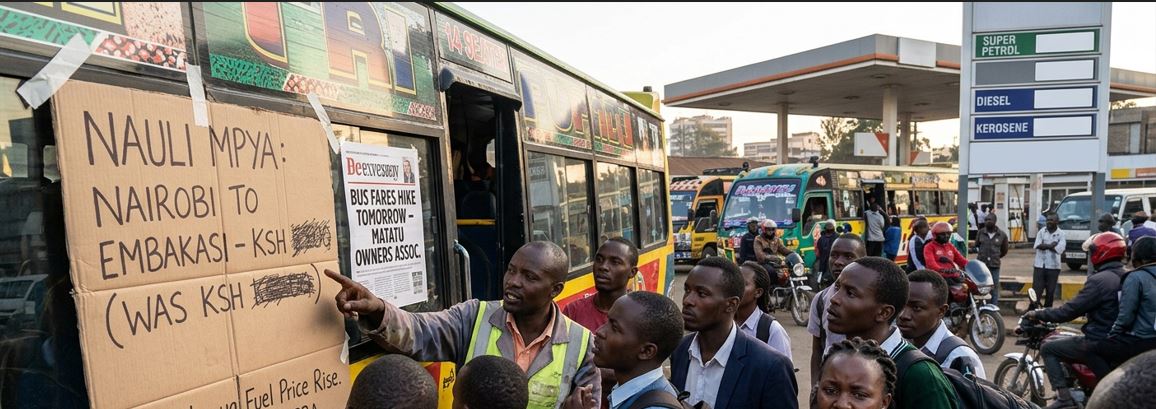
Matatu operators announce nationwide strike, 50% fare hike/AI ILLUSTRATION
Matatu operators have announced a nationwide strike set to begin on Monday, alongside a 50 per cent increase in fares, in protest against the recent rise in fuel prices.
Matatu Owners Association, led by chairman Albert Karakacha, said the industry had been pushed to the edge by rising operational costs, warning that public transport will grind to a halt unless the government responds to their concerns.
“On Monday, there will be strictly no movement of any vehicles; all the roads will be blocked until the government listens to our cry because we have been promised, but everything we are promised has not come to fulfilment,” said Karakacha.
He added that all public transport investors had been instructed to immediately implement a 50 per cent increase in fares, arguing that the adjustment was necessary to sustain operations following the fuel price surge.
“All transport network companies, wherever they are, be aware that we are going to increase our prices by 50% because we don’t have the mechanism,” they warned.
The announcement comes just hours after the government, through the Energy and Petroleum Regulatory Authority (EPRA), revised retail fuel prices upward in its latest pricing cycle.
According to EPRA, the price of diesel increased by Sh46.29 per litre, while super petrol went up by Sh16.65 per litre.
In Nairobi, the prices of petrol and diesel currently retail at Sh214.25 and Sh242.92 respectively.
In its statement released on Thursday, EPRA said kerosene prices would remain unchanged during the review period covering May 15 to June 14, 2026.
The regulator attributed the adjustments to changes in global oil prices and the cost of imported refined petroleum products.
Fuel prices in Kenya directly affect transport costs, electricity generation, food prices, and the overall cost of goods and services across the economy.
Energy CS Opiyo Wandayi had earlier stated the government will use approximately Sh5 billion from the Petroleum Development Levy (PDL) Fund to cushion consumers against rising fuel prices in the latest monthly review
He said the intervention has been used to stabilise prices of diesel and kerosene, even as Super Petrol and diesel record sharp increases driven by global market pressures, including rising crude oil prices, freight costs and geopolitical tensions in the Middle East.
“To mitigate the impact of rising global petroleum prices on consumers and the wider economy, the government has utilised the Petroleum Development Levy (PDL) stabilisation mechanism to cushion the prices of Diesel and Kerosene during this review period,” Wandayi said in a statement.
"Approximately KSh 5 billion has been applied to moderate the extent of price increases while ensuring stability within the petroleum supply chain."
EPRA maintained that the pricing model is designed to ensure importation costs are recovered while protecting consumers from excessive market volatility.

![[PHOTOS] The new Ngong –Naivasha Road viaduct](https://cdn.radioafrica.digital/image/2026/06/64d4f771-4432-4aee-ba3c-2f304c4436ec.jpg)









![[PHOTOS] 'Mr Speaker Sir' Gen Z protester in court](https://cdn.radioafrica.digital/image/2026/06/b3e62d8e-25c3-4780-90f9-4eb48b1ce8a7.jpg)